Musical accompaniment for this week's newsletter.
Joni Helminen has a test he runs on every AI draft his team produces.
He reads it cold. No context. No attribution. And he asks one question: does this sound like us, or does it sound like everyone else?
It’s a good test. If he can't tell, how will anyone else?
Helminen is the CMO of Barona, a Finnish WorkTech company that employs 30,000 people annually across the Nordics. He built his AI content system himself, which puts him ahead of 95% of CMOs. The result gets his team 70-80% of the way to a finished draft on any piece of content before a human touches it.
"Your most powerful brand asset is your humans,” he told State of Brand. “The AI should amplify their distinct voices, not iron them flat."
How does Barona do it? They’ve built a documented foundation covering brand style, tone of voice, visual identity, brand architecture, and a baseline company description. Each service line gets its own positioning file. ICP definitions are broken out by business unit. Go-to-market playbooks are drawn from actual customer and sales interviews.
We here at Rep Cap think they are doing a lot of things right that stave off the Great Blandification that AI brings to content most of the time. Helminen's other conclusion — that a CMO who fully delegates this work to an agency is outsourcing strategy — is where we'd push back. Not on the diagnosis. On the prescription.
He's right that tone-of-voice encoding, ICP definition, and positioning are brand calls. Do these need to be homegrown, in-house decisions? Not necessarily. Having done this work for 15 years, we’ve seen time and again when brands either can’t see these things for themselves or can’t get out of their own way. And here's what Rep Cap’s Limitless Content framework surfaces that the "build it in-house" argument tends to skip: the quality ceiling isn't determined by who's doing the writing. It's determined by the quality of the inputs feeding the system.
If you have customer voice informed by recordings of every client call your team has ever taken — the unguarded language, the sideways questions at the end of demos, the objections that never make it into the CRM — you have more than enough raw material. If you have brand voice informed by hundreds of published articles from your actual thought leaders, you have a depth of documented perspective that any skilled editor can work from.
The last 20 to 30 percent — the part Helminen rightly calls the spike — requires someone who knows the brand, brings a critical eye, and has the editorial judgment to rewrite the hook and remove the overpolish. That person absolutely needs to exist.
Whether they're on payroll is a different question entirely.
The lesson worth taking from Barona isn't "do it yourself." It's "own your inputs." Get the inputs right, and the question of who does the final editorial pass becomes secondary. A deeply briefed external content expert working from a rich foundation will consistently outperform an in-house generalist working from a shallow one.
The six inputs that make that system run — brand voice, brand POV, market demand, market context, customer voice, customer POV — are the staves in Liebig's Barrel. The system can only grow to the height of its shortest one. And the shortest stave is almost always customer voice: the real language buyers use, captured from actual conversations, not inferred from personas built in a conference room.
Blandification is a data problem most organizations haven't solved. Not because they lack good people, but because they haven't built the architecture to surface and feed that signal back into what gets made next. What works is a living system: one where AI handles the tending and the humans in the system do the work only they can do.
What else is going on this week?
AI Productivity at Work: Um, About That ROI
The relentless hype cycle insists AI is reshaping work at warp speed. However, a growing pile of evidence that the transformation is messier, slower, and way more expensive than the pitch decks suggested.
Start with the jobs narrative. The “AI kills everything” thesis keeps running into the same wall. Most work is weird, contextual, and judgment-heavy in ways models still can't crack. Economists have quietly upgraded their position from “jobpocalypse” to “we don't actually know yet,” which is at least honest. The jobs that require real human strangeness, like court reporting? Still here.
Josh Bersin's counter-argument is worth holding: maybe the productivity gains are real, and we just haven't built the instrumentation to see them yet. Maybe.
Meanwhile, the ROI story is getting complicated in real time. Uber blew through its entire 2026 AI budget in four months after encouraging maximum usage, and it still can't draw a straight line between that spend and better products. CFOs are staring at a new budget line that has no good measurement infrastructure behind it. And Bain's research makes it worse: companies are funding next year's AI budgets with cost savings that haven't materialized from this year's deployments. That's an idiotic strategy assumption. But here we are.
The hidden costs aren't helping. Tokens are just the invoice. As one CEO explains it, “So it’s $1 for the technology, $10 for the whole thing.” The real tab includes governance debt, attention tax, and all the organizational friction of workers quietly faking AI fluency. And what AI agents are actually doing in the wild looks a lot more Roomba than HAL 9000.
You can't lead an AI transformation you don't understand, and, right now, that describes a lot of the C-suite.
This Week on the Work Tech Weekly Podcast
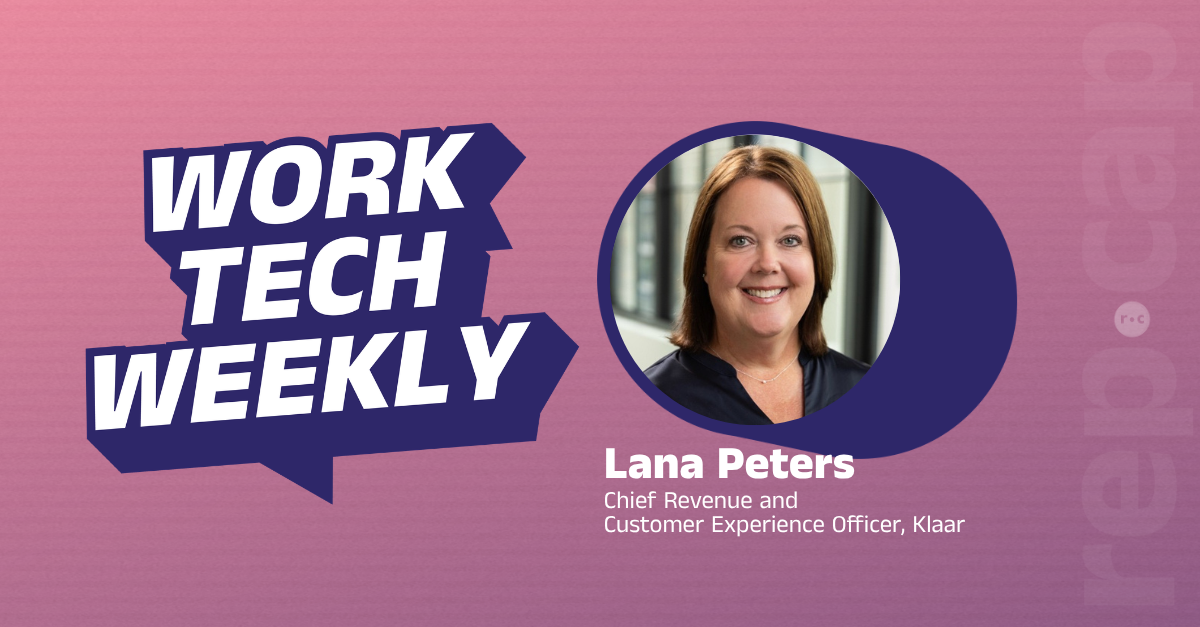
Toward the end of the Transform conference, I sat down with Lana Peters, chief revenue and customer experience officer at Klaar, for a conversation about what predictive performance management actually means in practice. Not the concept. The everyday moments. A manager getting a signal before a one-on-one. A leader seeing performance risk before it becomes a real problem. HR moving from explaining what happened to shaping what happens next.
That last one is the shift worth paying attention to. Give it a listen.
Transactions
-
OpenAI files for US IPO after Anthropic as AI giants head to public markets. Two of the three most consequential AI labs are now in the IPO queue alongside SpaceX, in what's shaping up to be the most concentrated high-stakes debut season since the dot-com era. OpenAI's own projections show negative cash flow through at least 2028, which highlights a key theme of the AI Era. Public market investors are being asked to underwrite the future, not the present. (Reuters)
-
Ramp raises $750M at $44B valuation as investors hunger for fintechs with an AI story. Ramp's valuation has nearly tripled in 18 months — and the new product angle is AI token spend management, essentially betting that controlling AI costs will be as mission-critical as controlling T&E. The Uber budget story is their best sales slide right now. (TechCrunch)
-
Lovable says it has hit $500 million in annualized revenue, with 1 million new projects a week. The vibe-coding platform founded in late 2023 is printing money before it's even hit its third anniversary, and the demographic data is the real story: most users are non-technical people building real businesses. (TechCrunch)
Industry Notes
-
San Francisco rejects a tax hike on companies with highly paid executives. SF voters passing on a chance to penalize high executive pay says as much about the city's shifting political calculus as it does about tech's renewed gravitational pull on local politics. When the AI gold rush is filling your empty office towers, you don't bite the hand. (Wall Street Journal)
-
Layoffs: Salesforce posted $1.2 billion in AI revenue, celebrated Agentforce as a breakthrough … and then cut employees working on Agentforce. GitLab cuts 14% of staff as it scales its platform to serve AI workloads. It's the new playbook: grow the narrative, shrink the team.
-
Workday and Google Cloud expand strategic partnership to bring AI agents for HR and finance into employees' daily workflows. More than the integration, the real bet here is the claim that HR and finance work can run inside a chat interface without employees losing trust in the outputs. (Press Release)
-
Oracle shares tumble amid pricey data-center build-out. The irony of a cloud giant getting punished for over-investing in the infrastructure everyone says is mission-critical isn't lost on the market. (Wall Street Journal)
-
Phenom partners with ServiceNow to introduce AI hiring agents. Here’s a bet that the next layer of TA automation isn't just sourcing or scheduling, but fully agentic hiring workflows, which either streamline the process or turn candidate experience into a customer service ticket. (Press Release)
-
Meta launches 'Workforce Academy' to train workers to build data centers. Meta is essentially creating its own trade-school pipeline for the physical infrastructure its AI ambitions require, and a quiet acknowledgment that the talent market can't fill these roles fast enough at any price. (Wall Street Journal)
-
Executive moves: Reid Hoffman is leaving Microsoft's board to go 'founder mode' with a cancer drug-discovery startup, which is either the most Reid Hoffman thing ever or a signal that the next frontier of AI impact is not enterprise SaaS. Or both. Also, Talent.com CEO to step down after 15 years, and Epicor appoints Rachel Barger as Chief Revenue Officer.
-
OpenAI launches new Codex tools for white-collar work. Codex moving up the stack from developer tooling to general office work is the quiet escalation everyone in knowledge-worker-land should be paying attention to — it's not just about writing code anymore. (TechCrunch)
-
No raise, no promotion: 1 in 4 white-collar workers are stalling out. A quarter of office workers are stuck in place — not laid off, not promoted, just ... frozen. It's the career equivalent of buffering, and it's happening at exactly the moment companies are betting on AI to handle the upward mobility logic. (Wall Street Journal)
-
America's data center build-out is falling way behind schedule. The bottleneck isn't models or money — it's transformers, permits, and power grid infrastructure that was never designed for this kind of load. The AI revolution is getting stuck in a very analog traffic jam. (Wall Street Journal)
-
Publishers will be able to opt out of AI search, thanks to new regulation. The opt-out right is a start, but it doesn't address the deeper question of whether opting out actually changes your traffic, or whether the AI citation economy has already moved the goalposts on what "traffic" means. (TechCrunch)
-
Payscale Peer data network surpasses 10 million incumbents. (Press Release)
Worth Reading
-
Earned media drives 84% of AI citations. Owned media is what makes it possible. The implication for B2B brands is uncomfortable: you can't buy your way into AI's answer box the same way you could buy your way onto Google's first page. Earned credibility is the new SEO, and the companies that ignored PR are about to feel it. (The State of Brand)
-
Is LinkedIn entering its post-cringe era? The platform's influencer culture has been peak cringe for years, but there are real signals that it's maturing into something different. Turns out that nothing motivates personal branding like existential dread. (The New York Times)
-
Everything is recorded now. The pervasive nature of ambient recording and what it means for trust, memory, and accountability in organizations is worth thinking about as AI in the workplace reshapes the concept of "off the record." (a16z)
-
China uses LinkedIn to lure spy recruits in West, U.S. and allies warn. The platform built for professional networking has apparently been an efficient vector for foreign intelligence recruitment, which adds a whole new layer to "connections you may know." (Wall Street Journal)
