Musical accompaniment for this week's newsletter.
First impressions can be deceiving. When G2 announced in January that it was buying Capterra, Software Advice, and GetApp, the press release at the time ran long on vision, short on numbers. The price tag didn't surface until Gartner's 10-K two weeks after the deal closed: $110 million for three of the handful of sites machines now consult before telling a buyer what to shortlist. To corner the citation market, it kinda looked like G2 fleeced Gartner.
Well, maybe not. Here's the part that actually matters: Gartner kept Peer Insights, the single most-cited platform in the group, and sold off the three that monetize through vendor placements and lead-gen. It seems Gartner knew exactly which half was still worth owning. G2, Capterra, and Software Advice now together account for over half of all review-platform citations in AI Overviews, and organic traffic to those same sites has collapsed by 80-90% over the same period. Think about that. The traffic left, the buyers didn't — they just stopped stopping by. If your GTM team is still optimizing for visits instead of citations, you're fighting the last war.
Not stomach-churning enough for you yet? Well, Reddit — the platform with an actual paid licensing deal with OpenAI — lost 86% of its ChatGPT citation share in four days this month, with no warning and no real explanation. In other words, the “independent” evidence layer AI leans on is quietly consolidating under a single commercial owner, and even the biggest, best-resourced, contractually protected player in that system can be erased from it overnight for reasons nobody will confirm. Unless AEO is a key component of your go-to-market strategy, you should be fine. Oh, wait.
Now guess what's about to pour into that exact unstable, unaudited system. OpenAI's own business CMO wrote this week that AI has removed marketing's last real constraint: cost. He's not wrong that budget used to gatekeep who got to try things. But the thing about gatekeepers is that the good ones have standards. Leonard Cohen might have said, “You’re not going to like what comes after America.” Well, you’re damn sure not going to like what happens after the gatekeepers are gone.
Take the cost out and every team can now produce endless competent, on-brief, forgettable content. I’ve talked to enough tech buyers and GTM leaders to feel pretty safe saying that removing marketing constraints hasn’t made things better for anyone.
So, the evidence AI cites is consolidating into fewer hands outside of your line of sight. That evidence layer can vanish or reshuffle with zero notice. And the volume of content trying to get absorbed into it has gone vertical because the gatekeepers don’t exist.
The only rational response in this irrational time is a flight to quality. The only positions that survive a re-ranking are the ones that didn't depend on the ranking in the first place: original research, a defensible POV, content that says something, and an audience that knows you for these exact things. Dare to do things the right way.
What else is going on this week?
This Week In Dystopia: How The AI Sausage Is Made
If that first item didn’t get you to your recommended daily allowance of Vitamin WITAF, I got your back. How about Google paying $10 million to strip-mine Spirit Airlines' carcass to the tune of 100 million emails, 500 million Teams chats, 30 million lines of code, all of it now feeding an AI model, because apparently bankruptcy isn't the end of a company anymore. It's just an estate sale for its digital soul.
Meanwhile, rare-book dealers are watching their inventory get shipped to warehouses and sliced off at the spine. One seller planted a tracker in a book's dust jacket and followed it to an Amazon facility nicknamed after a dinosaur that eats books. Another had to choose which copy of a dead friend's Ray Bradbury magazine to sacrifice to "the guillotine." That's not my usual hyperbolic flourish. That's the actual word he used.
And in San Francisco, an AI named Luna, which runs a boutique that's lost $40,000 and counting, actually fired a human employee. Its next move: hiring, badly, on Indeed.
Then there’s Blackstone and Anthropic's new $1.5 billion joint venture, which embeds AI engineers directly inside portfolio companies to squeeze more revenue per human. So, there’s the full picture: your data gets auctioned when you die, your books get guillotined to train the thing, your boss might not have a pulse, and private equity is scaling the sh!tt!ness. And don’t even get me started on this.
SaaS Multiples: Welcome to the K-Shaped Reset
Charles Bedard’s SaaS Capital Index shows that it’s tough times out there. Case in point: 5.58x EV/ARR down to 3.82x in seven months, mostly one brutal February. As he puts it, this is a K-shaped reset where AI-disrupted horizontal tools (Airtable, RIP) get crushed, while entrenched vertical platforms still command real premiums. Look at what happened with Weave last week — a 34% premium. No wonder the Workday rumors have everyone so dialed up. Any potential deal is looking at a 20% upside, according to Jefferies.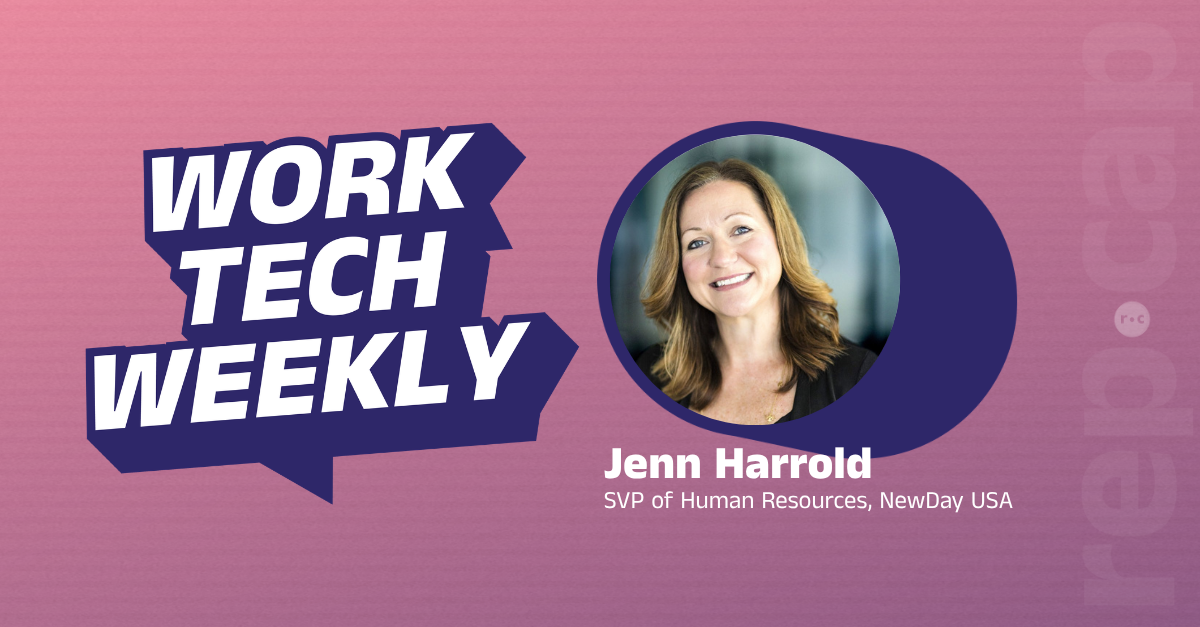
This Week on the Work Tech Weekly Podcast
Mortgage banking is one of the most heavily regulated corners of financial services, where a bad habit from a previous job can turn into real compliance risk. That's exactly why NewDay USA hires almost nobody who's already worked in the industry and instead trains everyone from scratch.
In the latest episode of Work Tech Weekly, we’re talking with Jenn Harrold, SVP of Human Resources at NewDay USA, about why the company hires for coachability rather than credentials and builds an entire coaching system to make up the difference. NewDay's intern pipeline has doubled twice in two years, with conversion rising right along. Listen Now
Transactions
-
Wispr raises big money. Not everyone is a fan. Last week, the buzzy AI dictation app Wispr closed $280 million in Series B funding at a $2 billion valuation, backed by Menlo Ventures and a cap table cameo from Dak Prescott, Klay Thompson, and half a dozen other athletes who apparently have opinions about dictation software. Meanwhile, the NYT ran an essay called — and I’m not making this up — “Everyone's Using This A.I. Dictation App That I Want to Murder With a Hammer.” Yeah, I’m kinda with the writer on that point. YMMV.
-
Alliant Insurance Services to acquire Nava, creating an AI-native model for the future of employee benefits. Insurance brokerages are the last stop on the AI-native tour bus, and now they're buying their way onto it. So, that’s the market stage we’re in. (Press Release)
-
Flip raises $25 million in new funding. Deskless/frontline worker comms keeps pulling capital. It seems that the "forgotten 80% of the workforce" pitch still works on VCs. (FinSMEs)
-
Lattice acquires Pando. Another HR tech tuck-in, another question about the future of talent solutions. For a truly revelatory take on this acquisition, check out this take from Lance Haun at Beacon Turn. (LinkedIn)
Industry Notes
-
Big Tech's AI borrowing binge is driving up bond yields. Alphabet, Amazon, Meta, and Oracle have issued nearly $223 billion in bonds this year — more than double 2025's total — just to keep the AI buildout funded. When the receipts show up in Treasury yields, "we're all in on AI" has become a balance sheet problem. (The New York Times)
-
Otter.ai puts meeting assistants on the hook for consent. Your meeting bot can now be sued directly, separate from whoever invited it into the call. If your HR team's stack includes anything that transcribes interviews or 1:1s, this is the week to actually read the consent settings instead of assuming the vendor handled it. (HR Executive)
-
'Ghost job' ads are getting so bad that lawmakers want to ban them. When fake job postings and AI data centers can stoke the fires of bipartisan indignation, you know it’s going to be a weird mid-term election cycle in the U.S. (Wall Street Journal)
-
LinkedIn has accidentally become a dating site, despite its no-romance rules. The professional network nobody asked to be swiped on is getting swiped on anyway. (Wall Street Journal)
-
Runlayer, Rippling drop lawsuits, but the brouhaha is still a cautionary tale for founders. Or is the proper word choice “bro-haha”? (TechCrunch)
-
U.S. workers are paying more for healthcare, and next year will be worse. Benefits costs are eating paychecks, and this crisis will be just about impossible to ignore during open-enrollment season. (Wall Street Journal)
-
ServiceNow’s Chief Innovation Officer on what's next in enterprise AI. Dave Wright wants to build a digital twin of your entire company so executives can simulate layoffs before actually doing them, because nothing says "innovation" like a SimCity mode for firing people. (Wall Street Journal)
-
Television's hottest genre is today's job market. Generation wars, side gigs and unemployment are just some of the career struggles captured in recent shows. (Wall Street Journal)
-
Tami Nutt: Before we decide what work becomes. Everyone's racing to redesign work around AI before anyone's agreed on what "good work" even means anymore — this one asks the question the roadmap decks keep skipping. (Substack)
-
Nobody wants to own candidate fraud. If y’all aren’t keeping up with David Manaster at ERE, you need to change that. The guy is absolutely on fire. Good read. (LinkedIn)
-
Gary Wiese named CRO at Safeguard Global. Another revenue leader hire in the global payroll/EOR space, where the land grab for enterprise logos is still very much on. (Press Release)
-
Joveo introduces job discovery for employers in ChatGPT. Recruitment marketing's AEO moment has officially arrived. (Press Release)
Worth Reading
-
Stacia Garr in HBR: How to respond to the coming AI cost shock. TL;DR: Enterprise AI right now is basically a free trial the size of the U.S. Gross Domestic Product, and 2027 is when every tech vendor finally makes you enter your credit card number. (Harvard Business Review)
-
Digital supremacy: why two-letter .com domains are the modern economy's scarcest strategic asset. A weirdly compelling reminder that the internet's real estate market has its own version of Manhattan penthouses, and most of us are renting studio apartments. (MSN)
-
Columbia House is shutting down after 71 years. Pour out your Bartles & Jaymes, Bud Ice, or Gen X adult beverage of choice for this one if you ever bought 12 CDs (or, um, records) for a penny. (NBC New York)
-
The Spaghett (aka the NASCAR Negroni) is the perfect pocketbook-friendly summer cocktail. A Miller High Life. An ounce of Aperol. Some lemon juice. It shouldn’t work. But it does. (The New York Times)
Want more Work Tech Weekly? Follow me on Substack to get stuff that’s not in the newsletter.
