Musical accompaniment for this week's newsletter.
Is this a good thing or a bad thing? Yes.
For two years, we’ve been getting the market narrative that AI is going to eat legacy enterprise software like that thing that’s locked in the basement on Widow’s Bay. Then one little Reuters story about Silver Lake talking with Workday about going private, and – voilà! – market cap jumps from roughly $43 billion to over $51 billion before lunch.
Nothing's signed. Nobody's confirming anything on the record. But the reaction alone tells you something the AI-doom narrative conveniently skipped: investors don't flash a $50-plus billion check at dying companies. They treat undervalued companies that way.
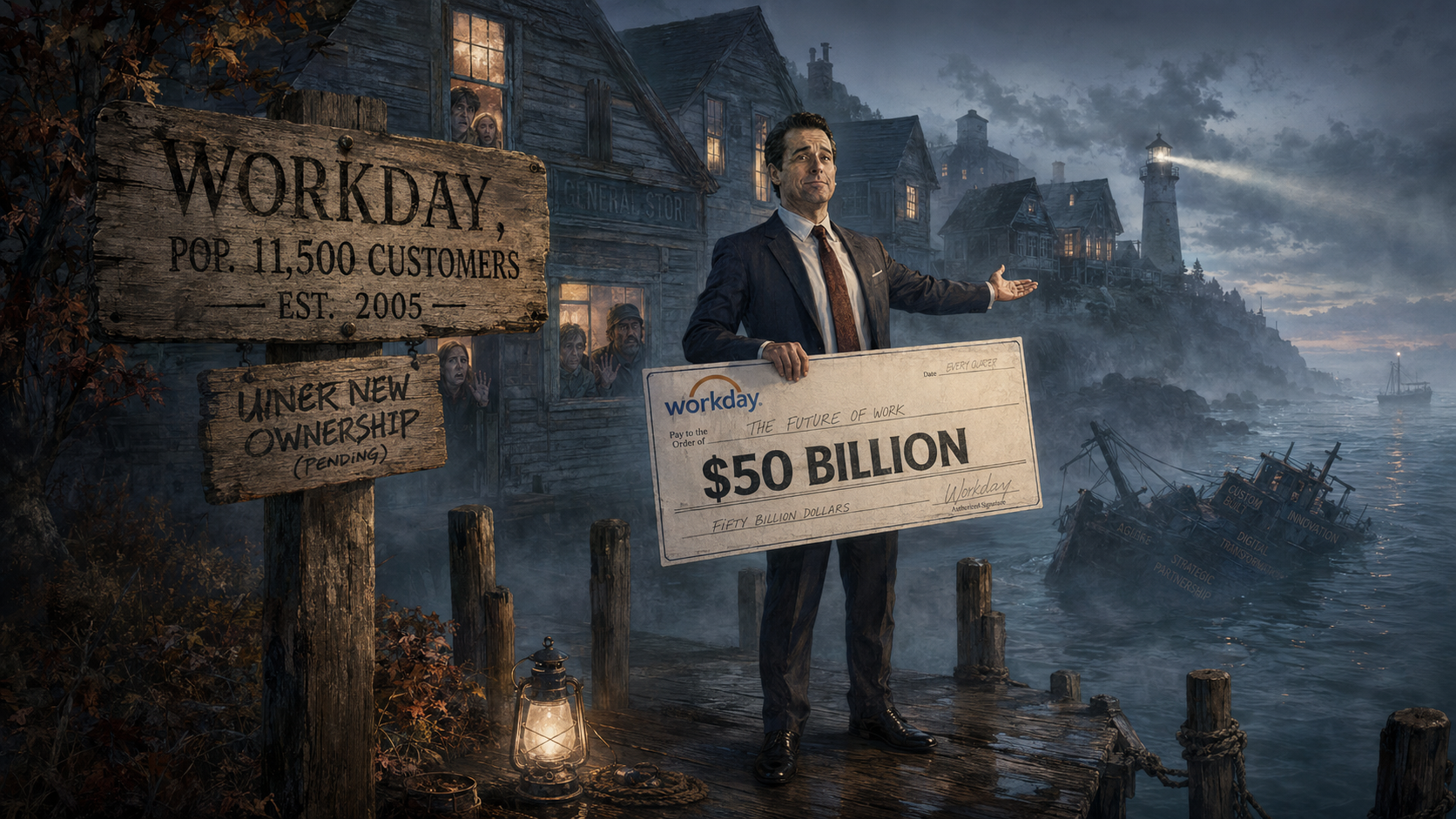
And Workday is objectively undervalued. Revenue grew from $7.26 billion to $9.55 billion over two years. Operating margin nearly tripled. And yet the Street's mean price target still fell 42% over a year, from $296 to $171, because of the AI-disruption market narrative. Needham thinks the real takeover price would be around $240-250 per share.
There’s certainly an optimistic case for why going private would be a good move. For a super-detailed deep dive, see Thomas Otter’s take on Substack. The TL;DR version: Jefferies analysts argue Workday "could have more room to pursue an aggressive artificial intelligence strategy and reignite revenue growth if taken private" since it would no longer need to protect near-term margins for public investors. So the actual thesis is that the AI transformation everyone keeps demanding requires patience, which public ownership structurally cannot provide.
Perhaps a bigger question is whether PE ownership can deliver the kind of innovation required to make the whole thing pay off. Silver Lake has run this playbook before with Dell. So, there’s proof that a caper like this can work if the new owners actually spend the freedom on real bets (R&D, major acquisitions) rather than just cost-cutting and debt service.
The open question is whether Silver Lake repeats the Dell playbook (invest, transform, re-list bigger) or just runs the standard PE cost-discipline script. Dell had hardware diversification and an EMC-sized swing available. Workday's growth lever is fuzzier. And a leveraged buyout of this size means heavy new debt, which could constrain future R&D and hiring exactly when it needs to invest in AI.
There’s also a brutal pessimist’s take on why it can’t work: Incumbent SaaS players have too much technical debt to transform, and the only way forward is to build from the ground up as AI-native. That’s basically what the CEO of Warp, an aspiring AI-native Workday disruptor, wrote on LinkedIn last week.
Then there’s the ultra-cynical read on the whole situation. PE is currently holding 33,575 unsold portfolio companies, per the NYT. That’s an exit backlog big enough to be its own asset class, and a lot of them are enterprise software companies. Look at Airtable. Look at Medallia. Bad stuff is going down. So it's not that Silver Lake suddenly discovered patient capital as a philosophy. It's that patient capital is where you go when you’re out of options.
If you read it this way, Silver Lake isn't chasing Workday because Workday's cheap. It's chasing Workday as a nice wrapper for HR Tech roll-ups because roll-ups are the consolation prize when the market won't cooperate. Buy, bolt together, hope for a strategic sale later. That's a fine model for mid-market SaaS. It's a much shakier one for a category leader that needs to out-innovate AI-native competitors rather than get folded into someone's platform thesis.
One thing is for sure: whether this deal comes to pass or not, the SaaS Era is drawing to a close as the AI Era is kicking into overdrive. The SaaS Era was as much about an unprecedented extended period of cheap capital availability as it was about the proliferation of new technologies. Cheap capital isn’t coming back. Enterprise software companies are at the beginning of a genuinely painful reset.
Workday was the most disruptive company in HR Tech during the SaaS Era. Stick around long enough as a disruptor, though, and you become the incumbent. Workday won't be one of the enterprise software logos that doesn't survive the shakeout. But that doesn’t mean it will be an easy go of it.
What else is going on this week?
Google Tells Applicants Its HR Filters Are Unreliable
The company building the models is also the company quietly admitting its own hiring stack can't be fully trusted, which is firmly in WITAF territory.
Oracle Preparing Fresh Round of Layoffs
Big Red is carrying billions in AI infrastructure debt and reportedly wants cuts locked in before its next fiscal quarter. It’s the same playbook as the last round, down to the reported early-morning email. The AI-capex-funded-by-layoffs isn’t even a subtext here. It’s little wonder that while layoffs slow overall, tech is still bleeding jobs. That is, unless you are North Korean. Those guys apparently have no problem getting jobs in tech.
 This Week on the Work Tech Weekly Podcast
In the latest episode of Work Tech Weekly, I sat down with Eric Nitzberg, founder of Sierra Leadership, who says seniority never bought anyone confidence; it just offers better cover for the days it disappears. They're not standing up in an all-hands and saying they're not sure they're up to the job, but privately, the doubt is there.
Eric also makes the case for something he calls "viewpoint agility," which is holding a confident opinion while staying genuinely open to being told you're wrong about it. As he puts it: "In your secret heart of hearts, are you really interested in the possibility that you're wrong?" That's the real test, and most leaders only pass it some of the time. Listen here
Funding, Acquisitions, and IPOs
-
Lovable doubles its valuation to $13.3 billion in eight months. $500 million in ARR on 146 employees is the kind of revenue-per-head math that makes VCs rewrite their thesis decks. And yes, one of its new investors also owns TechCrunch, which is its own little story about who funds who covering who. (TechCrunch)
-
OpenAI-backed Thrive Holdings raises $2 billion to bring AI to the enterprise. Thrive's whole model is buying up services businesses and rebuilding them as AI-native. (TechCrunch)
-
Metaview acquires Reval as recruiting AI moves from assistants to autonomous coworkers. “Assistant” implies a human's still driving. "Autonomous coworker" implies the AI's making calls on its own. We’ll see. (DHRMap)
-
zvoove acquires Pixi, an AI agent for staffing-agency admin work. Staffing is one of the most back-office-heavy verticals in HR tech, which makes it exactly the kind of unsexy, paperwork-choked niche where "AI agent that does the admin" actually earns its keep. (Press Release)
-
Marsh McLennan Agency acquires Accel Holdings. Another insurance brokerage roll-up adding headcount and Midwest offices. It’s unglamorous, but this is exactly how benefits distribution consolidates when nobody's watching. (DHRMap)
-
Palette raises €3 million pre-seed to build an OS for AI-native teams. Every funding cycle produces a fresh crop of "OS for X" pitches — the ones worth watching are the ones betting teams themselves will be structured differently, not just tooled differently. (Tech.eu)
-
Careerminds acquires Jobrapido. Yet another in a never-ending series of attempts by outplacement providers to “own the whole workforce-transition pipeline.” (DHRMap)
-
Jens Bender’s European HR Tech July investment update. Always a good read. (LinkedIn)
Industry Notes
-
An ADP leader says HR isn't asking the right AI questions. Everyone's obsessing over "will AI replace me" when the question about what decisions we are letting a model make unsupervised barely gets airtime. (HR Executive)
-
CHROs are the most cautious C-suite execs on AI readiness. Every other function is racing to claim AI fluency in their next board deck. HR's the one saying "actually, let's make sure this doesn't blow up in a lawsuit first." That's not timidity, that's actually HR doing its job. (HR Brew)
-
Bonusly launched a new product called Bizy. Recognition platforms keep bolting on adjacent categories to avoid becoming a commodity feature inside someone else's suite. (HR Tech Cube)
-
Job seekers are racing to AI-proof their résumés. Candidates are just responding rationally to a system that rewards keyword-stuffing over substance. If the ATS is the gatekeeper, of course everyone starts writing for the gatekeeper instead of the human. (Wall Street Journal)
-
Recruit Holdings' HR tech segment is soaring, with big guidance upgrades. This just in: Job boards are still not dead. The demand for full-time hiring infrastructure is still very much alive, and getting more profitable. (HR Tech Feed)
-
Upwork earnings. Margins are fine, cash position is strong, and they're still buying back stock. But it's a company whose core product (matching humans to cheap freelance work) is being quietly hollowed out by the very AI wave they're now trying to position themselves within. (Press Release)
-
Mercer and Compa are bringing compensation insights into everyday workflows. Comp benchmarking used to be a quarterly exercise buried in a spreadsheet. Baking it into daily workflow tools is the unglamorous shift that actually changes how pay decisions get made. (HR Tech Cube)
-
SafetyCulture rebranded to Mitti. A rebrand this late in a company's life is usually less about the name and more about repositioning away from whatever the old name boxed them into. (HR Tech Cube)
-
Fintech and HR are colliding, and leaders should be paying closer attention. The line between "HR platform" and "financial services company" is disappearing faster than most HR leaders have budgeted for. (HR Executive)
-
Clair hit a $100 million revenue run rate in under two years. Earned wage access isn’t a niche benefit anymore. (HR Tech Cube)
-
Fuel50 launched an MCP server. A talent marketplace that plugs directly into the same protocol Claude and other agents use is so much more than a chatbot bolted onto a dashboard. (LinkedIn)
Worth Reading
-
Open-weight AI models won't crimp demand for picks and shovels. Turns out cheaper models just mean more compute gets used, not less. Jevons Paradox, but make it enterprise AI. (Wall Street Journal)
-
Co-workers, not contractors: preserving the social fabric of work in a fractured world. The gig-ification of everything didn't just change paychecks. It quietly dismantled the informal social infrastructure that made workplaces feel like communities instead of transaction logs. (Roosevelt Institute)
-
Companies rolled out AI to kill busywork. Employees invented performative productivity instead. Give people a tool that eliminates the work, and they'll just find new work to stay busy with. (The State of Brand)
-
The White Sox gave away 40,000 pope hats, and it worked. What the world needs now is more stories about people wearing funny hats. (The Athletic)
