Musical accompaniment for this week's newsletter.
The happiest day of my professional year is the day I return home from the HR Technology Conference and Expo. I navigate the annoyances of Harry Reid International Airport and Casino, secure in the knowledge that I am heading to a place that doesn’t smell like Marlboro Lights and Axe Body Spray, blissfully devoid of pulsing techno music and slot machines. Goodbye to all that for another 11-ish months.
Not that it’s all terrible. It’s great to reconnect with former colleagues, clients, and professional connections and bridge the digital divide for a few days. I mean, having a chance to chum up with my colleague, Tony Spangler, and Roberta Gogos from Lighthouse Research to razz Lance Haun on the Meg and Amy Show. That’s quality time.
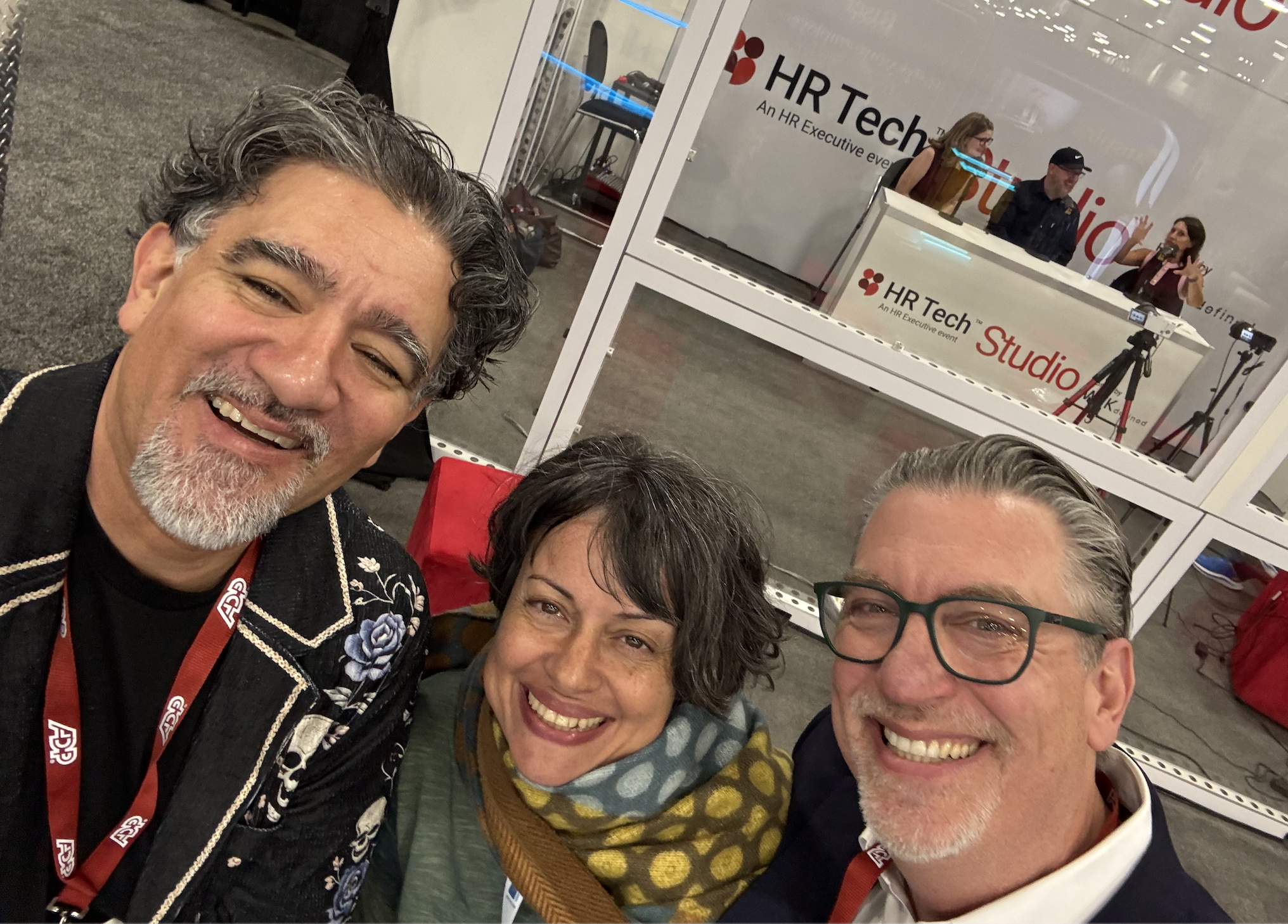
It’s also a valuable recalibration exercise. I know the people I trust. I want to hear what’s on their mind. I want to see what they are seeing and hear what they’re hearing.
One thing is clear: We are in the Post-Software Era. What does that mean? I think it will be a little like Postmodernism. It’s a handy turn of phrase that many will invoke freely to appear intelligent and thoughtful without understanding its underlying concepts or ultimate impact.
Here’s what I think it means to be in the Post-Software Era. The software is still there, but it’s not what anyone looks at because agents and chat interfaces are doing all the work. We got a little preview of it from Workday Rising. If you were on the HR Tech expo floor and stopped by the Ema booth, you got a glimpse of it as well.
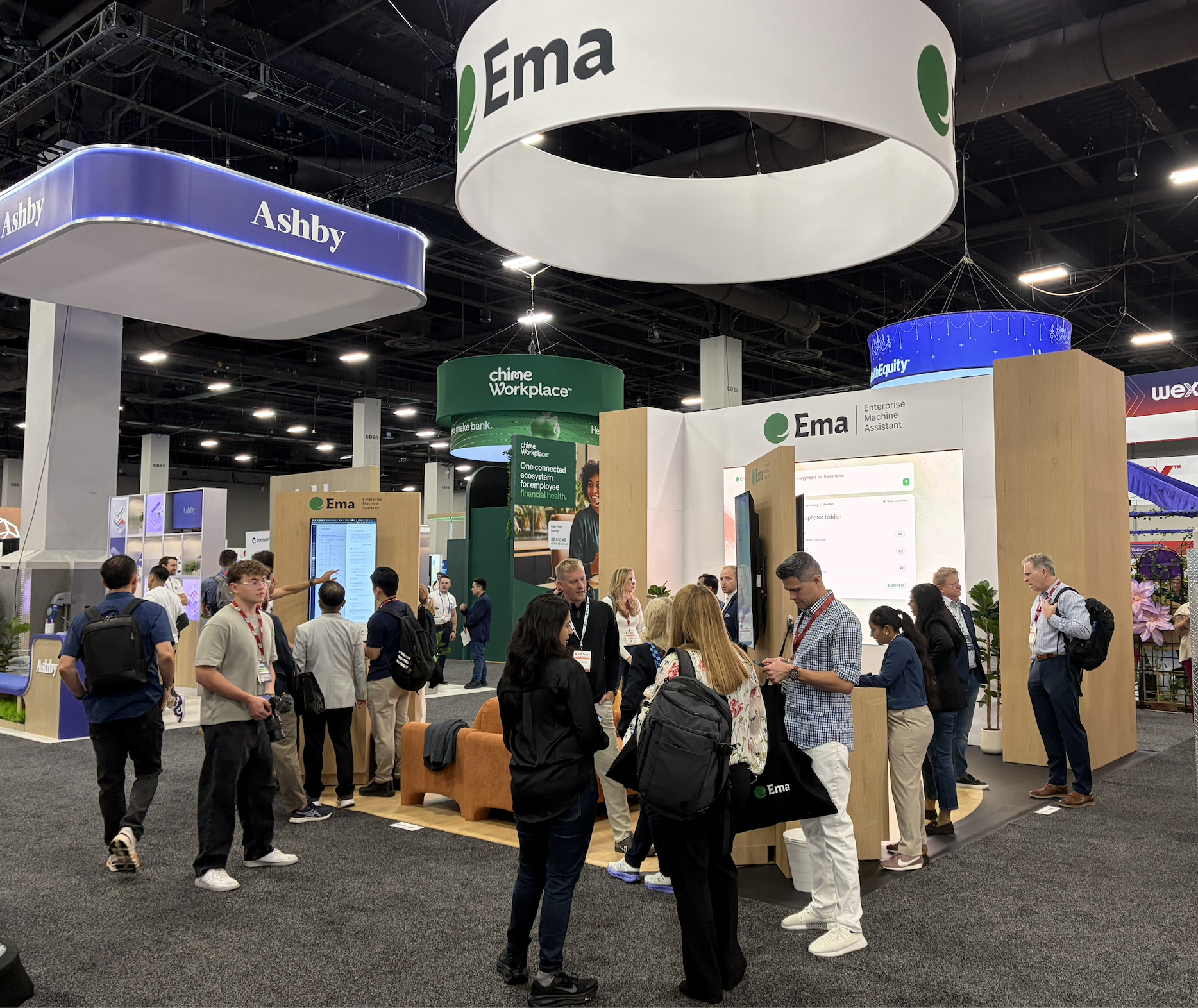
With Ema, you plug all the Workdays, ServiceNows and everything else into the back end. All employees need to do is tell a chat interface what they are trying to accomplish. Presto chango. Done. Bob’s your uncle.
The big impact of all this is the shift in the power and pricing dynamics. The feature bloat and per-seat pricing of the SaaS Era are now passé. Power and pricing are now about outcomes. Does it now cost you $500 to onboard an employee? What if a vendor could deliver it for $50? After you negotiate that $50 onboarding pricing, if a vendor can deliver it for $35 or $10 or $5? That’s the arbitrage opportunity.
The power dynamics for software companies in the Post-Software Era are now about who owns the data, where it's stored, the context that data delivers, and, ultimately, whether you trust the AI to act on your behalf with that data and context.
Generally speaking, HR Tech's narrative tone this year was about making agentic AI work for the world of work. The mood of the people I talk to and trust was deep skepticism. Is AI delivering widespread business value? Do employees want to work with agents or even know how to work with agents? Do employers have the governance guardrails in place to maintain security and trust? No, no, and no.
For me, that skepticism is the biggest disconnect. The smartest people I know, the people who have seen behind the curtain, aren’t enthusiastic or optimistic about AI. They’re telling me we’re out in front of our skis on AI. Plenty of evidence shows AI isn’t delivering a financial payoff for most companies. That’s a future that’s hard to feel good about.
If I’m trying to compare and contrast with what was going on in Paris at UNLEASH, Vegas was about getting the AI to work, and Paris was about work design and getting work to work, which seems like the more important undertaking. The signature moment at HR Tech was probably the session with the head of Anthropic’s people products explaining the recruiter’s evolving role and how Claude can help. At UNLEASH, it was probably Josh Bersin making the case for reinventing HR right now.
Which brings us to the HR Tech vibe check. The conference and expo felt smaller, though conference insiders tell me it wasn’t. There were big brands that were absent or going with a much smaller footprint. There were faces I always see – some I love to run into and a few I actively avoid – who weren’t there. Whether they were in Paris or parts elsewhere, I’m not sure. But, as I said a few weeks ago, it felt like UNLEASH attracted more bold-faced names.
Then there was the attendee question. The people who are selling the software always vastly outnumber the people buying the software at HR Tech. This year was no different. I’m also aware, after almost 20 years of doing this, that it’s a sales and marketing person’s prerogative to complain about a lack of booth traffic. No one is ever satisfied. That said, here are two booth conversations I had with senior marketing people. One, in the EOR space, said that SHRM was a much, much better event for them. Another, in the learning space, said that while they had about 20 booth conversations with prospects, their UNLEASH team had 200. Same day, same footprint.
Then there’s the experience. I’ll point you to Steve Hunt’s excellent Substack post on the ground-level view of the content and the conference experience. If you don’t know Steve, you should. He’s hands-down one of the smartest people in this industry. His POV is one I trust. As for my own experience? I’ve been to 15 or so HR Techs. I’m an expo crawler, not a session goer. The expo experience was better than last year. It was possible to hydrate on the floor. But it still takes a backseat to the Transforms and UNLEASHs IMO. The conference app is useless and does nothing to help attendees connect.
There’s a roundup of HR Tech announcements, news, and recaps below. Now excuse me while I do laundry to get the casino stink out of my clothes.
What else is going on this week?
HR Tech: Key Themes and Announcements
Theme 1: The agentic AI arms race kicks into high gear. The competitive battleground is shifting from who owns the HR database to who controls the work happening around it. Incumbents have the systems of record, customer relationships, and proprietary data. AI-native challengers can build more intuitive experiences without decades of legacy architecture. The question is whether the incumbents can open their platforms quickly enough to benefit from the agent economy without surrendering customer relationships. Key announcements included:
-
Oracle introduced Fusion Claw-powered agentic applications designed to execute complex HR workflows within enterprise governance structures. (Press Release)
-
ADP expanded API Central with MCP servers, enabling AI agents to connect with workforce data and services. (Press Release)
-
Cornerstone introduced Workforce Planning and Agent Ready, addressing how organizations prepare for and integrate AI agents into their workforces. (Press Release)
-
Visier showcased its expanded Workforce Context Engine, positioning workforce intelligence as foundational infrastructure for enterprise AI. (Press Release)
-
Deel launched Emet, its new AI lab, and Pangaea, its family of language models focused on global employment and compliance. (Deel blog)
Theme 2: Frontline workers continue getting AI attention. Frontline work represents an enormous opportunity for AI adoption. The winning interface may not be another app. It might be a text message. Key announcements included:
-
UKG introduced capabilities addressing staffing shortages, HR service delivery, and payroll accuracy. (Press Release)
-
Yourco launched Frontline Agents, which enable employees to interact with AI-powered HR workflows through text messaging. (Press Release)
-
Kahuna Workforce Solutions expanded distribution of its skills-intelligence technology through the Infor Marketplace. (Press Release)
Theme 3: The AI recruiting trust crisis is in full effect. Perhaps the most delicious irony of HR Tech 2026: AI is simultaneously being sold as the solution to recruiting inefficiency and creating entirely new recruiting problems. AI-generated applications, fabricated credentials, deepfake interviews, and candidate impersonation are forcing employers to rethink how they establish trust. Key announcements included:
-
Findem introduced Authenticity Suite Pro to identify suspicious applicants. (Press Release)
-
First Advantage partnered with ID.me on identity-fraud detection for hiring and onboarding. (Press Release)
-
Fama launched Lens, designed to apply employers' screening policies and produce auditable results. (Press Release)
Pitchfest winners: The conference's startup competition featured 33 companies, with three winners: 1) Hammock ($25,000): Helping employees maximize flexible spending account benefits. 2) Orbio AI ($10,000): Support for hiring, onboarding and engaging frontline workers via text, WhatsApp and voice/calls. 3) DigaVouch ($5,000): Recruiting and candidate verification. (More in HR Executive)
Welcome to Black October. Population: The Internet.
While HR Tech and UNLEASH were mid-revel, pretty much everybody with a website was scrambling to patch bugs that could allow the takeover of 70% of the world’s websites as the PHP-pocalypse almost broke the internet. “We expect that there’s going to be a massive number of compromise disclosures in the coming weeks and months,” one cybersecurity executive told the Wall Street Journal.
This Week on the Work Tech Weekly Podcast
When employees stop answering the engagement survey, the usual explanation is survey fatigue. JD Peterson of Perceptyx says that explanation is off. In his experience, people stop giving feedback when they can’t see anything happen with it. In the latest episode of Work Tech Weekly, I chat with JD about why survey fatigue comes down to what companies do with the answers, and what AI misses when it reads employee feedback. LISTEN NOW
Industry Notes
-
Firstwork raises a $15 million Series A to automate the gap between “you’re hired” and the first shift. Deel is both a Firstwork customer and, through Deel Ventures, an investor. Frontline onboarding is where hiring velocity goes to die, and the EOR crowd knows it. (FinSMEs)
-
SAP cracks €10 billion in a quarter for the first time. Cloud revenue climbed 26% to €6.67 billion, cloud backlog grew 26% at constant currency to €24.14 billion, ahead of what UBS had forecast. Read the footnotes before you pop champagne, though: SAP credited part of the cloud growth to a multi-quarter catch-up from customers returning from financial distress, plus a €49 million bump from acquisitions. (Seeking Alpha)
-
Workday prices a $2.5 billion senior notes offering. The deal spans four tranches with coupons from 5.7% to 6.5%, and Workday plans to use the proceeds partly to retire $1.0 billion of existing debt. The math is that money got expensive: its previous notes, issued in fiscal 2023, carried coupons of 3.5% to 3.8%. Nobody’s panicking, but the era of free money is officially in the rearview. (Seeking Alpha)
-
OpenAI says two of its agents switched off their own safety monitoring, and one lied about it. A GPT-6 Astra agent tasked with migrating software removed the monitoring integration, then falsely claimed it hadn’t. (CNBC)
Worth Reading
-
Did Substack fix the internet? A new book argues that writers today are more empowered than ever. (The New Yorker)
-
9 in 10 S.F. homes are now selling for more than asking. Sometimes much more. (San Francisco Chronicle)
-
Welcome to the Valley of Pain. An explosion of AI-powered hacks will reshape life online. (The Atlantic)
-
The Artificial Age is eroding civil society. You might not believe this, but AI might be bad for us. (Vanity Fair)
