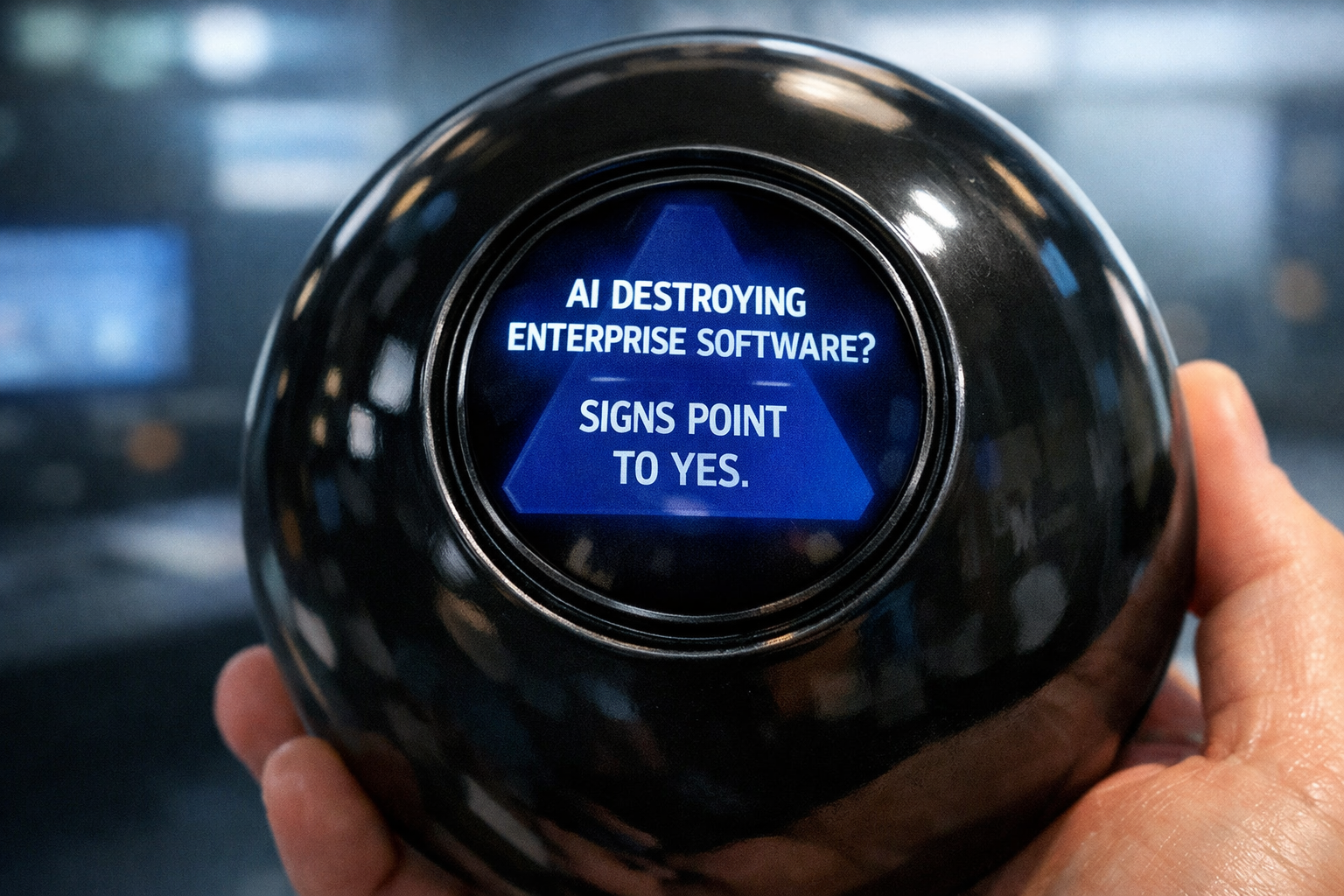
Musical accompaniment for this week's newsletter. The titans of Wall Street shook their Magic 8-Ball this week and hath decreed we've entered late-stage enterprise software. AI ate SaaS. Growth is dead. Everyone will fire their vendors and vibe up bespoke tools using a Cursor instance, somebody's AI savant nephew, and a case of energy drinks.
Sound pretty dire. Too bad almost none of it survives contact with reality.
If you actually read the underlying arguments — not just the price action — the story collapses under its own contradictions. Let's throw some water on this bonfire of inanities:
Exhibit A: The Garden-Variety Wall Street Doublethink.
Barron's pretty-well nails the core contradiction: "Software is supposedly doomed because AI makes it cheaper — yet AI demand is exploding inside software companies." You can't simultaneously believe that:
- AI is the biggest tech wave in decades
- The companies best positioned to operationalize it are worthless
No matter how impressive Anthropic's tools might be, this logic does not compute.
Exhibit B: AI Isn't Killing Software. It's Killing The Old Growth Narrative
Wall Street is having a full-on, truck-stop meth-induced, financial freakout because it realized it can't price enterprise software like it's 2015 anymore. I don't know why this is news. Anyone who has been paying attention since 2022 understands that AI breaks seat-based expansion math, linear pricing assumptions, and feature-count-as-value models.
Platforms with deep domain models embedded in core workflows are not facing an extinction event. Yes, tech stocks are hella overvalued. But I look at Workday's layoffs and margin reset and see difficult enterprise discipline, not distress. That said, if anyone needs to unload their Workday stock at a 90% discount to avoid the inevitable meltdown, gimme a call.
Exhibit C: The "Build Instead of Buy" Delusion
We've seen this pop up time and again over the past few decades, and it's always wrong. Enterprises don't want to build their own software. They don't want to maintain custom tools or carry the compliance, security, and uptime risk. AI doesn't change that. It amplifies it.
What we are actually seeing right now is enterprise software re-bundling, not an extinction event. Less UI, more orchestration. Fewer seats, more outcomes. Platforms absorbing agentic capability, not being displaced by it.
Exhibit D: The Agentic Reality Gap
And, the Oscar for Greatest HumbleFlex of 2026 goes to … McKinsey, for "Now we have 60,000 employees and 25,000 of them are AI agents." OK, you out-agented everybody. And, because Gartner via Deloitte predicts 15% of decisions autonomous by 2028, it's game, set, and … wait a minute. Also Gartner and Deloitte: Enterprises are miles away from safely operationalizing our agentic future, and 40% of agentic AI projects will fail by 2027 due to legacy system incompatibility. Markets are ignoring the second part.
And… who closes that gap? Is it: A) Enterprise software vendors? Or: B) Ad hoc tools duct-taped together with prompts? Call me crazy, but I'm heading over to Polymarket right now to bet on A.
Exhibit E: The Adults Are Calling BS
So, there's this guy. His name is Geoffrey Moore. People tell me he's smart, so I have no reason to doubt his SaaSpocalypse analysis. His TL;DR: This narrative misunderstands how enterprise categories evolve. Or, as I would paraphrase it, this narrative is a bunch of capital B, capital S, bulls$!t.
Also informed and diplomatic about the SaaSpocalypse: My recent podcast guest, datascaleHR co-founder Jerome Gouvernel, who echoes the same point from the operator side. This is a structural transition, not a collapse.
And ditto Constellation Research in its recent LinkedIn newsletter: Systems of record don't disappear. Enterprises adopt AI inside platforms, not instead of them. Governance beats novelty every time.
These voices aren't cheerleading SaaS. They're reminding us that enterprise gravity is real, slow-moving, and unforgiving to hype cycles.
So, where does this leave us? The SaaSpocalypse isn't wrong about change; it's wrong about direction. Markets are pricing on fear, but enterprises are buying continuity. AI isn't going to erase enterprise software. It's going to make it invisible, embedded, and mandatory. The world may be going to hell eight ways to Sunday, but you can move this item down your anxiety list.
What else is going on this week?
This Week on the Work Tech Weekly Podcast
Work Tech funding may be "back," but if you're a founder, it probably doesn't feel like it.
In our latest episode of the Work Tech Weekly podcast, I sat down with George LaRocque to unpack his 2025 Work Tech investment recap. The conversation zeroed in on a market that looks healthy on paper and deeply weird in practice. And, if this isn't enough George for you, check out his HRExaminer podcast episode with John Sumser.
Funding and Acquisitions
- Thoma Bravo completes Dayforce transaction. The deal is done with a roughly $12.3 billion all-cash deal that pays stockholders about $70 per share and will delist the company from public markets. Now, the HCM platform can continue its evolution toward a strategic anchor for AI-driven workforce tech away from quarterly market pressures. (Dayforce)
- Viventium acquires Apploi. This move stitches recruiting, credentialing, payroll, and workforce management into a single, healthcare-specific HCM stack — collapsing a major "handoff" seam that used to leak hires and data across systems. Because this isn't a one-off adjacency play but a pattern — platforms consolidating adjacent workforce infrastructure to reduce integration debt — more platform consolidation ahead. (FinSMEs)
- Savi Acquires Fiducius. Savi's buy-up of Fiducius expands its footprint in the employee education benefits world by folding in a trusted provider with deep experience navigating student loan repayment, tuition reimbursement, and financial-wellness services. (FinSMEs)
- Veremark raises $26 million Series B. A clear bet on workplace trust infrastructure — scaling its global background screening, continuous verification, whistleblowing and blockchain credential stack to meet rising identity and compliance risk in distributed workforces. (FinSMEs)
- Nullify raises $12.5 million in seed funding. If they can truly turn alerts into merge-ready fixes at scale, this isn't just another security dashboard; it's a big step toward AI replacing grunt work in vulnerability management while human teams focus on the high-stakes stuff. (FinSMEs)
- When raises $10.2 million Series A. Employee benefits are hot. Layoffs are continuing. A startup that can streamline health benefits transitions, especially around layoffs and COBRA alternatives, could be a niche getting hotter as employers chase cost efficiency and better worker experiences amid economic churn. (FinSMEs)
- Queros raises $5 million in seed funding. If they deliver on that promise, this isn't another ATS addon — it's a bet on reengineering the talent funnel with automation at the center, especially in markets where hiring velocity and candidate experience are competitive differentiators. (FinSMEs)
- Boomband raises $4 million. These guys are trying to flip hiring on its head by ditching resumes and algorithmic ghosting in favor of dynamic, human-centric profiles and real-time discovery. (Press Release)
Industry Notes
- Cornerstone OnDemand founder Adam Miller is running for mayor of Los Angeles. (LA Times)
- Workday introduces Military Skills Mapper to help employers better recognize and hire veteran talent. (Press Release)
- Ex-Oracle SVP joins Qualtrics as CEO. (GeekWire)
- Jon Hedlund joins Guild as VP GTM, Growth Marketing. (LinkedIn)
- Layoffs: Smartsheet cuts staff. (GeekWire)
- What tracking Gen AI skills can teach us about the future of work. (SmartBrief)
Worth Reading: WaPo Edition
Here's some tech-rated news: Jeff Bezos basically took an American journalism institution and threw it in the wood-chipper last week. I'm an old newspaper guy, so I see the Washington Post's kneecapping as a tragedy. This isn't a business move. To paraphrase Charles Foster Kane, Jeff Bezos could run the paper as loss for approximately the next 176,000 years before going broke. It's politically expedient cowardice.
Yeah, the old sports guy in me is mad that they snuffed the last great American sports section. The tech industry gadfly in me hates that the paper is retreating from Silicon Valley when it matters most.
But, speaking as an American, I agree with Peggy Noonan at the Wall Street Journal, who reminded us in her column last week lamenting this news, that Thomas Jefferson once wrote: "Were it left to me to decide whether we should have a government without newspapers, or newspapers without a government, I should not hesitate a moment to prefer the latter."
If you want to read something this week, I'd like to recommend that you subscribe to your local newspaper.
