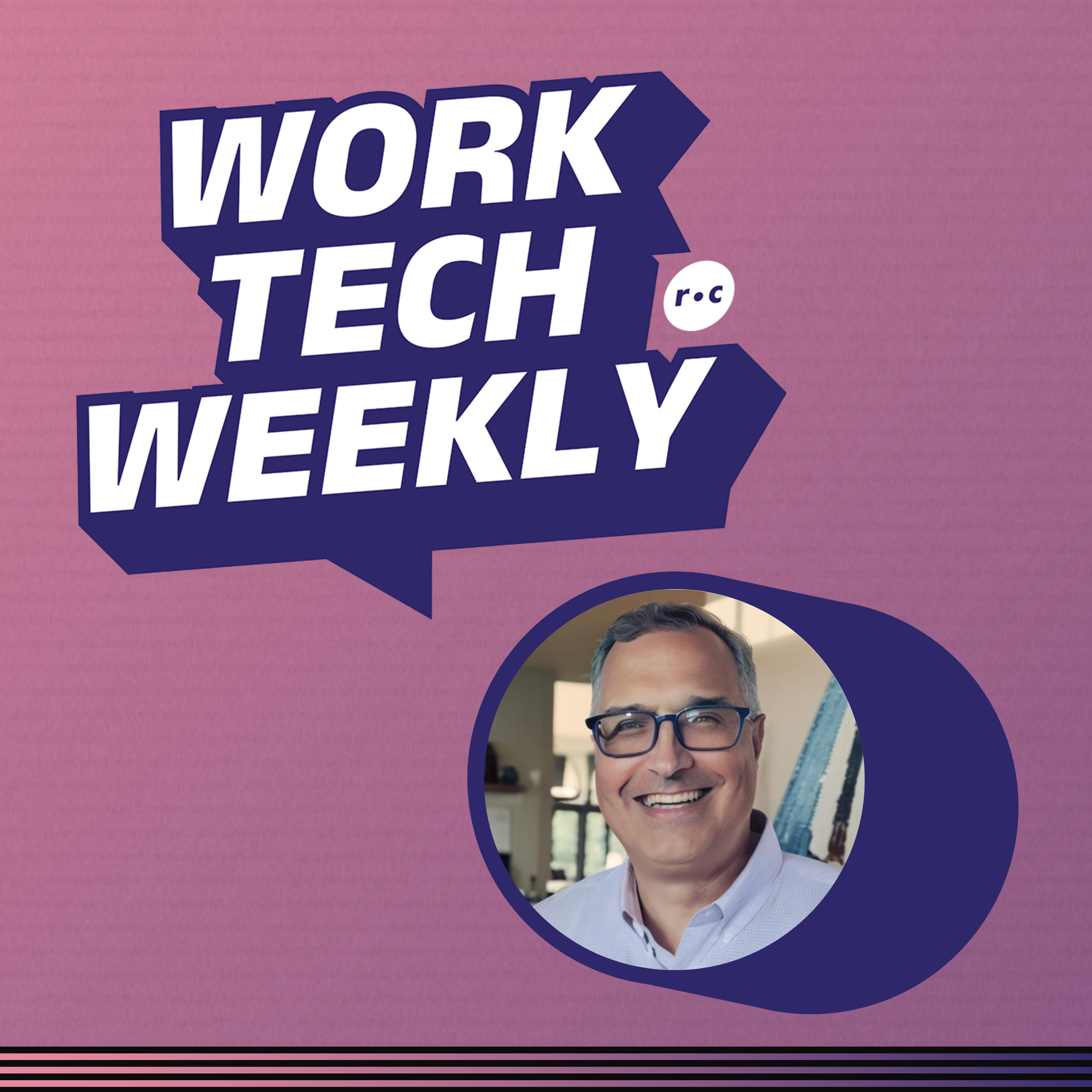
George LaRocque: I feel like this market, speaking globally, including the economy, everything is just really confusing right now. It has been for a while. We can look at this upward trend since 2023, 2025 at 6.24 billion is now the third biggest year we've ever had. But if you were to talk to the founders and talk to the folks running the companies raising the money, they'd say it didn't feel that way.
Steve Smith: Hello, everyone. Welcome back to another episode of Work Tech Weekly. I am your host, Steve Smith, managing director here at Rep Cap, and today's conversation is about money, momentum, and what's actually happening beneath the surface of the Work Tech market.
My guest today is George LaRocque, founder and chief analyst at WorkTech. George is a global analyst and advisor who works with employers and HR technology vendors across categories like core HR, talent acquisition, employee engagement, and workforce innovation.
Through his Work Tech research, George helps organizations understand the trends shaping the workforce today and where the market is headed next. And just to clarify upfront, WorkTech, the research firm, is not affiliated with this podcast despite our very similar names.
In this episode, we unpack George's latest Work Tech investment report and compare what the data says to how the market actually feels. We dig into why capital is concentrating into fewer bets, why frontline and compliance-driven categories are attracting spend, and why adoption, not hype, has become the real bottleneck.
We also look ahead to the rest of 2026 and take a look at where innovation is quietly emerging and which parts of the market may not make it through this cycle. If you're trying to understand where Work Tech investment is headed, what buyers are truly willing to pay for and how AI is reshaping the market unevenly, this conversation offers some much needed clarity.
Let's get into it.
George LaRocque, welcome to the show. How are you today?
George LaRocque: Steve, I'm great because I'm here with you. Thanks for having me. How are you?
Steve Smith: Well, thanks so much for saying that. I know that you mean it. It's always good to talk to you because we're going to go down some rabbit holes. We are going to just poke at a lot of things here. And I think it's going to be a fun conversation because we're talking about money in the Work Tech market, and you have just released your 2025 recap looking at the year that was. And yeah, I just spent some time going through this and this is a good read and there's actually some good news in there. Where you're looking at coming out of some of the scaries of '22 and '23, I think that it feels like maybe things are building some velocity. What's your takeaway from the report?
George LaRocque: I almost used the word rebound when I was writing some stuff. Maybe I did use it. I was hesitant though, because I feel like this market, speaking globally, including the economy, everything is just really confusing right now. It has been for a while. So while we can look at this upward trend since 2023, 2025 at $6.24 billion is now the third-biggest year we've ever had. But if you were to talk to the founders and talk to the folks running the companies, raising the money, they'd say it didn't feel that way. So I think it is good news. I think it's positive. Back at the HR Tech show, running the investor experience there, a lot of investors were telling me they felt like moving into 2026, entering another go time. I don't know if we're there yet. I don't know if we'll get there, but it feels like, to use your words, there is momentum. There is momentum.
Steve Smith: Well, and what was interesting about going through your report, George, is that if you factor out the anomalous years of '20 and '21, last year was ahead of 2019. So you can tell a story of continuous upward trajectory. And one of the things that surprised me about the report is when you look at the tech investment space broadly, the story is you have the OpenAIs and Anthropics and the big AI players gobbling up these giant investment rounds and you're seeing fewer rounds and more money. But it's just like a lot of money going to a few players and a lot of folks left scrambling. And I didn't think that was necessarily going to be the case in Work Tech, but yeah, it was. It was exactly the case. Do you think it's the same dynamics at work or do you think there's something else going on?
George LaRocque: Yeah, I think... Well, let's see. We had 17 mega rounds that's worth $100 million or more. That's what qualifies for that. It's a technical term, mega round. There are two things there. One, investors are more comfortable making big bets on established players because those are later stage, much later, very late-stage deals for the most part. The other thing it reflects is investors looking at our space like they like core HR, they like benefits, they like HR platforms, they like... Those are the things in our market that sound like must-haves, and they're highly compliance-driven. So there's a lot of risk if you don't have the right tech in those categories, benefits, etc.
So I think the big trend there in our world, yes, it was AI-driven, 100%, but the surprising thing, Steve, was that we had, I think it was 72 seed rounds, that's not even including the pre-seed rounds. So while the average deal size there came down in the seed rounds from $5.4 (million) to $5 (million), that's still good news because where it was up by 25% or something, volume-wise. So I think I was surprised at some of the momentum and some of those signals
Steve Smith: Looking ahead, what I sort of wonder is just like, okay, you're seeing employers everywhere regardless of category or industry running much tighter with headcount, much tighter with spend. Yeah, maybe they need to invest in people-forward solutions, but you have that tightness in how you're managing your own resources. And then you have the promise of AI saying, "Oh, okay, maybe you don't need this headcount after all. We'll just automate all that away." It just seems like there's this paralysis in the market driven by a whole cocktail of factories here. What gets us out of that? Or is it, "Hey, great, everything's changed, and there's just a swath of companies that may not survive this moment."
George LaRocque: I wish I had the answer to what gets us out of that. I'd be on a beach somewhere just telling that. But I think there's another factor here which you hit on, it's real important. Things are changing out in the buyer's landscape. So never before has adoption been so tied to your ability to exit, raise capital. Things have changed so much that categories where you were able to sort of have a go to-market, a very steady cadence of whether it's marketing or sales, however you're going to market, channels, activity and get there. Or the capital was flowing freely enough that you could get another boost to get to the next stage. Now, unless you're focused on an area where for the employers, there's a real clear line to an ROI, some improvement in efficiencies that are quantifiable, they're not buying it.
So when I look at what's happening in the market, everybody focuses a lot on frontline recruitment, high-volume recruitment. Well, there's a lot of spend, a lot of wasteful spend, a lot of transactions to automate, a lot of humans involved in the process doing a lot of things like scheduling and just trying to get people back in to interview. We've been able to automate a lot of that, and that's why companies like Paradox have done really well. Then you've got areas like benefits administration. Guess what? A lot of waste, a lot of cost, a lot of spend, a lot of compliance issues, a lot of terrible employee experience. So we're starting to see spend there. There's always spend there. We're starting to see more AI and spend on automation, so investors are going there.
I think as we start to see some of these things, other areas in the workforce, like shift scheduling, workforce management, performance management, learning, we're going to start to see where are the levers to pull to drive the same kind of improvements. We'll see more investment, we'll see more traction coming from that. But if you weren't aligned in one of those areas or didn't react quickly enough, I think you're in trouble right now unless you can ride this out.
Steve Smith: Totally agree. And I think there's a lot of investment that went into companies that focused on essentially white-collar workforces. And that was great for a while. But I was talking to somebody the other day, and it's just like, why is everybody out there seeming to be a frontline employee solution? And I was just like, well, that area was totally underinvested for such a long time. The solutions just weren't being built for that, for those audiences, for those industries. And now those are the industries that have essentially the disparity between labor supply and labor demand that gives a market for these solutions. So when you look at what UKG did in their last kind of big event, it's just like, well, yeah, of course that makes sense. It's like the old story, it's just like, why do you rob banks? Well, that's where the money is. Frontline workforce, that's where the money is.
George LaRocque: Right, right. Yeah, that's true. There's a whole category around skilled trades and areas that we've had vendors dabble in here or there, but never really, we've never seen it emerge as a true category in our space. Skilled trades, I think early careers, I think that whole... It's really tough for college students right now and folks two to three years out. I think we're going to see some innovation there. And I think employers are now... We used to be very aspirational in a lot of areas where now we can provide solutions. You can see a path to a solution. So having a wider net, getting the best young, new grads in the organization from anywhere. So here's a great one. You might have some thoughts on this. I keep reading that return to work is where it is, the remote and just forget the remote workforce and all of that. Yet employer of record solutions are... Nobody seems to care that Deel’s enthralled in a massive espionage lawsuit. They're just raising money.
Steve Smith: I know that story just vanished.
George LaRocque: Which …
Steve Smith: It's like, oh, well, a little corporate espionage.
George LaRocque: Yeah. So you look at this and it's confusing. I thought everybody was going back to work. I didn't think we were hiring distributed workforces and I didn't think we needed... Logic would say we didn't need as much as that, but I guess, we need so much of it that we're willing to look the other way on certain issues. So I don't know.
Steve Smith: Do you feel like that the trust factor in AI is maybe inhibiting the growth of these solutions? Because inside our tech bubble, we talk a lot about AI this, AI that, agentic AI fill in the blank. But when you get into actual adoption and how employees and users of these solutions feel about AI, there's a lot of fear and skepticism, which it seems like the buyers and users aren't moving as fast as the industry. Do you think that maybe could build some friction into go to market?
George LaRocque: I think so. You know what I was saying earlier about the adoption rates in places where if there's an overwhelming amount of pain and a lot of transactions to automate, and I can see a path to ROI. And I'm not putting anybody at risk with making hiring decisions or an experience with an employee that maybe get me into some kind of compliance issue, I think I'm more prone to adopt or lean in there. But generally, it's the folks that are either taking a new product to market or a new vendor who's coming to market, it's not hard to... Not hard, it's feasible, I'll say that, to go get a handful of pilots, paid pilots, folks that want to test a feature on a use case.
What's happening now is even where there are good results on those pilots, they're not converting as rapidly as they used to in pre-AI days. We've got a use case, we've got a test, here are the metrics, here's what success looks like. Look at that, we made it happen, but we're still not going to pull the trigger. We've got to go to the committee. We've got to bring other people in. Yeah, I think that's because of trust. I think you're on the mark.
Steve Smith: I think that trust is an element, but it's interesting that you kind of brought up the buying committees and a lot of companies are expanding. Buying decisions are slowing down unless it is something that is super on fire urgent and there's just not that many problems that really kind of fall into that category. Yeah, if you need payroll, you have to pay employees. That's super on fire urgent. But when you're getting into a lot of these solutions, it's just like whether it's fear of investment or fear of what the ramifications are going to be to the business, it definitely does seem like it's putting a lot of friction into the workforce and into buying decisions.
George LaRocque: And all that hesitancy on both ends of that, that really helps the platforms because they've got more time to look, more time to think about build-buy-partner, test out some partnerships, test out some integrations. Right now, it's a platform's world and let's say a platform or a suite's world. So you've either got to have the breadth of solution, which means you've got a lot of data to capitalize on for that AI. Or if you're a point solution right now, even the most agentic of point solutions, it's a tough time because the platforms are moving quicker than they ever had, more quickly than ever.
Steve Smith: Well, and you talked about that there's a burst of seed funding out there. Do you see in that cohort the future? Are you seeing a fundamental rethinking of how we should approach these problems as opposed to maybe some of the existing players or even the existing leaders and all of the associated technical debt that comes along with it?
George LaRocque: Yeah. Yes and no. I want to be optimistic. There's a lot of innovation happening. I don't get to look at all of them over time. I get to look at a lot of them, a lot of cool stuff. On the learning front, I've seen some tools like what I described. I think that's really cool. But again, the onus isn't on the AI, although they're using it, the onus is on how much engagement they get with the workforce and how things work. I'm optimistic. I see a lot of cool things. I also see a lot of really stupid ideas, just really just re-imagining, hiring, or learning, or whatever and really complicating it, making it more complicated, not simplifying it. And that's been a... I mean, my whole career, I know you've seen that too, the solution looking for a problem or I thought you're going to solve this problem, not make it more difficult kind of response.
Steve Smith: Oh yeah. I had this conversation with our mutual friend, Lance Haun, a lot, which is like we'll go into a briefing with a company that has this revolutionary new hiring solution and it's just like you get off the call and just like, "Wow, they just invented the ATS. That's really amazing." And the funny thing is, it's just like we were having those meetings in 2012, we had them in 2018, we had them in 2022, and we're still having them is what's crazy.
George LaRocque: I know. There's always a lot of energy on certain areas. Hiring is one of them. The whole resume front is another one. I just haven't seen anything that really doesn't just look like what we already have with a slightly better interface.
Steve Smith: Well, and that's one of the things I wanted to ask you about specific to talent acquisition because as a discipline, recruiting and talent acquisition has just been decimated over the past few years. But as hiring has kind of stalled, a lot of these solutions have really been struggling. Do you see any product innovation that is worth thinking that maybe there's a very different future for talent acquisition ahead?
George LaRocque: I think that from a tech perspective, I'm really interested in the intersection of generative AI and the tools that people are starting to use to discover anything, a product, a job, and what that means for the current behemoths like Indeed, to some degree, LinkedIn. I think this foundational technology that is generative AI, I think we could see a Glassdoor killer emerge because why do I need a website to worry about my reputation and my company's brand when that's not where the conversation's happening anymore? It's happening with these AI interfaces. The Indeed, I don't know if you've been following what's been happening with Indeed, but it is just fascinating to me. They're a huge brand. They made a lot of smart moves a long time ago. They've made some really questionable moves with the branding agencies that help employers, their terms for employers, and starting to make some decisions to try to create a closed ecosystem around Indeed.
And that flies right in the face of what's actually happening with AI for the consumer and the job seeker, the candidate. So I'm really curious about what's going to happen there. And I know there are a couple of companies starting to roll out tools that help employers with discoverability, help them with not just their jobs showing up in those chat interfaces, but how they're showing up. And I think that's really interesting to me. And once that shift, as that's happening, well, how do we then get them from there into an application, a job application? I think there is a lot of innovation coming. I don't think anybody really knows what the pipes on that look like yet, but a lot of folks are working on it.
Steve Smith: Let's talk a little bit about the future. Obviously, it's just like, 2025 is the year that was. When you're looking ahead to 2026, what are you seeing and what do you think is going to happen in regards to Work Tech investment and growth?
George LaRocque: I think we're going to continue to see some robust investment. I think in a lot of ways, it's going to take the same shape that 2025 did. You're going to have a lot of doubling down on bigger players, later-stage players. When I step back and I look at the broad B2B tech market, last year there were a lot of headlines, a lot of stories about VCs going earlier. And that data point I gave you about 72, that's just seed. It doesn't include pre-seeds and we have no idea how many angel rounds or those don't usually get reported. That's a signal to me that says there are these opportunities. I take less risk, I get in earlier, I'm able to get my fingerprints on that company and set them up for that next stage sooner. I think we might see increased early-stage investment, some firms coming downstream a little bit.
I think it's going to be a tough year for that middle market that we talked about. The challenge with the PE roll-ups is that they're even looking at the much bigger shops. I get frustrated with some private equity firms that they talk a good game about, we're not concerned about the size anymore, it's more about the fit. But I haven't seen any triggers get pulled yet when it comes to making that... At the end of the day, once they go to put their money on the table, they're looking for EBITDA, they're looking for traction, and growth, etc.
I think we're going to continue to chug along. We're going to see when the market gets tough; it's good that there's some increased, I think, early-stage investment coming, because we're going to see an incredible... The barrier is so low and a lot of folks have been handed not a great deal with an employer and they're building better mousetraps. I know they're coming. We're going to get... There's going to be a huge wave of super early-stage startups so that... I'm sorry, Steve, but you're going to have to tell people that we already have ATSs some more.
Steve Smith: Well, shit.
George LaRocque: But I think that's going to happen. I think we're going to... On the M&A front, I think there has been a strategy of waiting out on the M&A side. I think we're probably going to see a lot of tuck-ins, a lot of aqui-hires happening to get some good IP off the table. Nobody's hair has been on fire to make some of those decisions, but I think we're going to see some of that happen, a lot of them.
Steve Smith: Do you feel like most of that M&A activity is going to be from strategics? Is it going to be PE or in private capital or a little bit of both? It just seems like when I'm having these conversations with people, it seems like the subtext really is strategics have been sitting on cash, they've been waiting, the time is right, and they're going out there and it's going to be a very acquisitive year. How's that jive with your take?
George LaRocque: Everybody's acquisitive. Everybody's busy and there's a lot of inbound, but there's also a lot of priorities being set, theses being written about what we need and why and when, and what we're willing to pay for it. I think there could be some really interesting... I've been waiting for the surprise move by somebody adjacent. I guess, Zoom acquiring BrightHire might've been like that, but that wasn't a massive deal. And I don't know if Zoom's really getting into hiring as much as they're getting into more into meetings, but we'll see. I feel like there's this push around pay to align payroll and payment and then lay a little financial wellness over that.
And there are players that might look like banks, they might look like insurance companies, it might look like everybody. It's easy to say Intuit, but these companies that are providing more of a back office financial solution and some payroll that could be really interesting. The Microsofts of the world, I don't know that they'll do anything. They've got bigger fish to fry, but there could be some really interesting moves like that.
Steve Smith: There's definitely, I think, a surge of overlap between fintechs and Work Techs. And a lot of that is around payroll and payments and trying to unify that. I see a lot of that happening with industry vertical solutions. I think you're seeing a ton of growth, especially in sort of construction SaaS verticals. And it just seems like going to scheduling payroll, time and attendance is a really natural next step there. Or again, like you're talking about looking at what Chime is doing. It's just like, they're really making forays into that or a toast where it's just like, great, we're the restaurant operating system, but yeah, we're also going to get into the payroll and the employee part. So it seems like anything related to a dollar going to an employee or a dollar going in or out one way or the other, it just seems like there's still a lot of opportunity and energy there. Whereas maybe if you're looking at talent, well, we'll see.
George LaRocque: Right. Yeah, that's true. We're sort of at a 20-year cycle now with Workday or beyond 20-year cycle, but Workday didn't exist at a time when I was in this market. And not that they're the only market leader, but we could see some new leaders emerge.
(Background dog barking)
Steve Smith: Sorry about that. My dog had some opinions about Workday. I don't know if you heard him in the background or not, but my dog has very strong opinions. He really loves the ecosystem approach that they're taking.
George LaRocque: Nice, nice.
Steve Smith: But he's not sure about some of those acquisitions that they've made. We talk about that on walks.
George LaRocque: I bet you do.
Steve Smith: Looking at the year ahead or the year that was, is there anything that you think should be said that hasn't been said by us or by other people right now?
George LaRocque: What's on my mind a lot is there are a lot of strategics and a lot of investors that I think would get a lot out of getting out into the market with some folks that are actually in the market. And I love the MBAs with the spreadsheets and the armies of corp devs that can run a model better than anyone in Excel. But I think right now there are a lot of really interesting opportunities out there in the market and there's a lot of time being spent looking at the forensics and not of the deal and not really looking at the rubber’s meeting the road around the dollars and cents. And maybe that's the way it's always going to be, but I think somewhere along the way, the gaps in the product and the strategic opportunities to solve problems for customers are going by the wayside a little bit.
And I'm not just talking about deals that I'm around or a part of. I'm talking about surprising misses that... And I think that's been on my mind a lot lately is I think the, let's put the customer first and let's solve some problems. I think there are some opportunities out there to make some acquisitions that could end up moving the needle and not just shoring up short-term financial numbers for your next board meeting.
Steve Smith: Yeah. I think that's an excellent point, George, and I 100% agree with that. I think that there is a degree of separation between the finance part and the boots on the ground reality. I guess, what's kind of on my mind right now is international. I think over the last five years or so, we've seen an explosion of innovation coming out of basically the non-US, non-North American market. And I'm wondering if that accelerates in this moment that we're at, where it's just like you see that talent in the rest of the world is catching up to anything that's going on in the US, innovation in the rest of the world the same way. And I'm curious to see what kind of the immediate impact of that is and if maybe buying decisions are like, "Hey, I want to go with a local vendor rather than buying this US vendor." If that starts to play out, and then what's the long tail of that over time? I think that I'm curious to see where that goes.
George LaRocque: Yeah. Yeah, that's a great question. Silicon Valley still seems to be at the heart of everything, but logic would suggest that things are going to start to flatten out around the world.
Steve Smith: Well, George, thanks so much for joining. I want to keep our regular quarterly cadence intact, where we get together and jawbone about what's going on in the finance front.
George LaRocque: I'm in. I'm in.
Steve Smith: So hopefully this is just the first of many conversations.
George LaRocque: Well, yep, count me in. I'll be there.
Steve Smith: Right on. George, thank you.
George LaRocque: Thank you.
Steve Smith: All right, that'll do it for this episode of Work Tech Weekly. A huge thanks to George for a thoughtful and very grounded conversation. What I appreciate about George's perspective is that he doesn't just look at the numbers in isolation. He looks at how founders, buyers, and investors are actually behaving when capital gets tighter and decisions get harder. This episode reinforced a few important realities. Investment may be stabilizing, but it's becoming more selective. Buyers are slower, more cautious, and far more focused on clear ROI AI than on promises of transformation. And while AI is clearly driving innovation, platforms with breadth, data and distribution still have a structural advantage in this phase of the market.
If you're a founder, operator, or investor trying to navigate this next chapter of Work Tech, George's insights are a reminder that momentum and survival are not the same thing, and that alignment with real customer problems matters more than ever. If you enjoyed this episode, be sure to subscribe to Work Tech Weekly on Apple Podcasts, Spotify, or YouTube Music. And if this conversation sparked a new perspective, share it with somebody who's trying to make sense of the market right now. Thanks for listening, and we'll see you next time.
![[WTW] Hubspot thumb - BLOG SQUARE (5)](https://repcap.com/hs-fs/hubfs/%5BWTW%5D%20Hubspot%20thumb%20-%20BLOG%20SQUARE%20(5).png?width=3000&height=3000&name=%5BWTW%5D%20Hubspot%20thumb%20-%20BLOG%20SQUARE%20(5).png)