Musical accompaniment for this week's newsletter.
Here's a sequence of events happening simultaneously in the world of work right now and I want you to sit with the cognitive dissonance for a second.
Companies are cutting headcount based on what AI might do. Paying workers less based on what AI is starting to do. Watching their people fall behind on skills because L&D can't move fast enough to close the gap. And FedEx — 500,000 employees deep — just went on record building an AI agent workforce layer into its logistics operations.
That's not four separate stories. That's one story. And I had a conversation this week on the latest episode of the Work Tech Weekly podcast, which brought the whole thing into focus.
I sat down with Donald Thompson, managing director of the Center for Organizational Effectiveness at Workplace Options. He's a multi-exit entrepreneur, and one of the clearest thinkers I know on AI adoption and organizational culture. Donald works with C-suites navigating major change, and right now, he's watching the same movie you are — just from a better seat.
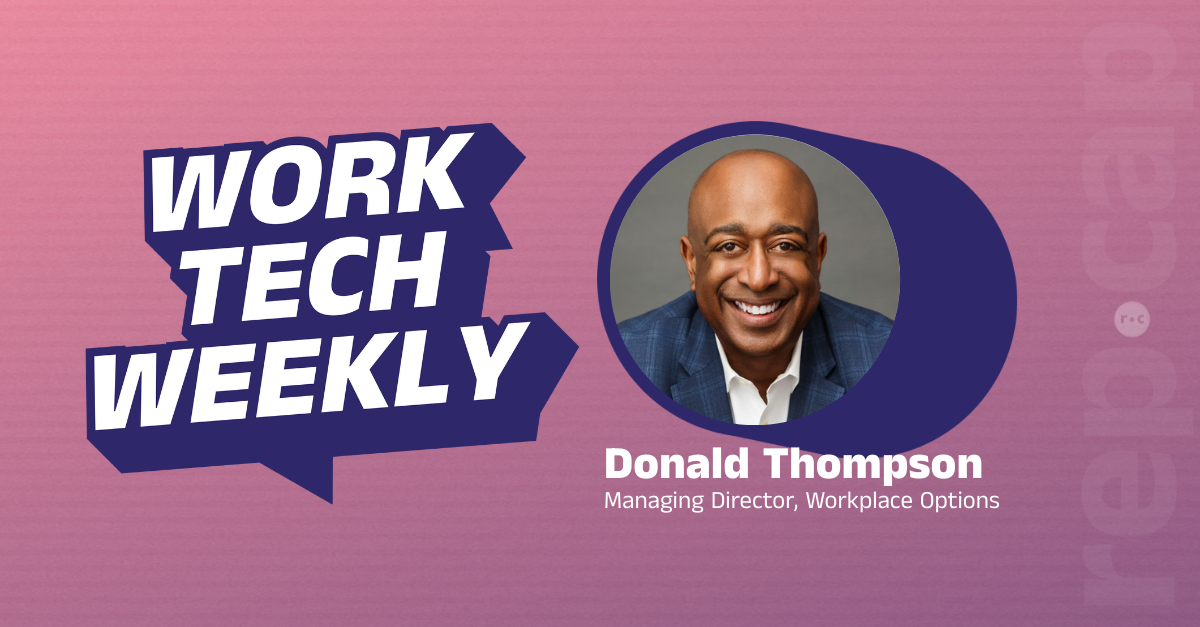
His diagnosis is blunt: the AI adoption gap is real, and most organizations are making it worse. "If you push adoption too fast — without education, without context, without real work redesign — you don't get efficiency. You get fear, uncertainty, and doubt. Which actively de-programs productivity."
The word de-programs is doing a lot of work here because that's exactly what the data is showing. New research flags that employers cutting headcount on projected AI gains — not demonstrated ones — are sitting on serious operational risk. The companies moving fastest on AI-justified layoffs may be the ones with the most painful reversals ahead. You can't backfill institutional knowledge with a prompt.
Meanwhile, ResumeBuilder data shows employers are also using AI adoption to freeze or cut worker pay. (CFO Dive) The productivity gains aren't flowing to workers. They're flowing to margins. Donald would call this exactly what it is: cost-savings math on a spreadsheet, without any real thought about implementation. The C-suite is doing Excel math. The workforce is absorbing the consequences.
And here's the scary part: Workers already feel behind. New data shows confidence in tech skills is dropping, and the gap is widening faster than L&D can close it. Donald's framing on this is sharp: You can't solve a real-time skills crisis with quarterly course catalogs. You solve it by meeting people where they are, with education first, then the business conversation.
The FedEx news is the timestamp on all of this. When a half-million-person employer starts treating AI agents as an actual workforce layer (not a pilot) the "this is still theoretical" argument officially expires. The template is being laid down right now. The question is whether your workforce strategy is built for what's arriving or what already left.
Donald's answer to the command-and-control CEO who wants 20% cost cuts, fast, no debate? Don't argue philosophy. Talk risk. Reputational risk. Performance risk. Information risk. "I do it with a smile," he told me. "But typically, they slow down because their self-interest is there."
That's not a hack. That's meeting people where they are, which, as Donald puts it, is the most important leadership skill in this moment. Speed is not the same as progress. AI can take you from zero to 70% fast. But someone still has to care about the last 30.
Give the full conversation a listen. It's worth your time.
What else is going on this week?
Workday, Sana Unveil Bold New AI Strategy
Workday's global launch of Sana is the biggest platform bet in enterprise HR tech this year. This $1.1 billion acquisition is now live for 11,500+ customers. The pitch: Sana replaces the old Workday menu navigation entirely with a conversational AI that can actually take action, not just surface information.
Funding and Acquisitions
-
Findem to acquire Glider AI. Talent discovery (Findem's strength) plus skills validation and AI interviews (Glider's core) equals a candidate who's sourced, screened, and verified before a human ever touches the process. It's also a data play: Glider's verified skills outcomes give Findem's matching engine better feedback loops than most competitors have. (Press Release)
-
Small and mid-sized startup purchases are still well below the 2021 peak. The M&A market for venture-backed startups hasn't snapped back the way bulls hoped. Deal volume for smaller exits remains depressed even as AI investment surges. For HR tech founders hoping for an acqui-hire or bolt-on exit, the window is narrower than the headline fundraising numbers suggest. (Crunchbase News)
-
Microsoft hires employees from Cove, a small Sequoia-backed AI startup that helps teams collaborate. Microsoft is still actively hunting for AI talent in workplace productivity, even with Copilot already deployed at scale. (GeekWire)
-
Ramp acquires Juno. This acquisition is less about the product and more about Ramp's stated goal of owning the full financial operations layer for modern companies. (GeekWire)
-
Viventium expands HCM platform with acquisition of Perks4Care. Viventium was already on an acquisition tear after buying Apploi in January and it now adds Perks4Care's caregiver-specific rewards and recognition platform to its post-acute care HCM stack. The smart design detail: recognition points follow the caregiver across employers, which matters in a workforce that changes facilities frequently and needs portable proof of appreciation. (Press Release)
-
eTip acquires Shiny Solutions to expand its end-to-end workforce engagement platform for the hospitality and service industry. The frontline workforce tech space is heating up fast, and eTip is staking its position before the big platforms box everyone else out. (Press Release)
-
Paraform raises $40 million Series B. The bet: expert human recruiters plus AI agents will consistently outperform either alone, and the market is starting to agree. (Press Release)
-
Edra raises $30 million Series A. The NYC-based workflow automation startup shows that there's still white space in talent and workforce tech despite the crowding at the top of the market. (FinSMEs)
-
Definity raises $7 million Series A. Healthcare-specific workforce management is attracting capital as the sector's labor challenges (turnover, credentialing, scheduling complexity) remain unsolved by horizontal HR platforms. (Press Release)
Industry Notes
-
Global tech hiring stays strong as U.S. sees Q2 improvement. The Experis Q2 outlook ticked up 8 points quarter-over-quarter to 41%. It's a stabilization signal, but still 5 points below year-ago levels, which tells the real story. The demand is there, it's just increasingly narrow: employers want AI, cloud, and data specialists, not generalist engineers. (Press Release)
-
Galileo Mars introduced with intelligent workflows, 1,100+ companies licensed. Josh Bersin's Galileo AI platform just crossed 1,100+ licensed companies, which is a real adoption signal for an AI-native HR advisory tool. (Press Release)
-
Online bot traffic will exceed human traffic by 2027, Cloudflare CEO says. For HR tech vendors and talent platforms, the implications for candidate traffic quality, job board economics, and apply-rate data are significant and mostly unaddressed. (TechCrunch)
-
UKG debuts AI-led workforce orchestration at UNLEASH, Transform. Here's an example of how AI actually coordinates across scheduling, compliance, and labor forecasting, not just surfacing recommendations. For WFM buyers, the question is no longer whether AI belongs in the stack; it's whose AI they trust with shift coverage decisions. (Press Release)
-
ICIMS expands talent platform with frontline AI and automation. The enterprise ATS market is quietly bifurcating with one track for knowledge workers, one for frontline. ICIMS is trying to win both. (Press Release)
-
BambooHR announces the launch of new services offerings. Buyers want implementation support and advisory wrapped around the software, not just a login and a help center. In a market increasingly crowded with AI-native competitors, stickier services relationships are a real retention strategy. (Press Release)
-
Dayforce expands partner ecosystem with Emburse and Docusign. As HCM platforms compete to become the default financial operations layer for mid-market enterprises, owning the ecosystem matters as much as owning the product. (Press Release)
-
TriNet raises dividend by 5.5% to $0.29. The SMB HR services market is generating enough stable cash that they're returning it to shareholders rather than betting it all on AI transformation. Not flashy, but worth noting. (Seeking Alpha)
-
Visier announces the launch of global partner program. In a market where buyers want analytics embedded in their existing stack, the channel matters more than ever. (Press Release)
-
As health insurance costs soar, CFOs seek ways to dull the pain. Health insurance is now one of the top line items keeping CFOs up at night, and the strategies they're reaching for (narrow networks, reference-based pricing, self-insurance) have direct implications for benefits teams and the employee experience. The benefits vendor market is about to get a lot more interesting. (Wall Street Journal)
-
Trusaic expands presence in European market with Ireland hires. Ireland is the gateway to the EU market for a lot of US tech companies. Are we seeing signals that global pay equity and transparency mandates are driving real commercial expansion? (Press Release)
-
Seattle puts Microsoft Copilot expansion on hold as new mayor takes stock. Government entities are starting to pump the brakes on enterprise AI deployments for political and budgetary reasons, not just technical ones. Every public sector HR tech vendor should be watching this. (GeekWire)
-
One Model reports record 2025 growth amid HR data blind spot. Most organizations still can't answer basic questions about their workforce because their HR data is fragmented, poorly governed and locked in siloed systems. Until that's fixed, AI-powered people analytics is expensive noise. (Press Release)
-
ZipRecruiter launches ChatGPT app for AI-powered job discovery. Whether this move generates meaningful conversion is the real test, but the channel logic is sound. (Press Release)
-
meQ announces the appointment of Brad Swingruber as CEO. (Press Release)
-
O.C. Tanner adds LinkedIn sharing to boost employee recognition. (Press Release)
-
Nucleus Research releases 2026 Enterprise HCM Technology Value Matrix. (Press Release)
-
Rivermate expands EOR services to enhance cross-border employment solutions. (Press Release)
-
Workable announces the launch of Workable Agent. (Press Release)
Worth Reading
-
Finance bros to tech bros: Don't mess with my Bloomberg Terminal. For enterprise SaaS vendors, this is a preview of the "AI-native upstart vs. deeply entrenched workflow" battle they'll all face eventually. (Wall Street Journal)
-
Thomas Otter: Comments on A16Z's "Why the world still runs on SAP." Required reading for anyone in enterprise HR tech. A practitioner's pushback on the VC framing adds real texture to the ongoing "will AI displace ERP or just run inside it" debate. (Substack)
-
Lance Haun: Why failure was on stage at Unleash. Here is a refreshing debrief in an industry conference circuit that tends to celebrate success theater. It's also a cultural signal worth tracking as vendors try to build trust in an AI-skeptical buying environment. (LinkedIn)
-
Employees had to restrain a dancing humanoid robot after it went wild at a California restaurant. This is either a terrifying preview of the agentic future or just the most 2026 thing that's happened so far. (TechCrunch)
