Musical accompaniment for this week's newsletter.
As Work Tech assembles this week on both sides of the North Atlantic for the annual migrations known as HR Tech and UNLEASH World, we’re no longer just moving the furniture around the room. We’re in a whole new world. When I land in Vegas this week, here are the questions I’m bringing.
1. Are frontier models here to partner? Or replace? The AI powers have been moving these pieces into place all year. Anthropic expanded Claude Cowork with enterprise plugins and private agent marketplaces. Google folded its agent tools into Gemini Enterprise, with connectors that reach into Microsoft 365, Jira and HubSpot. That’s competitors’ turf. Earlier this year, OpenAI launched Frontier, a platform for building, deploying and governing “AI coworkers.” Then it brought in McKinsey, BCG, Accenture and Capgemini to help customers redesign their work.
That makes all the Workday Rising news more interesting than it looked last week. More on that below. TL;DR: Workday is betting that employees can live in Claude while Workday keeps the data, the permissions and the transactions. Someone else owns the conversation. Workday keeps owning the rules.
Here’s the catch. OpenAI and Google are already building governance layers of their own. The idea that the labs handle the thinking while the incumbents keep the controls forever? That’s a lot of wishful thinking.
Still, let’s not write SaaS’s obituary. Again. The labs need the incumbents more than their pitch decks admit. Models don’t come with 20 years of payroll rules, compliance knowledge and customer configuration. A payroll error isn’t a hallucination you can apologize for. You can’t just say: Payroll sometimes makes mistakes. Check important info.
That’s the key question this week. The models are growing up. How ready for Prime Time are they?
2. What’s the future of point solutions? Suite vs. best-of-breed was HR Tech’s longest-running narrative thread. Every point solution seems destined to be an agent or an API now. Nothing else seems defensible. The real question is whose platform you plug into, and who decides it gets near your HR data. HR? IT? Security? My bet is most buyers can’t answer that yet. Then there’s the whole pricing angle. Per seat, per task, per outcome. How a vendor charges for its agent tells you who it thinks owns the customer. Then there’s the work design aspect. Is your product designed for a world where the basic unit of work is the task?
3. Who’s ultimately accountable? The elephant in the Expo Hall is Mobley v Workday. Who’s accountable when the AI or the agent gets it wrong? Answering that question, or at least avoiding the worst case, is creating a lot of human work. In G2’s data, 31% of buyers say employees spend six-plus hours a week overseeing agents. That’s a job design problem. Tomas Chamorro-Premuzic’s keynote argues AI will expose how broken our human systems already are. That’s the session I’d circle.
4. What does Paris look like from Vegas? I’m not talking about the Disney version at the center of the Strip. As I said, UNLEASH is running in Paris on the exact same days. I don’t buy that global HR Tech is decoupling from the U.S. But the rulebook is splitting. The EU pushed its high-risk AI hiring rules to December 2027 but didn’t shrink their scope. Colorado scrapped its AI law for a narrower one. I’m wondering how often “EU AI Act” comes up on the Vegas floor? If the answer is “basically never,” that says something.
See some of y’all in Vegas. Someone put twenty bucks on 26 for me.
What else is going on this week?
Rising Recap: Workday Stops Fighting for the Front Door
For 20 years, Workday’s whole business was becoming the front door to the enterprise. At Rising this week, it basically said: Meh, work wherever you want.
That’s the real headline out of Vegas. Not the shiny new Sana home screen and the agents. It’s the Anthropic deal, where Sana calls on Claude’s reasoning for individual steps and shares only the context that step needs, while the data stays put.
Claude does the thinking. Workday keeps the keys.
Then it bought C1.ai to become a central identity governance layer for people, money, and agents. Mark Vigoroso has the best metaphor going: Workday wants to be the notary of enterprise AI. It doesn’t need to own the conversation. It needs to stamp the paperwork.
Genius or surrender? Depends on whether you think the future is the interface or the rules.
Wall Street is already sweating the interface. BofA spent the week flagging AI interfaces as a long-term risk to software companies. But, as you see above, the incumbents are racing to own the keys. UKG announced a similar bet to Workday, going “headless” so frontline workers can start in Claude, Gemini, or ChatGPT while UKG enforces the rules underneath. ServiceNow shipped agent governance tools the same week.
From my newspaper days, I know what it looks like when you stop owning distribution. Usually it’s not great. But here’s the thing: this just might work. Rules are sticky. And more than a quarter of new annual contract value at Workday now comes from AI products. Early returns are positive.
Other POVs from Workday Rising:
-
HR 2030 is coming: The Josh Bersin Company partners with Workday. Smart business for both. Also raises questions for every buyer who reads Bersin’s research going forward. (Workday)
-
Lance Haun: Did anyone ask for this? Turns out, yes, customers. Lots of them, as long as the agents stay inside Workday’s permissions and nobody hands a SOX control to a bot. (LinkedIn)
-
Mike Wood road report. Mike thinks the sneaky headline is Work Intelligence, a friendly demo that quietly decides which jobs get automated first. (LinkedIn)
-
Mark Smith recap. Mark gives Workday credit for a more coherent architecture, then hands over the homework: prove it works end-to-end. (LinkedIn)
The AI Economy Now Has Two Failure Modes
Meanwhile, running in the background: IMF Managing Director Kristalina Georgieva said AI infrastructure investment is helping sustain global growth near 3%. IMF research estimates that roughly 40% of jobs globally — and 60% in advanced economies — could be augmented, downgraded or eliminated by AI. She also warned that gains could be uneven and that safeguards are needed. Economist Dani Rodrik framed the larger dilemma starkly: if AI delivers the anticipated productivity gains, labor disruption could intensify; if it does not, excessive data-center investment could trigger a financial correction.
This Week on the Work Tech Weekly Podcast
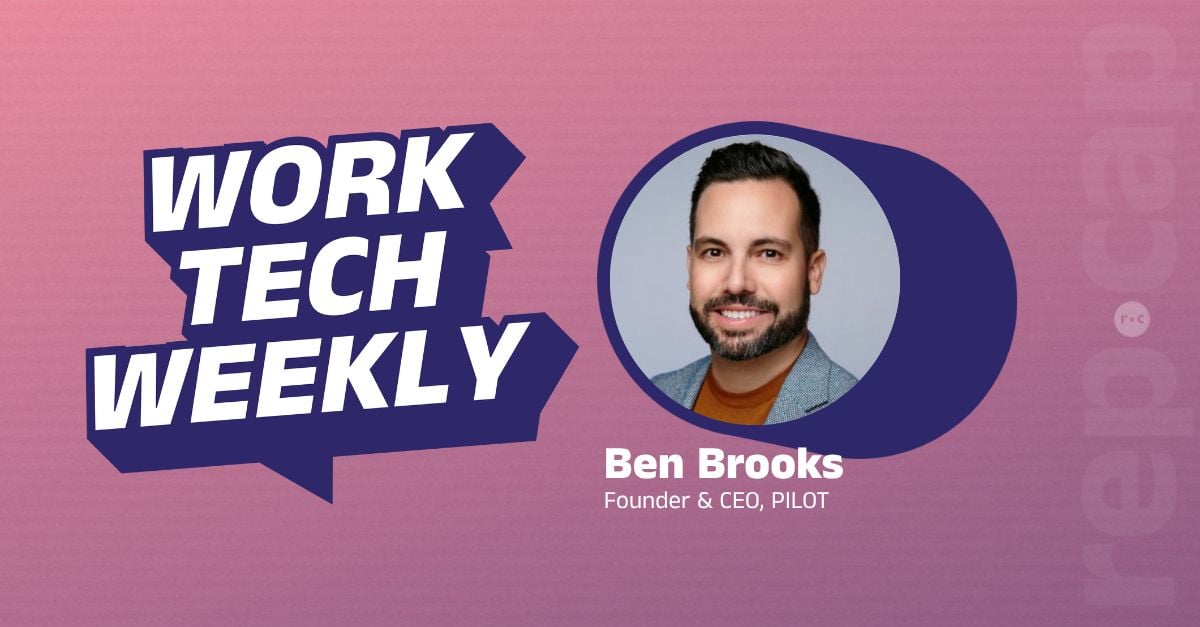
In the latest episode of Work Tech Weekly, I sat down with one of my favorite people in the industry, Ben Brooks, founder and CEO of PILOT. Ben says organizations have never really defined what good management looks like. Now AI is speeding up production, and the decisions nobody made are landing on managers. Give it a listen.
Funding, Acquisitions, and IPOs
-
Ramp raises about $1.85 billion at a $60 billion pre-money valuation. The round adds $16 billion to Ramp’s value in four months. Meanwhile, its closest rival, Brex, sold to Capital One for $5.15 billion earlier this year. This is less a funding round than a coronation. (FinSMEs)
-
Humanly acquires CareerArc to connect recruitment marketing with AI hiring. The high-volume hiring stack is getting rolled up one tuck-in at a time, and the people-to-product ratio on these deals keeps shrinking. (GeekWire)
-
HR Path acquires SnapAI to accelerate its AI strategy. SnapAI helps clients comply with the EU AI Act, which classifies AI used in recruitment, assessment and employee management as high-risk. (HR Path)
-
Gotham Growth CEO David Hain on HCM M&A: why buyers are buying and what to expect in 2027. A banker’s-eye view of the deal market. (WorkTech)
Industry Notes
-
Gusto enters the PEO market. Gusto is standing up a PEO — one of the biggest new bets in the company — and Benefits is the anchor. TriNet and Justworks just got a new neighbor who already knows everyone on the block. (Stream HR)
-
Rippling expands its New York City presence. More office space in the most expensive real estate market in America is a flex in a year when everyone else is “rightsizing.” (HR Tech Feed)
-
Checkr launches a Fraud Detection Suite. AI made applying free, and now somebody gets paid to sort out who’s real. (HRTech Cube)
-
Airtable’s new owner is laying off a “large part” of the team. Anyone could have seen this coming the day the deal was announced. The script never changes — just the logo. (Business Insider)
-
HR giant SHRM hit with a $400,000 verdict after rescinding a job offer over a service dog. The organization that calls itself “the trusted authority on all things work” lost its second employment-related jury trial in under a year. The ADA is literally on the certification exam. Oof. (Inc.)
-
The State of Interview Intelligence 2026. Kyle & Co puts some much-needed data behind this category. Worth the read. (Kyle & Co)
-
U.S. employers integrate health benefits ecosystems. Point-solution fatigue is officially a buying behavior. Expect a lot of benefits vendors to discover they’ve always been “platforms.” (Press Release)
-
“You need the humility to believe you haven’t solved it”: OpenAI’s CPO on fast decisions and the people side of AI. Humility is not the first word anyone associates with OpenAI. Which is precisely why it’s worth reading. (UNLEASH)
Worth Reading
-
Thomas Otter on UNLEASH Paris 2026. As you might expect, it’s honest, specific, and occasionally grumpy. (Substack)
-
Tami Nutt: There is a reckoning coming. Companies that will spend billions teaching a machine Linda’s job but wouldn’t spend $1,500 sending her to a conference aren’t investing in AI so much as finally admitting how little they valued Linda all along. (Substack)
-
Craig Hepburn: The talent we couldn’t see. AI didn’t create a new class of brilliant misfits; it just made it cheap enough for the ones you’ve been ignoring to build the thing you wouldn’t fund. (Substack)
-
Getty Images was worth $4.8 billion four years ago. Now it’s filing for bankruptcy. Enterprise value can vanish in a flash in the AI Era. (Fast Company)
