Musical accompaniment for this week's newsletter.
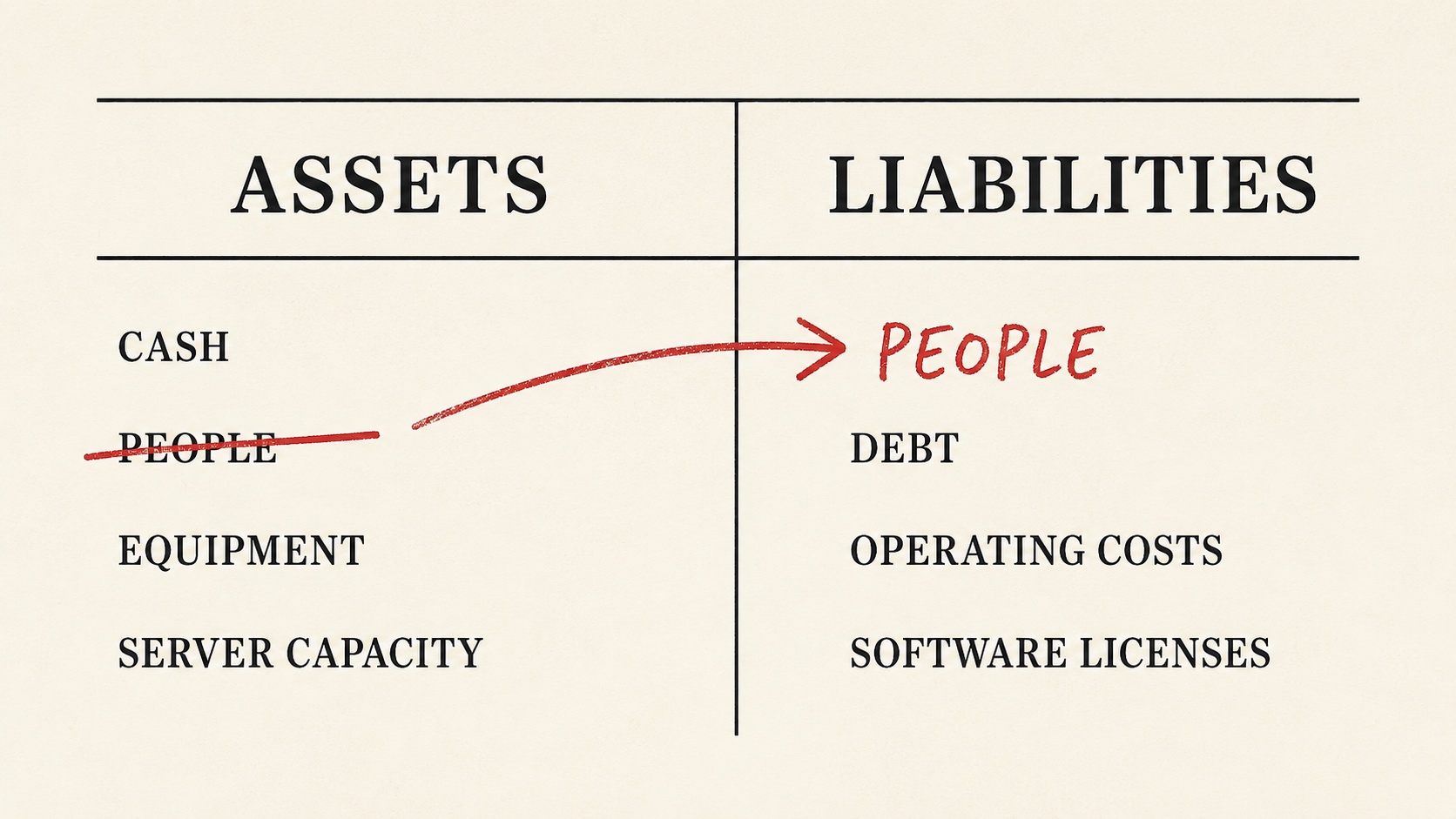
The fiction that Work Tech embraces is that old cliché: People are our most important asset. That’s never been true. Businesses will stockpile assets beyond their need, whether you’re talking cash reserves or server capacity, when holding it is cheap and running out is expensive.
Nobody does that with headcount. It’s a cost dressed up as an asset. Back in the days when Work Tech was still really just HR Tech, we loved this idea. It allowed The Man to pretend they weren’t The Man. People are our greatest asset? This was a turn of phrase that didn’t cost anything until the actual behavior it was supposed to describe disappeared. That’s where we are right now.
Consider two stories running side by side this week: the million-dollar company running on one employee and the $1 million job listing for a marketing department of exactly one human plus 3,000 agents. (And, no, it’s not the same guy.) The Solo Superhero has been the unspoken dream that employers have been pursuing in the AI Era. That’s the leanest possible workforce. In this world, the business is the greatest asset, not the people.
From a people empowerment standpoint, the one-person company with seven figures plus in revenue is the solopreneur dream, the ultimate freelancer flex. To anyone who can do this, more power to you. Just don’t post a bunch of BS in the socials about how you’ll share your proven process if we just comment on your post. We’re all wise to that nonsense.
Click Up’s million-dollar CMO story isn’t as clear-cut. Let’s call it for what it is — a gimmick, an attempt to reframe the market narrative after buzzsaw layoffs. Besides, if anyone can deliver on that job description, why not just go the solopreneur route?
The irony is that just at the moment this tantalizing AI fantasy seems within reach, the job market reality is going full-on Lee “Not So Fast, My Friend” Corso. There’s a sense that AI agents are an ineffective, unmanaged workforce. Big employers seem to be hiring again after years of treating it like an expensive last resort.
Gallup says organizational AI adoption is up six points this quarter. Employee engagement? Flat. Companies have been deploying the tools faster than they're figuring out what to do with the humans standing next to them, which, as Geoffrey Moore points out, is a leadership failure. For now, AI displacement isn’t happening. Employers still need people. On one end, electricians and carpenters, recruited by AI companies "by the thousands," per The New York Times, because somebody has to wire the data centers that make the whole AI economy run. On the other, 20-something math prodigies commanding eight-figure packages to build the models in the first place. Infrastructure and IP. The physical layer and the intellectual layer.
What about increased junior-level hiring? Lattice CEO Sarah Franklin offered her perspective that companies are hiring juniors again; she says it turns out AI agents still need adult supervision. Fair enough. But an HR platform CEO has a vested interest in that narrative. I hope it’s true, but I'll believe the junior comeback when the actual hiring numbers show a little more “there” there.
I believe that a corner has been turned. I believe that the pendulum that has swung all the way toward employers is swinging back toward employees. But belief and four bucks will buy you a terrible cup of coffee at Starbucks. Time will tell if this is just another self-deluding fiction.
What else is going on this week?
Tech Earnings Report Card: Variability and Volatility
Same week, wildly different report cards. Microsoft's stock jumped 16%, adding roughly $450 billion in market value — the biggest one-day gain for any U.S. company on record. Meanwhile, Apple and Meta slumped while Amazon surged.
The fine print explains the variability. Microsoft's Azure crossed $100 billion in annual revenue, growing 43% in the quarter, which seems like an indication that AI infrastructure spend converts into actual dollars. Oracle's making the identical bet on a much shakier foundation. The NYT profile of Larry Ellison notes nearly half of Oracle's $638 billion backlog may ride on a single tenant, OpenAI. Same thesis, crazy different risk profile.
Investors are done extending the benefit of the doubt on AI spending. They want proof, and the ones falling short are getting punished. Back on Planet Work Tech, ADP didn't need proof of anything new with a steady 17% EPS growth, solid guidance, zero drama, and zero fanfare. Boring looks pretty appealing these days. Certainly more appealing than ServiceNow, which has been not-so-quietly spending down its own internal trust. Bill McDermott's own line applies here — trust is earned in drops, lost in buckets. Microsoft's buying trust in bulk right now. Oracle's spending it. ADP never touched the meter.
Are Employee Benefits Reaching a Breaking Point?
August is the traditional start of open enrollment season for benefits in the U.S., and the forecast is looking a little bleak. A new Segal survey projects health plan cost trends to reach 15-year historic highs, driven by GLP-1s, inflation, AI, and surprise billing arbitration. Employers are reaching the limits of what they can do to keep costs from overwhelming employees. Meanwhile, employers keep stacking benefits programs employees don't use. What’s going on with the utilization gap?
This Week on the Work Tech Weekly Podcast
A $4,000 bill. That’s what one woman was billed instead of just a $100 co-pay after a true emergency was miscoded. And no one caught it.
Nataly Youssef's point isn't that the employee didn't know better. Figuring out a coding issue falls outside of most people’s expertise. And that’s before the time and hassle involved. So people pay what they're billed … and overpay as a result.
Nataly built her company, Reclaim Health, around a different assumption. Employees don't need a better explanation of their benefits. They need every claim reviewed automatically, with someone already acting on the error before it becomes a decision the employee has to make alone. That someone is AI. Listen now!
Transactions
Banks are in talks to lend $15 billion for an Anthropic data center backed by Google. The same week a Silicon Valley backlash against Anthropic is reportedly brewing, the banks are writing the biggest check of the cycle. Evidently, conviction and skepticism are running on completely different timelines. (Wall Street Journal)
PEX raises $160 million in funding. Is there room for another payments/expense platform? Evidently, yes. (FinSMEs)
LearnVector receives $100 million investment from Coursera. This is the week’s biggest headscratcher. What’s the strategy behind this? Seriously. It doesn’t make sense. (FinSMEs)
Gravie closes a new funding round. Benefits-tech keeps pulling capital even as the broader "AI HR" funding narrative cools — health and benefits infrastructure is proving to be the boring, durable bet. (FinSMEs)
Healia raises $14 million Series A. Another health-adjacent Work Tech bet in a week full of them. Interesting angle: a healthcare benefits platform for dual-income families and employers. (FinSMEs)
Buildforce raises $10 million Series A. Staffing for electricians powers up as AI infrastructure needs skills to pay the bills. (HR Tech Feed)
The Access Group agrees to acquire Talent Funnel. Another ATS/staffing-adjacent roll-up. (The Access Group)
Industry Notes
LinkedIn is done pretending AI posts are harmless. The platform that launched a billion humblebrag posts is realizing that there is a slop crisis. (The State of Brand)
How "no tax on tips" is starting to disrupt frontline-first companies and workers. A tax policy quietly reshaping frontline compensation strategy. (Josh Bersin)
Executive moves: It’s been a busy week across Work Tech:
Darwinbox names Chaitanya Peddi as new co-CEO. Co-CEO structures are having a moment across Work Tech right now. (LinkedIn)
Allvia adds Chris Michalak and Larry Dunivan as independent directors. Two industry veterans joining the board is usually the quiet signal a company's prepping for something bigger. (HRTech Cube)
Scale AI announces Francis deSouza as CEO. (LinkedIn)
Sapiens appoints Paul Wheeler as CEO. (Sapiens)
ZipRecruiter names Carmen Chan as CFO. (Press Release)
Illumia appoints Eric Schuster as CPO. (Illumia)
Freelancers rethink Upwork and Fiverr as fees bite. Freelancers are asking gig platforms whether the toll is worth paying. (Self Employed)
Businessolver introduces AI-powered client onboarding and a universal data gateway, cutting implementation effort 40%. (Press Release)
Workera launches proctored assessments to power high-stakes hiring decisions. (HRTech Cube)
Apply Government Solutions launches a new brand. (HRTech Cube)
Worth Reading
This Dutch bookseller thought a request for 3,000 copies was 'spam or phishing.' Instead, AI companies are scanning and destroying books to train AI. The most specific, quietly damning AI-training detail of the week. This one sticks with readers longer than another funding round will. (Yahoo)
What would it mean for AI to be wise? A rare piece asking the right question instead of the usual "will it take my job" framing. (LinkedIn)
a16z: Marc Andreessen's reading list. It's less "here's how I think" and more "here's how I'd like you to think I think." It reads less like a syllabus and more like a Rorschach test for late-stage capitalism. (LinkedIn)
Being on video is making us hate ourselves. The Zoom-fatigue essay finally goes existential. Worth it for anyone who's caught themselves staring at their own face mid-meeting. (The New York Times)
One last thing: RIP Glen Hansard, gone too soon. As this piece makes clear, a good song matters. And he wrote a few.
