Musical accompaniment for this week's newsletter.
Agents are commoditizing fast. Every Work Tech vendor is touting one, and every keynote promises it “understands your business.” The part that nobody can fake is the context underneath: What work actually gets done, who’s done it, how people feel about it.
That’s the real land grab, and two vendors placed opposite bets last week.
SAP went walled garden when it agreed to acquire TechWolf. As Stacia Garr from RedThread Research explained in her excellent instant analysis of the transaction, this was about platform more than product. In the AI era, this base unit of work is the task, and TechWolf allows SAP to map the work people do, the skills they have, and the external labor market using what it calls a context graph for work. SAP’s own pitch is that the graph makes token usage more efficient and lowers the cost of deploying workforce agents. In short, SAP is saying, “we own the evidence, so our agents are cheaper and smarter than yours.”
BambooHR went the other way. Its new Claude connector lets users ask questions about HR data, pull reports and take action in plain language. That’s a bet that the foundation model becomes the interface and the HRIS becomes the best-stocked aisle in someone else’s store.
Everyone else is betting somewhere in between. LinkedIn’s Hiring Assistant 2 runs on memory, and that memory raises both the value of staying and the cost of leaving. Alight bought Abett to unify benefits data. Perceptyx is piping listening data into enterprise AI, with an admirably blunt caveat that connecting AI to employee data doesn’t mean the AI can interpret it.
Perhaps the bigger question is The Field of Dreams question: If you build it, will they come? There’s another new report that sounds like a lot of new workforce research reports these days. AI capabilities are a priority for 83% of employers, but only 29% say they’ve built mature AI capabilities. Nearly four in five lack a strong mandate to lead AI upskilling. A separate report has 78% of managers using AI in performance reviews, but only 16% of employees aware of it.
So, everyone agrees it matters, but nobody’s sure whose job it is.
It also raises the question that HR Executive brought up citing Businessolver research about whether CHROs are mistaking employee concern for excitement. If people are adopting AI mostly to prove they’re not replaceable, the usage dashboard looks great while the culture curdles faster than that Pumpkin Spice creamer in your fridge.
Craig Hepburn nailed it in one line: everyone is adopting AI, almost nobody is absorbing it. Adoption is a license count, a SaaS-era relic. Absorption is changing how work actually gets done, and no vendor can sell you that.
Zoom out and the stakes get bigger. McKinsey estimates about 11 million U.S. workers may need to switch occupations by 2035. The model is less doom-y than the headline. It points to net job growth. But it implies about 3.6 times the historical pace of occupational switching. That’s a lot of starting over.
Leadership is measuring adoption. Workers are living absorption. The space between those two numbers is where trust goes to die.
What else is going on this week?
Give Credit Where Credit Is Due
Year one of enterprise AI ran on that convenient fiction that everything was basically free. Year two is when the invoices arrive.
Start with Figma, which just did the thing every SaaS vendor is quietly modeling. Its design agent moved from beta to general availability on Oct. 6, and it now consumes AI credits. The agent was popular. It was also expensive to run. And guess who’s covering that now.
In a related and completely unsurprising headline, the WSJ reports that businesses can’t predict their AI spend because token bills don’t behave like seat licenses. So, CFOs who spent a decade taming SaaS sprawl now have a usage meter that spikes whenever someone gets curious.
Then there’s the headcount line. Workday is cutting roughly 500 jobs, its second round of layoffs this year, mostly in product and technology. So, “the AI made me do it” defense. HubSpot cut nearly 660 jobs. CEO Yamini Rangan went out of her way to say the move was “not driven by AI-related efficiencies.” Maybe so. But when you have to say it, you know what everyone’s thinking.
And once agents are doing real work, someone has to guard them. Rein Security just raised $25 million to secure enterprise AI agents at runtime. That’s a new budget line that didn’t exist 18 months ago.
That’s the AI Era’s uncomfortable calculus. AI costs don’t disappear. They shift. Sometimes into the vendor’s margin, sometimes into the customer’s budget, and sometimes out of the workforce. The big question will be whose line item absorbs it. That’s when the oldest adage in marketing comes into play: The large print giveth, and the small print taketh away.
Payroll Was the Beachhead. The Paycheck Is the Prize.
For years, HCM vendors fought over payroll. Turns out payroll was just the beachhead. The real prize is everything that touches the paycheck: expenses, compliance, benefits, wages on demand. This week, nearly every corner of the market moved toward it.
Personio made the boldest move. Its acquisition of Circula is the largest in Personio’s history, bringing more than 3,000 customers and about 250,000 users. The pitch is “everything a company spends on its people, under one roof.” Factorial should be taking notes.
Gusto went up the services stack. Business Compliance arrives about six months after Gusto bought compliance automation company Mosey, alongside HR Partners and its own PEO. That’s a direct shot at Justworks.
UKG is building a frontline fintech ecosystem. Cash App just joined partners including Payactiv, ZayZoon and OnePay inside UKG’s platform. Earned Wage Access, banking and direct deposit, all living where hourly workers already clock in.
Then there’s the vertical play. Miter says roughly two of every 100 U.S. construction workers are now paid through its platform, and it just raised $40 million to grow that number. Horizontal HCM may have won the office, but the jobsite is still open.
The logic is simple. Whoever owns the money moment owns the relationship. Workers check paystubs more often than they open the LMS.
The skepticism is just as simple. Suites that try to do everything tend to do most things adequately. And embedding fintech into the time clock raises a question EWA has never fully answered: does it fix paycheck volatility, or just make it more convenient?
For buyers, consolidation means fewer vendors and more lock-in. Choose wisely.
This Week on the Work Tech Weekly Podcast
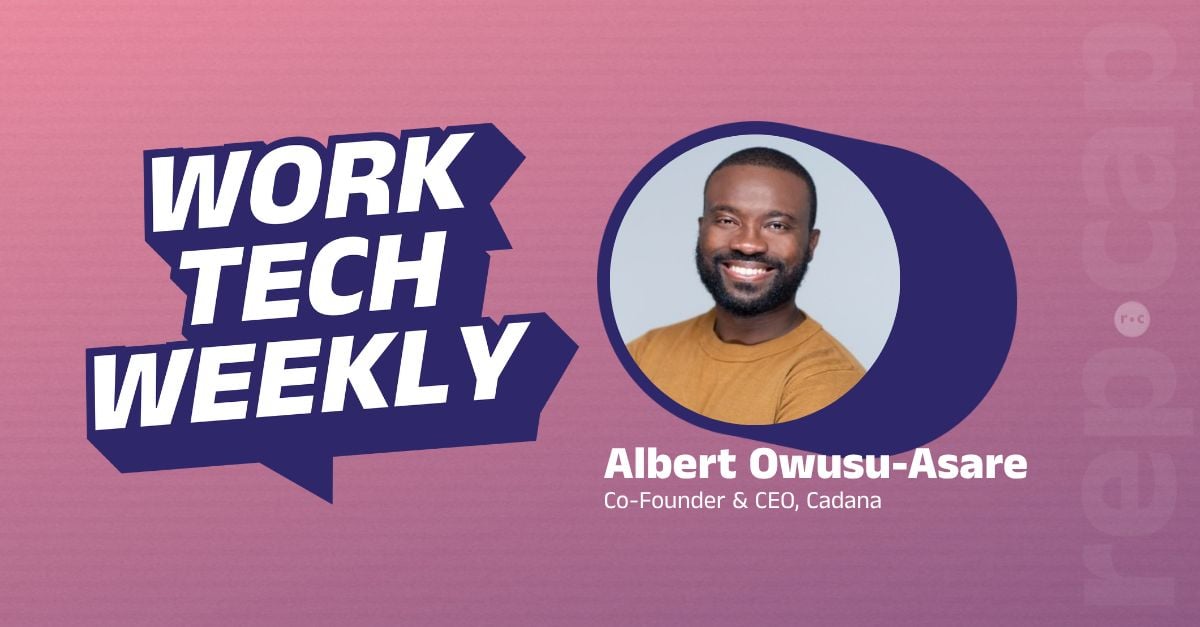
In the latest episode of Work Tech Weekly, Albert Owusu-Asare says that's where international payroll has the most room to improve. Getting the calculation right is half the job. The other half is moving the money through a chain of banks that can take 5 to 7% of it along the way.
Albert is co-founder and CEO of Cadana, which builds global payroll and payments infrastructure for Work Tech platforms. On this episode, we get into the last mile of international payroll, from local payment rails to where stablecoins fit in. LISTEN NOW.
Transactions
-
Armanino acquires HCM consultancy Sability. Accounting firms buying HCM implementation shops is the consolidation trend nobody’s posting about. As HCM gets more AI-heavy, the services layer is getting rolled up too. (DHRMap)
-
Juicebox acquires Fetcher’s assets. Note the word “assets.” Customers can switch to Juicebox, but the deal does not carry their accounts, pipelines or integrations across. AI recruiting’s shakeout has arrived, and it looks less like a merger than an estate sale. (Fetcher)
Industry Notes
-
Workday named a Market Shaper in Gartner’s 2026 Emerging Market Quadrant for AI agents in HR. Nice badge. It lands days after Workday disclosed cuts concentrated in product and tech, which is its own kind of market shaping. (DHRMap)
-
Deloitte and Thrive Global partner on health and well-being. Wellbeing is getting bundled into consulting engagements. That’s either how it finally gets taken seriously or how it becomes another line item on the transformation SOW. (HRTech Cube)
-
Inspiring Workplaces spotlights global HR tech with the WorkTech Awards. (Inspiring Workplaces)
-
Executive Moves: Bill Mastin joins NuHQ as CEO. Atlas HXM appoints John Fennelly as CEO. Dayforce appoints Jake Varghese as chief product and technology officer. Josie Sutcliffe joins ChartHop to lead marketing.
Worth Reading
-
A new era of talent assessment and candidate selection. Steve Hunt has spent a career on the science of hiring. When he says the assessment playbook is changing, that’s worth your time. It matters even more when AI makes every application sound equally polished. (Steve Hunt’s Substack)
-
Even woman-presenting AI bots get “paid” less. A University of Limerick study found female AI agents received 10.25% less pay than male agents built on the same technology. Even bias moves faster in the AI Era. (HR Dive)
-
Lars Schmidt on what it’s like to work at Anthropic. You can trust Lars to be thoughtful. (LinkedIn)
-
When AI shopping agents go wrong. Consumer agents are the canary for enterprise ones. If an agent can’t reliably buy the right thing, think hard before you hand it requisition approvals. (Wall Street Journal)
