Musical accompaniment for this week's newsletter.
Upwork has a new kind of client. It doesn’t have a LinkedIn profile or a procurement process. It doesn’t have a pulse, either. It’s an AI agent, and it’s hiring humans.
Yep. Tech companies are all-in on agents, if you haven’t heard. We saw a lot of that last week: Salesforce agreed to buy Cresta for a reported $2.7 billion. Five9 bought Level AI for $325 million. CrowdStrike paid a reported $495 million for two companies that test agents, watch them and, when needed, shut them off. Dropbox spent roughly $350 million to become storage for AI agents. The TL;DR: Native AI capability seems hard to build quickly inside mature platforms, so incumbents are opting to buy rather than build. It’s full-speed ahead. LFG.
But employees? The people who get to work with and for those agents? Yeah, they are a lot less all in. According to Gallup, more workers fear their job could disappear within five years. And Pew found that 71% of Americans now expect AI to mean fewer jobs over the next two decades, up from 64% in 2024.
Last week, those employees went to the polls in the U.S. To be fair, Americans were in a bad mood about a lot of things. That anger stemmed from a lack of control. In that sense, AI was definitely on the ballot. Their fears about losing livelihoods, their fears about data centers, their fears about things that are happening to them – all showed up in the results.
Democrats won both chambers of Congress. President Trump keeps the veto, so a national AI law is a long shot. Oversight is not. Incoming committee leaders want AI executives testifying under oath, and bills like the No Robot Bosses Act, which targets automated workplace decisions, now have a path to hearings.
For two years, the distance between boardroom enthusiasm and employee hesitation was seen as a change-management issue to smooth over. The people who will actually work next to those agents are a different audience with a different take: LNFG.
In Upwork’s agent channel, the bot isn’t replacing the freelancer. The bot is hiring the freelancer. CrowdStrike’s plans for its acquisitions include a rollout plan and, my favorite detail, an AI kill switch when one starts doing dodgy s#!t.
You don’t buy a kill switch for a tool. You certainly don’t buy one for a coworker. You buy one for a robot with system access and questionable judgment.
If you’re a Work Tech vendor taking agents to market, get ready to sell to the skeptics, not just the true believers. The voice of the employee will be a bigger elephant in the room for every buying committee. Get ready for a lot more GTM friction.
What else is going on this week?
Canva Faces A Gut-Check Moment
Canva announced restructuring changes affecting 1,271 employees, or 22% of its workforce. CEO Melanie Perkins said Canva’s growth slowed for the first time in a decade and that new technology is changing what users create and expect from products. Canva occupies an increasingly exposed layer as image generation, presentation creation, and basic design become native functions inside Gen AI. That doesn’t make Canva obsolete. It does mean the company must justify why users need a dedicated design platform after the assistant can produce a competent artifact directly.
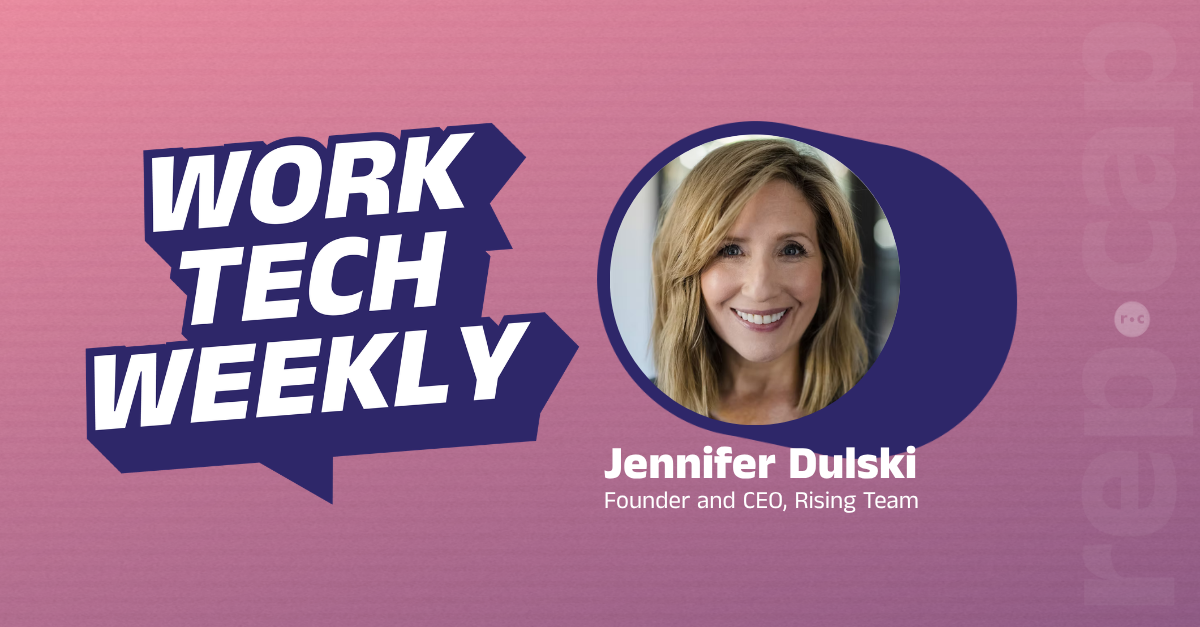
This Week on the Work Tech Weekly Podcast
In the latest episode of Work Tech Weekly, I sat down with Jennifer Dulski, founder and CEO of Rising Team, to talk about who should be management. Plenty of first-time managers took the job because it was the only way to keep growing their career. Some of them never wanted to manage, and first-time managers get very little support either way. Jennifer thinks both problems can be fixed now. LISTEN NOW
Transactions
- Arena lands $4.5 million to accelerate workforce mobility. The Baltimore company uses career data from more than four million people to predict who’ll succeed and stay in a role, and it’s now aiming that engine at public-sector workforce and education systems. A modest check for a company that’s been around this long reads less like a moonshot and more like a pivot to where the buyers are. (HR Tech Feed)
Industry Notes
-
Is AI taking white-collar jobs? What the latest numbers tell us. The vibes say “white-collar apocalypse.” The spreadsheets keep saying “Definitely? Maybe?” The aggregate 2026 hiring picture looks stable, but entry-level professional jobs are down 29% since January 2024, which suggests the real damage is at the bottom rung of the ladder. (Wall Street Journal)
-
How the data center backlash could play into the hands of Big Tech. The counterintuitive angle is that tougher rules and longer permitting tend to favor whoever has the deepest pockets and the most lawyers. (Wall Street Journal)
-
HR Tech 2026: Madeline Laurano’s key trends and providers to watch. Worth reading for who got real buzz versus who just had the biggest booth. (Aptitude Research)
-
New Businessolver research finds CEOs and CHROs expect empathy to cost them authority. Here’s the paradox in one stat pair: 99% of CEOs say empathy drives business results, yet 59% of CEOs and 51% of CHROs expect to get challenged when they lead with it. Everyone agrees empathy pays. Almost nobody feels safe actually doing it. (Press Release)
-
Can an AI agent be your next CMO? At some small startups, it already is. Some of the so-called lean startups run specialized agents as their heads of growth and design, with SaaStr among the examples. It works. To a point. (Wall Street Journal)
-
After SuiteWorld 26: the autonomous suite is here. NetSuite founder Evan Goldberg declared the end of ERP as we know it and rolled out 45+ SuiteSkills toward an “autonomous suite.” Of course, most of this “is on the roadmap.” (LinkedIn)
-
Leapsome’s agentic HR platform now covers hiring. The pitch is a closed loop where performance data tells you who to hire next. That’s a direct shot at the “best-of-breed ATS plus everything else” stack. (Press Release)
-
Culture Amp introduces Enso. The smart design choice is that it won’t report on individuals to their managers. That one guardrail is the difference between “culture tool” and “surveillance tool.” (Culture Amp)
-
candidate.fyi launches agentic hiring platform. The interview-scheduling specialist is going up-stack. Its agent already handles over 80% of scheduling requests end to end.. (candidate.fyi)
-
Talroo to relocate Austin HQ to One Uptown. The talent-matching platform is leasing nearly 10,000 square feet after an executive-led search that took more than two years. (HR Tech Feed)
-
Chime expands partnership with Workday. Payroll is the most powerful distribution channel in consumer fintech, and Workday controls the onramp. (Press Release)
-
Cisive appoints Brian Matthews as CEO. The former itel chief brings two decades of data and tech experience and succeeds Margaret Keane, who stays on Cisive’s board, and brings two decades of data and tech experience. (Press Release)
Worth Reading
-
David Brunner: The future of work may be brighter than feared. The real workforce question isn’t “Will AI replace people?” It’s “Will organizations redesign work so AI compounds human capability instead of eroding it?” (Industrializing AI)
-
Stacia Garr: Workday is building fast. Its customers will set the pace. Workday is now explicitly moving like a startup, but enterprise customers adopt on enterprise timelines. Shipping agents is one race. Getting 11,000 HR teams to trust them is a different one. (LinkedIn)
-
Will AI throttle the retirement money machine? AI’s ripple effects are reaching the 401(k) economy. If AI destabilizes jobs, affected workers may face more leakage, interrupted savings, or involuntary early retirement, and that’s a benefits story HR can’t ignore. (Wall Street Journal)
-
The Geo-Located Generation. What constant surveillance is doing to parents and children. (The Atlantic)
