Musical accompaniment for this week's newsletter.
The headline number landed with a thud last week: tech job postings at a three-year high. Recovery narrative confirmed. Green shoots everywhere. Get your AI of choice to spin up a slide deck. Woo.
Don't buy it.
Look one layer beneath the dashboard, and the story gets considerably messier. Entry-level hiring — the intake valve for every talent pipeline worth having — is, by most accounts, broken. Not "underperforming." Not "facing headwinds." Broken. The combination of AI-generated applications flooding the top of funnel, hiring freezes that quietly never ended at the junior level, and a generation of new graduates who can't get a first call is producing a market that looks healthy in the aggregate and feels catastrophic up close.
Then there's LinkedIn. The platform that sells the labor market narrative — the one whose data gets cited every time someone needs to prove the job market is fine — just cut 5% of its own workforce. Engineering and product roles, specifically. While posting record quarterly revenue. LinkedIn isn't struggling. LinkedIn is optimizing. And what they're optimizing away is human headcount, in the same week they shipped new AI enhancements to their Hiring Assistant product. The irony isn't subtle: the tool replacing recruiters is being built by a company that just replaced some of its own people to fund it.
Meanwhile, a federal lawsuit dropped that should be getting more attention than it is. The allegation: that most of the online resume market that job seekers trust to distribute their credentials and employers trust to surface candidates is actually one company operating under multiple brand names.
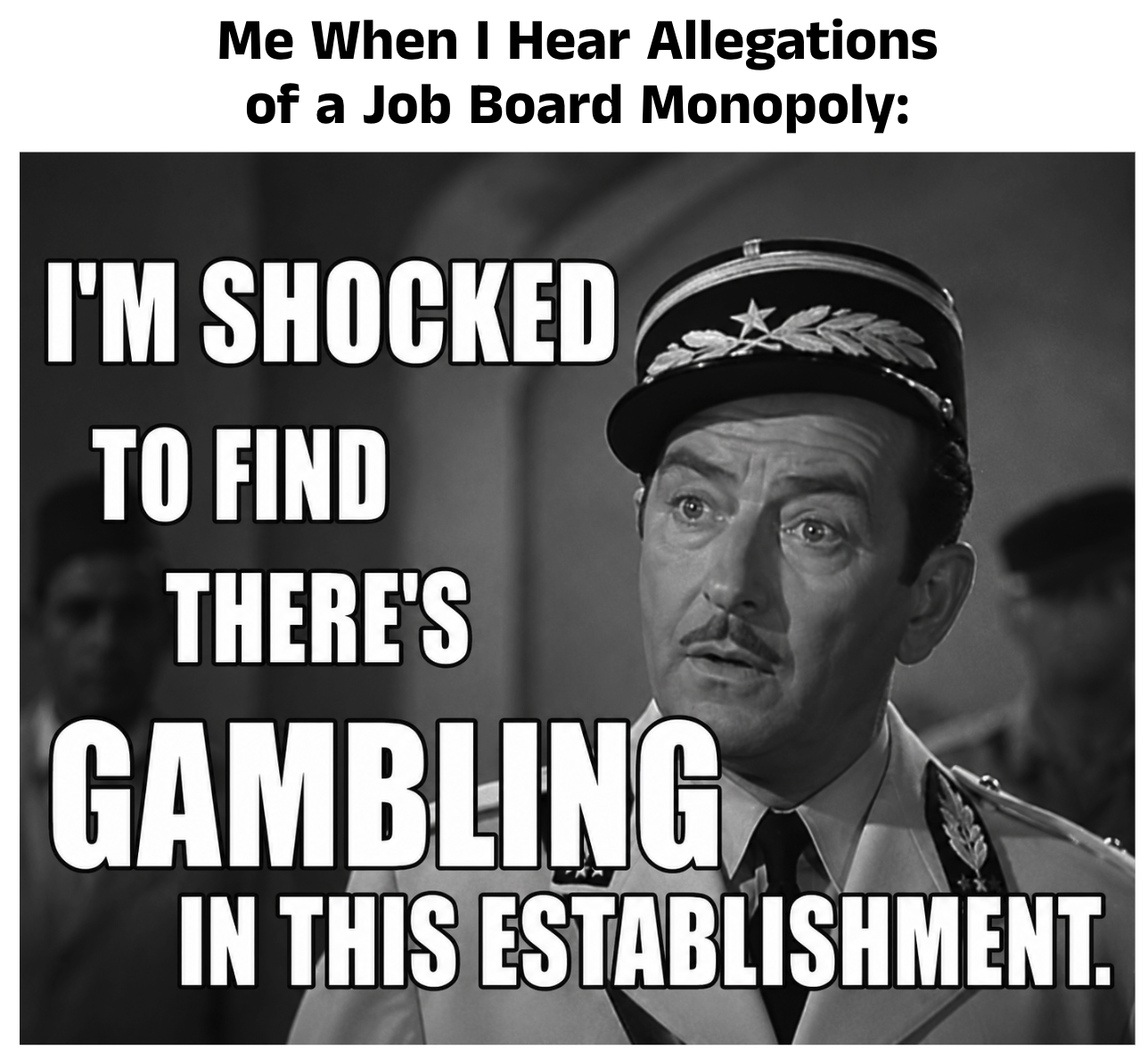
If true, it means the infrastructure of the modern job search is a competitive illusion. Not a marketplace. A monopoly in a costume.
And then there's the talent going the other direction. China's best and brightest tech workers, the ones who spent years building their careers in Silicon Valley, are heading home. Not trickling. Going. The combination of geopolitical friction, better opportunities in a Chinese AI ecosystem that's moving fast, and a U.S. immigration environment that makes long-term planning difficult has flipped the calculus for a meaningful cohort of senior technical talent. You don't feel that in the job posting numbers. You feel it two years from now when certain teams can't fill certain roles.
Then there's Gen Z. They aren't disengaged. They're scared. And some of them are fighting back in ways that are going to make your HR head hurt. According to a recent report from Writer and Workplace Intelligence, 44% of Gen Z workers admit to actively sabotaging their company's AI rollout. Feeding proprietary data into unauthorized tools. Deliberately producing low-quality work to make AI look bad. Skewing performance review results. Nearly half of a generation, running a covert resistance campaign from inside the org chart.
Here's the brutal twist: it's backfiring. The same report found that workers leaning hard into AI are three times more likely to have gotten a promotion or raise in the past year. AI "super-users" are saving nearly nine hours a week. And 69% of executives say they're already considering laying off employees who won't adopt the tools. The fear of being replaced by AI is producing exactly the career outcome the resisters were trying to avoid.
So you've got a generation entering the workforce in a broken entry-level market, watching colleagues get automated out, and responding with sabotage — only to find that the sabotage accelerates their own obsolescence. That's not a talent strategy problem. That's the trust problem at the heart of the modern workplace.
And it runs deeper than one generation's anxiety. The resume market lawsuit matters not because it will necessarily succeed in court; it matters because it feels true. That's what a collapse of trust looks like. Not a scandal. A shrug.
Every one of these news stories is a line item in the same ledger: the social compact between employer and employee — the unwritten agreement that if you show up, work hard, and play by the rules, the system will work for you — is broken.
A market built on a foundation people no longer trust is not a healthy market. It's a platform with a bad line of code running underneath everything — invisible until it isn't, and then it's very hard to fix.
What else is going on this week?
AI Populism Is Here. Buckle Up.
Last week, we covered Galloway versus the data and a16z versus the anxiety. This week, the backlash went structural.
The NYT isn't running think pieces about whether AI will disrupt work anymore. It's running pieces about AI populism as a political force. When the newspaper of record frames your industry's flagship technology as a populist grievance, you've left the hype cycle and need to start worrying about torches and pitchforks.
Meanwhile, Gartner quietly surveyed 350 large enterprises and found them cutting AI research budgets. Why? Because they found no correlation between AI-driven layoffs and improved ROI. At all. Mind you, they're still buying AI products. They just aren't getting too dialed up about whether any of them are actually working. That's cognitive dissonance at enterprise scale.
Then there's Meta. The Former Undisputed Champion of the Rest and Vest ethos pretty much sounds like an AI workplace hellscape these days.
And California's governor just proposed a new tax targeting cloud-based software sales. Thanks, Governor Good Hair. I'm sure that won't have an impact on jobs at all.
The populist moment isn't coming for the tech industry from the outside. It's already inside the building.
Workday Makes Five Bets. The Clock Is Running.
The 2026 Workday Innovation Summit produced a clear message: here are our five bets, here is where we're going, hold us to it. Admirable transparency. Also a hostage to fortune. Here's Stacia Garr's excellent breakdown.
The Microsoft partnership is real — embedding Workday's Sana agent directly into Microsoft 365 Copilot is a meaningful distribution move. But when your growth strategy depends on living inside someone else's interface, that's not platform dominance. That's platform dependency with better branding.
The bets are placed. The chips are on the table. See y'all on the next earnings call.
- RELATED: SAP's third bet-the-company moment. Can they pull it off without Plattner? The generational leadership question underneath the AI strategy question: SAP has reinvented itself twice before, but never without its founder in the room. Whether that matters is the more interesting debate. (LinkedIn)
Transactions
-
Ashby acquires Talent Llama. The ATS category has been quietly consolidating around whoever can make AI interviewing feel less like a science experiment — Talent Llama's voice AI chops give Ashby a meaningful top-of-funnel upgrade right when candidate volume is making the old screen-and-schedule model untenable. (Press Release)
-
Chromie Health raises $2 million in pre-seed funding. AI in employee health benefits is one of those spaces where the moat is regulatory complexity, not just technology, which means whoever cracks the compliance layer first has a real business. (FinSMEs)
-
Coworked raises $1.8 million in funding. The coworking and distributed workforce infrastructure space keeps attracting early-stage bets. It's a signal that the hybrid work buildout is far from finished, even if the headlines have moved on. (FinSMEs)
Industry Notes
-
Oracle launches Fusion Agentic Applications for HR. Eight new agentic applications in one announcement, covering everything from career mobility to workforce scheduling — Oracle's bet is that coordinated agent teams can do what individual AI features couldn't. The product is real; the question is whether enterprise HR teams are ready to hand that much autonomy to a system they don't fully understand yet. (Oracle)
-
Gusto: defensible compliance moat or future SaaSpocalypse victim? Kyle Lagunas does the actual analytical work on whether Gusto's Mosey acquisition makes a real difference or just delays the inevitable — required reading before you take a position on the SMB HR platform arms race. (Kyle Gets IV)
-
The interface layer is becoming the new GTM battleground. The most actionable piece of analyst commentary this week for anyone trying to figure out where to compete in the next 18 months. The fight for the workflow interface is the fight for distribution, and most vendors haven't internalized that yet. (3Sixty Insights)
-
Mark Smith on ServiceNow: AI intervention and software innovation. Bill McDermott is never short of conviction, and ServiceNow's AI buildout is real — but the gap between the vision articulated on earnings calls and what teams are actually deploying in the field has rarely been wider. (LinkedIn)
-
OpenAI launches the OpenAI Deployment Company to help businesses build around intelligence. OpenAI going enterprise-direct is the move every Work Tech vendor pitching "AI-powered" features should be watching closely — if the model provider is now also the implementation partner, the middleware layer just got a lot more exposed. (OpenAI)
-
SaaSpocalypse? Why software's reported death is actually a Cambrian explosion of new life. A useful contrarian corrective to the doom narrative. The argument isn't that SaaS is fine, it's that the category is fragmenting and multiplying rather than dying, which has different implications for incumbents than most of the eulogies suggest. (VCWire)
-
Is software losing its head? A16z asks whether the UI layer is becoming irrelevant as AI agents bypass front-ends entirely — if the agent doesn't need your dashboard, the question of what you're actually selling gets uncomfortable fast. (A16z)
-
Microsoft exec Shawn Bice returns to AWS to lead reliability push for AI agents. The executive shuffle between Microsoft and Amazon is basically its own talent ecosystem at this point — and every move tells you something about where the real AI infrastructure battles are being fought, which is increasingly at the reliability and trust layer, not the capability layer. (GeekWire)
-
A $2 billion tech firm is halting 401k contributions for staff. Any guess where that money is being shifted? (TheStreet)
-
Think you own shares in a hot startup? Anthropic says maybe not. Secondary-share platforms may have just been torpedoed. (Wall Street Journal)
-
The guy who invented the term "vibe coding" says that vibe coding is dead. The shelf life of buzzwords ain't what it used to be. (LinkedIn)
Worth Reading
-
AI agents as employees? Lance Haun says not so fast. In the "agents are the new headcount" narrative, the enthusiasm for replacing workers with agents is running well ahead of anyone's ability to actually manage, evaluate, or hold them accountable. (Beacon Turn)
-
Tokenmaxxing on performance reviews will backfire. Kyle Lagunas is calling out the emerging practice of gaming performance reviews with AI-optimized language. The irony is that the same AI evaluating output is also being used to produce it, which is a loop that ends badly for everyone who wasn't already good at their job. (Kyle & Co)
-
The engineer who won't use AI. Laurie Ruettimann's conversation with Andrew Norcross is the rare counter-narrative that doesn't read as either Luddism or performance. Sometimes the most interesting signal is the person who looked at the tool, understood it fully, and decided the tradeoff wasn't worth it. (LinkedIn)
-
San Francisco's housing market has lost its mind. The city that AI built is now unaffordable to most of the people building AI, which is either a delicious metaphor or just another day in tech. (TechCrunch)
