Musical accompaniment for this week's newsletter.
We got another reminder of the new abnormal last week when Workday disclosed in an 8-K that it's cutting about 2.5% of its workforce, roughly 525 people, mostly in Product and Technology. That's its third layoff in under 20 months. The filing calls it aligning "team structures with strategic growth priorities," which is corporate-speak for "we know exactly which teams we're not paying for anymore."
And in the same week? Workday launched Total Benefits.
Ship more, staff less. That's the uncomfortable calculus of the agentic era. Back in April, Josh Bersin wrote about Workday's reinvention from system of record to platform of agents. Well, this is what that reinvention looks like on a P&L. If AI writes more of the code, you need fewer people writing code. To paraphrase Ron Washington, that’s the way enterprise software go in the age of AI.
And if the bellwether is doing it, everyone else in the category will be running the same spreadsheet eventually. They just haven't filed the 8-K yet.
One of the great paradoxes of this current moment is that companies like Workday have, in part, businesses that focus on delivering on the employee experience of its customers. Yet, they are delivering such an exceptionally sh!#y experience for their own employees. The tech industry is at the front end of both AI adoption and AI job disruption. To state the obvious, it’s not a great time to work in tech.
But as hard as it may be to empathize with these companies' leaders, it’s also not a great time to run a tech company. I've said before that Workday's cuts look more like enterprise discipline than distress, and I'm sticking with it. Headcount actually grew in fiscal 2026 despite last year's layoff. The filing says Workday will keep hiring in strategic areas. Early returns suggest that bringing Aneel Bhusri back to take the helm was the right move.
The real question is whether Workday’s customers will notice. Fewer builders, with even higher stakes for roadmap development, means a bet on AI productivity that Workday's own buyers get to grade in real time. The report card is still to come.
What else is going on this week?
Panic! At the Desk-o: AI Fear Outpaces Adoption
A record 27% of U.S. workers now worry technology will make their jobs obsolete, per Gallup. That's up seven points in a year and roughly double the 2017 reading. At the same time, Gallup's own AI tracker says only 30% of employees use AI at work a few times a week or more. Half have tried it. Most haven't made it a habit.
So we've got a workforce increasingly scared of a tool most of them barely touch.
The anxiety isn't random, either. For workers under 45, tech displacement now ties benefit cuts as the No. 1 job worry. And Gallup flags early signs of weaker hiring for entry-level roles in AI-exposed occupations. The fear has a reasonable basis.
But Gallup research also shows that anxiety is running ahead of actual displacement. Also, AI's overall effect on jobs remains modest, at least for now.
So what's actually driving the panic? Let’s start here: Only 25% of employees say their organization has communicated a clear AI plan. Three out of four workers are being told AI is the future, and nobody's telling them what that future looks like for them. People will fill an absence of facts with their own worst-case scenarios.
The fix is almost insultingly boring. Employees whose managers actively support AI use are 1.7x as likely to use it frequently. This leadership gap needs to be addressed at the line level.
This Week on the Work Tech Weekly Podcast
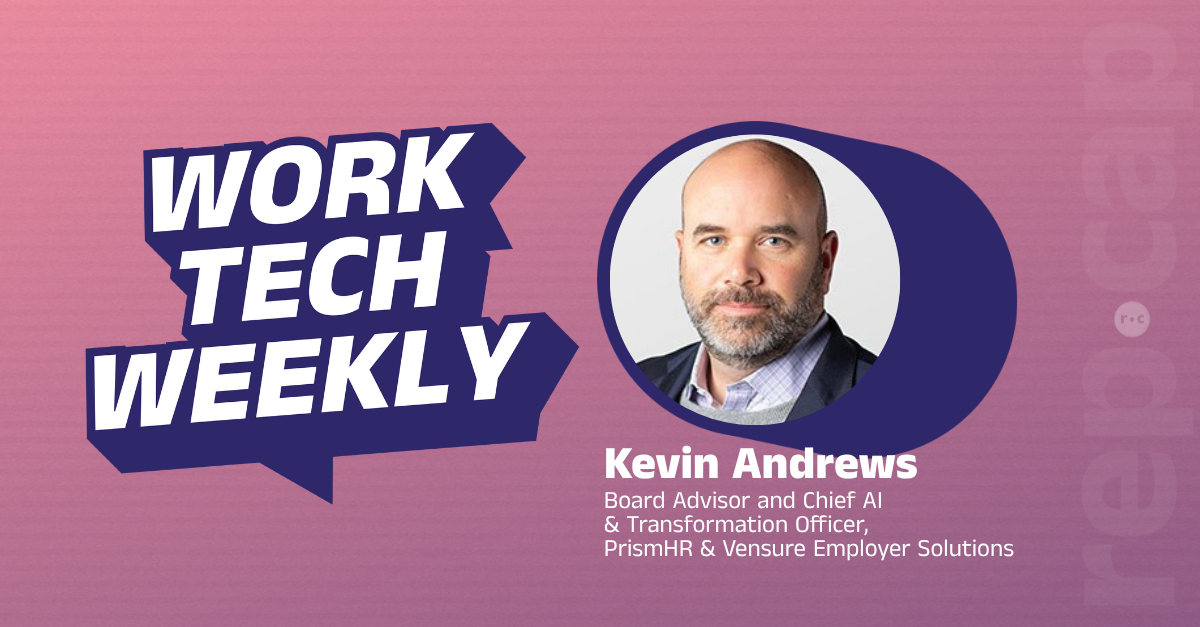
In the latest episode of Work Tech Weekly, I’m talking to Kevin Andrews about the compliance plumbing of PEO software. That’s not meant as a slight. Anyone who thinks plumbing doesn’t matter is in for a rude shock when the plumbing stops working. As Board Advisor and Chief AI and Transformation Officer at PrismHR and Vensure Employer Solutions, Kevin has a highly informed POV about the value of software for small business customers, where AI can help and where it can't be trusted near the term. LISTEN NOW
Transactions
-
Anthropic's IPO prospectus shows a sweeping AI vision and surging costs. The S-1 era of frontier AI is here, which means we're about to learn exactly how much "transforming work" costs to run. (Reuters)
-
Pearson acquires Workera, an AI-native skills assessment platform. A legacy learning giant buying skills verification. Maybe Phoenix + Fuel50 was the start of a trend. But, to go by LinkedIn comments, end users don’t seem to be fans of this deal. (Pearson)
-
Alight acquires Abett to boost benefits data intelligence. If benefits admin is a data business wearing a services costume, Alight just bought a much bigger costume. (DHRMap)
-
Armanino acquires HCM consultancy Sability. Consulting consolidation is quietly reshaping who sits across the table during HR tech implementations, and buyers should notice who owns their advisors now. (DHRMap)
-
Jeeves raises $110 million in equity funding. Nine-figure rounds outside the frontier labs are rare enough these days to count as a vote of confidence in spend management as a durable category. (FinSMEs)
-
Metaview lands $60 million Series C to scale agentic recruiting. Recruiting tech funding has been frosty, so a raise this size suggests investors see AI interview intelligence as one of the few TA bets still worth making. (HR Tech Feed)
-
Miter raises $40 million Series B. Construction payroll and workforce tools keep proving that vertical HR tech is where the boring-but-real money lives. (DHRMap)
-
BoomerangHR raises $12.7 million while investors stay cold on talent acquisition. Raising into a frozen category is either a contrarian masterstroke or a very expensive lesson, and the headline is basically daring you to pick one. (WorkTech)
-
HiringCafe raises $6.8 million to fix the job hunt with an AI talent agent. Job seekers are drowning in ghost listings and auto-rejections, so naturally the fix is another AI agent. To be fair, this one targets the candidate side for once. (The Next Web)
-
September 2026 WorkTech funding highlights. Jens Bender brings the European Work Tech POV. (LinkedIn)
-
DealTalk: the back office is converging into a solution. Charles Bedard on why HR, payroll, and finance tools are collapsing toward one stack, and who gets squeezed in the process. (LinkedIn)
Industry Notes
-
Accenture stock jumps on earnings. When the world's biggest AI implementation shop beats, it's a decent read on whether enterprise AI budgets are real or just keynote material. (Wall Street Journal)
-
Software firms are discounting AI to keep customers from defecting to Anthropic and OpenAI. When your AI add-on has to be marked down to compete with the model makers, the "AI premium" pricing story starts looking a little wobbly. (The Information)
-
Meta seeks a payoff from AI spending with a new push for business customers. After years of pouring capex into models, Meta wants an enterprise revenue line, and it's betting businesses will trust it with their workflows. (Wall Street Journal)
-
Meta hires MongoDB CEO CJ Desai to lead its enterprise AI charge. Poaching a sitting enterprise software CEO is how you signal "we're serious" about B2B. (The State of AI)
-
3Sixty Insights adds Lance Haun as principal analyst. A respected HR and workplace voice joining the independent analyst bench is good news for anyone who wants keen Work Tech insights. And dad jokes. (3Sixty Insights)
-
Quantum Workplace adds Rupali Jain to its board to accelerate AI investment. Board appointments framed around AI are the new "we hired a chief digital officer," and the follow-through is what counts. (Quantum Workplace)
-
Checkr partners with Workday on income and employment verifications. Verification is one of those invisible chores that slows every hire and loan, so plugging it into the system of record is quietly useful. (HRTech Cube)
-
Deloitte and Thrive Global partner on health and well-being. Big consulting meets wellbeing behavior change, and the question remains whether it reaches workers or just the deck. (HRTech Cube)
-
BambooHR and Employee Navigator automate benefit deductions. Not sexy, but anyone who's reconciled payroll deductions by hand just felt a small spark of joy. (HR Tech News)
-
LinkedIn launches Hiring Assistant 2 with memory, trust signals, and ATS integration. LinkedIn owns the candidate graph, so every upgrade to its recruiting agent puts a little more pressure on the ATS vendors sitting downstream. (DHRMap)
-
Gusto launches business compliance, HR partners, and a PEO. Gusto keeps expanding from payroll app to full SMB back office, which puts it on a collision course with Rippling and the PEO incumbents. (DHRMap)
-
Gloat brings its Galileo AI agents to enterprise HR. Internal talent marketplaces are getting the agent treatment, which raises the eternal question of whether employees will actually use them this time. (HR Tech News)
-
Perceptyx Anywhere builds AI for workforce intelligence. Listening platforms are pivoting from "here's your engagement score" to "here's what to do about it," and that's the right move. (HR Tech News)
-
Salary.com expands into talent management. Comp data is the one thing every talent decision eventually bumps into, so a land grab from the pay side makes more sense than it first sounds. (Yahoo Finance)
-
DailyPay extends on-demand pay with a deductions method. Earned wage access keeps maturing from perk to payroll plumbing, and regulators are watching closely. (Press Release)
Worth Reading
-
Gartner expects AI to wipe out entry-level marketing jobs at most high-performing teams by 2030. Unfortunately for those of us in marketing, this feels violently true. (The State of Brand)
-
Marketers are rebranding as "engineers" to survive the AI era. Much like trying to rebrand AI as “Super Intelligence,” this feels equal parts stupid and futile. (Wall Street Journal)
-
People are starting to talk like AI chatbots. What fresh hell is this? Prompt-speak has come for us all. (Wall Street Journal)
-
Will AI make your brain lazy? What the new research actually shows. TL;DR Yes. (The New York Times)
