Musical accompaniment for this week's newsletter.
Earlier this year, I spent an entire newsletter begging Wall Street to breathe into a paper bag as software companies shed roughly $1 trillion in market cap in 30 days.
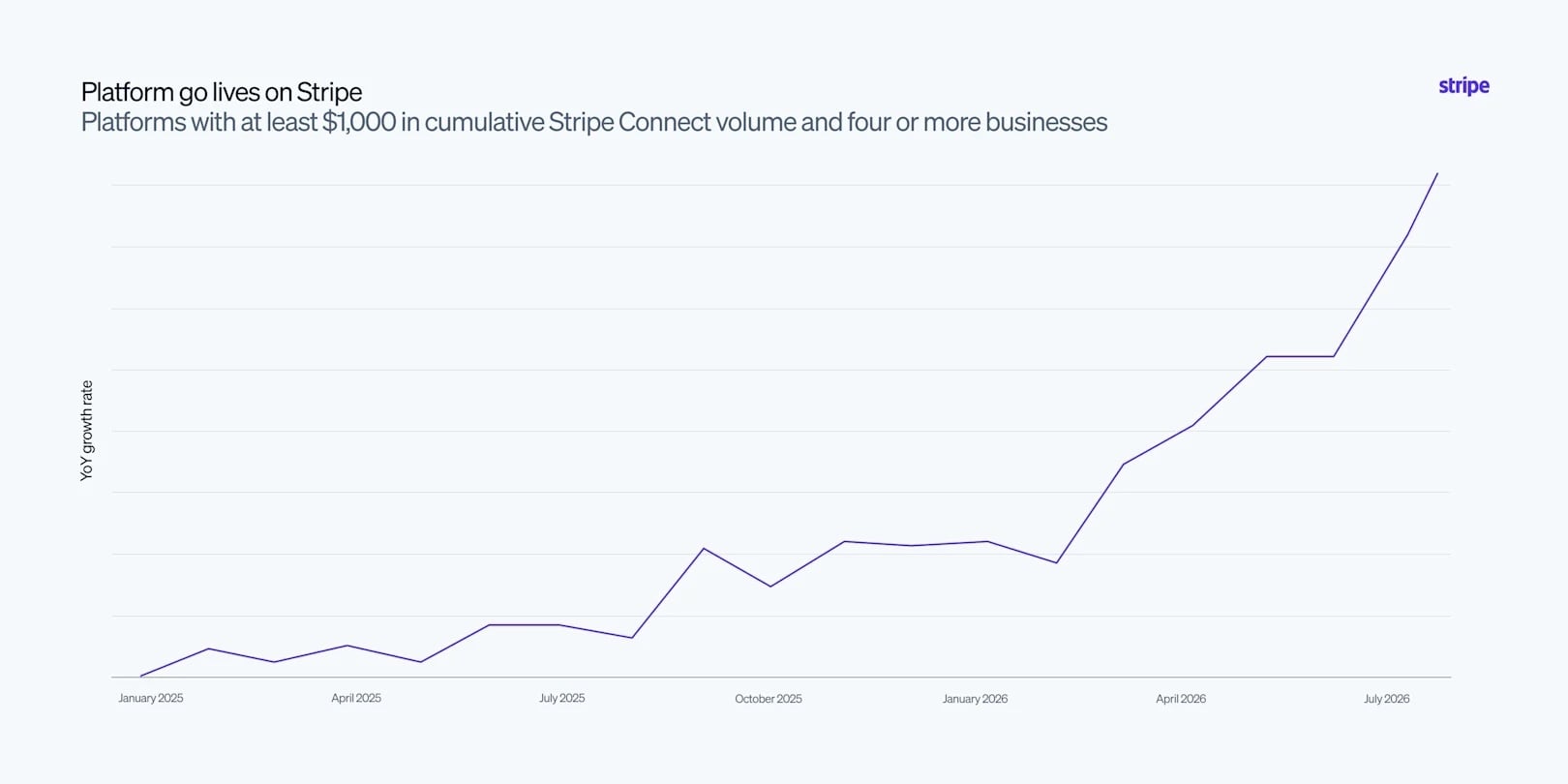
Since then, much of that decline has reversed. Meanwhile, new platform businesses on Stripe are up 182% year over year and added more new platforms in the last three months than it did in the final six months of 2025.
Good news for enterprise software: SaaS isn't dying. Bad news for enterprise software: The SaaS per-user, per-month pricing model is.
More employees using the tool meant more revenue, but AI is breaking that. If an AI agent does the work inside Salesforce or Workday, fewer humans log in. Fewer logins mean fewer seats. The pricing model loses its foundation. And … that’s pretty much what seems to be happening. And so you’re seeing:
-
Incumbents are giving AI away. A year ago, vendors charged extra for AI features. Now Microsoft, Workday, Adobe, and others are discounting or offering them for free. That's a defensive move. The goal is keeping buyers from wandering off to Anthropic and OpenAI.
-
Startups are pricing on outcomes. Ema, a startup that uses teams of AI agents to automate corporate processes across HR, IT, and finance, just announced a $77 million raise. Its pricing model is billing for completed work, not seats. I mean, the press release literally says: "Stop buying software. Start hiring AI Employees." Subtle, it ain't.
-
Even Salesforce is improvising. Marc Benioff says enterprise customers can now choose how to pay for Agentforce, including custom contracts, charges based on revenue from AI-assisted sales, or billing on customer service savings.
On top of all that, the raw intelligence is getting cheaper every quarter. Anthropic just shipped a new flagship model priced 20% below the last one. This makes a premium on the wrapper harder to justify. Procurement teams have no doubt noticed.
If you lived through the Dot-Com Era, this may feel familiar: give it away, grab eyeballs, and figure out revenue later. We all know how that went.
But there's a scary difference. Back then, free was an acquisition tactic. Today, it's a retention tactic. When the biggest vendors in the world start giving away the product they told you was worth a premium, it’s a sign they are hanging on for dear life.
In case this needs to be said, don’t get too comfortable. Free is never free. Somebody's paying for the compute, and that somebody is getting expensive.
SoftBank just sold a record $11.1 billion in junk bonds, with yields up to nearly 10%, to fund its OpenAI bet. AI cloud provider Nscale is heading for an IPO with $103 billion in signed contracts, less than $3 billion of it actually active.
All that expensive money will want to be paid back. Eventually, that shows up downstream as minimum commitments, longer contracts, and pricing built to protect somebody's balance sheet. "AI keeps getting cheaper" is a lovely budgeting assumption, right up until the moment it’s not.
What else is going on this week?
Workday AI hiring bias lawsuit seeks class-action certification
Plaintiffs allege Workday's AI tools, including HiredScore Spotlight, Fetch, and Candidate Skills Match, rely on historical hiring data and apply common screening logic across employers. A class-certification hearing is set for March 9, 2027. Every TA vendor should be watching, because the real question here is whether the software maker shares liability with the employer.
Is Point Solution Era Ending?
Charles Bedard argues the workforce compliance market is consolidating fast, and points out that vendors are running out of runway. Buyers pay more for companies that earn money repeatedly from the same customer, and less for companies that get paid once per transaction. He tracked 100 workforce compliance deals so far this year. Companies that own recurring identity and verification data sold for 3.7x to 12.2x revenue. Companies charging per background check? 1.0x to 2.8x.
The AI Skills Vortex is Upending Comp, And HR Isn't Ready
AI is setting pay with less transparency than ever, just as employees want more. Payscale research finds 49% of employers say salary structures haven't kept pace with AI, and 48% say benchmarking no longer reflects the skills roles require. The bigger problem: upskilled employees are watching new hires command 20% to 40% premiums they aren't getting. That's a retention time bomb.
This Week on the Work Tech Weekly Podcast
I went into this week's Work Tech Weekly wanting to know whether HubSpot is trying to become a Work Tech company. Alec Cherrin spent a week at HubSpot UNBOUND in Boston, and his answer was "AI harness territory."
We did this one live, AMA-style, and covered everything from AI credit costs to the new loop framework, which neither of us is buying. Alec also filed a full report on his $25 conference lunch, which might be the most useful part if you're deciding whether to go next year. LISTEN NOW
Transactions
-
Angle Health raises $600 million at a $2.7 billion valuation. Employer health costs keep climbing, and investors keep betting the fix is a new kind of health plan, not another point solution bolted onto the old one. (FinSMEs)
-
Island raises $400 million in Series F at a $6.4 billion valuation. The enterprise browser keeps quietly becoming the place where work (and increasingly, agents) actually happens. (FinSMEs)
-
Paychex buys Wizehire and launches WISE Hire for AI-powered recruiting. With the deal, Wizehire will power hiring for more than 800,000 businesses as a core part of Paychex's product suite. Essentially, it sounds like an agentic AI staffing agency for SMBs. (Press Release)
-
Ando emerges from stealth with a $20 million pre-seed round. These guys want to take on Slack with a team messaging app built for humans and agents. Founder Sara Du wants to eliminate "meat proxies," her term for people relaying AI agents' work to their teams. Not loving that messaging. (TechCrunch)
-
Spott raises $21 million to build an AI recruiting platform. Three founders from McKinsey, Bain, and BCG, firms famous for billable hours, are now building software to squeeze the hours out of hiring. The irony writes itself. (DHRMap)
-
Corridor raises $16 million in seed funding. A hefty seed in this market says investors still write big early checks when the AI angle is sharp enough. (FinSMEs)
-
50skills raises €5.3 million for AI HR workflow automation. HR ops automation is where every agent startup seems to land first, so differentiation is getting harder by the week. (DHRMap)
-
360training acquires Atlantic Training, adding OSHA and workplace safety courses. Compliance training will never be sexy. It's also recurring revenue with a legal mandate behind it, which is sexier than most SaaS metrics right now. (DHRMap)
-
millionways receives investment from Hunt Scanlon Ventures. When executive search insiders start funding AI talent assessment, that's either a strategic bet or a very expensive hedge. Maybe both. (FinSMEs)
Industry Notes
-
Gen Z is reshaping how bosses give feedback. The "gentle performance review" is either overdue empathy or managerial bubble wrap, depending on who you ask. Either way, the annual review template is due for a rewrite. (Wall Street Journal)
-
Workday launches Total Benefits. Workday keeps pushing deeper into benefits administration, in the same week it's reportedly giving top customers its AI platform free. Offense and defense, simultaneously. (HRTech Cube)
-
Fuel50 launches Task Intelligence for responsible work redesign. The skills era is quietly becoming the task era, and every talent vendor wants to own the map of which tasks AI takes over. (Press Release)
-
Mentimeter launches three new leadership tools. A live, polling tool wants a seat at the leadership development table. Bold move, and a reminder that every point solution is currently trying to become a platform. (HR Tech News)
-
Dayforce enters the FedRAMP Marketplace. Government is a slow sales cycle with a very long tail, and FedRAMP is the ticket to ride. Smart diversification while commercial buyers keep squeezing HR budgets. (HRTech Cube)
-
Survey finds two-thirds of workers value mobile access to payroll information. Shocking news: people want to see their paycheck on the device they check 200 times a day. (HRTech Cube)
-
Checkr partners with Workday to expand income and employment verifications. (HRTech Cube)
-
Businessolver's Sofia AI named 2026 AI-Powered Enterprise Solution of the Year. (Press Release)
-
Brown & Brown names Erik Templin North American benefits leader. (HRTech Cube)
Worth Reading
-
ZoomInfo's new recruiting product has one job: prove the data is good. Lance Haun says the sales intelligence company crossing into recruiting makes sense on paper, since people data is people data. The catch is that recruiters have been burned by stale contact data for years, so "trust us" won't cut it. (Beaconturn)
-
Road Report: RecFest USA, Nashville. Mike Wood's ground-level take from the TA jamboree is a good read. TL;DR: AI can solve time to hire. Quality of hire? Not so much. Yet. (LinkedIn)
-
Companies are using their own data to newsjack breaking stories. Proprietary data is the most underused asset in B2B marketing. Brands sitting on product usage data and not turning it into timely stories are leaving free earned media on the table. (The State of Brand)
-
AI layoffs are backfiring, and employers may have bet too much on the AI boom. Rehiring when the productivity doesn't show up is expensive and embarrassing. (Forbes)
