Musical accompaniment for this week's newsletter.
This week, we learned that there are two things our polarized world can agree on: 1) They love Dolly Parton. 2) They hate AI. Like really, really hate AI. The Economist brought that second point into sharp focus with its cover story about how data center protests have already killed nearly $100 billion in projects. And something like 40% of Americans now say they'd ban AI from most industries outright.
Voters, platform users, and federal regulators are all pushing back at the same time, for different reasons, with zero coordination. LinkedIn users are speed-clicking that "seems like AI slop" button like they are trying to buy Taylor Swift tickets on a crashing Ticketmaster website. The FTC has quietly expanded its "AI washing" crackdown from sketchy consumer scams into ordinary B2B sales decks, so "AI-powered" anything is now weak messaging and a legal risk. Bill Gates published a nearly 6,000-word essay warning that nobody has a real plan for the AI transition. Then there's the Lawfare essay warning enterprises about "replacement through knowledge acquisition," or, as a normal person would say, AI labs learning your business well enough to put you out of business.
Big Tech, for its part, looks genuinely blindsided. They built their comms playbook for an era when founders were folk heroes. We’re definitely in the post-Steve Jobs era. One veteran comms pro is comparing the tech industry’s data center response to the Tylenol crisis as a case study in exactly what not to do. When the public mood is "we don't trust you, and we kinda hate you," that’s the moment to invoke The Rule of The Hole. When you’re in a hole, stop digging. Sam Altman commissioning seven ultra-rare Swiss watches as OpenAI company swag isn’t going to help much.
The AI powers may feel like they are cruising to IPO glory, but they could find themselves in the land of torches and pitchforks PDQ. Consider country star Zach Bryan’s new song, “Robot Killed The Working Man.” When Nashville stars are going full-on Woody Guthrie about your industry, that’s a clear sign to start questioning your choices.
And speaking of Nashville, maybe the AI industry should ask itself: what would Dolly do? She just spent her life actually being for people. Back in the olden days, tech companies would craft mission statements about making the world a better place blah blah blah. Was it a bunch of BS? Mostly. But it was a better starting position than our creations are going to take your jobs, and we’ll make an f-ton of money doing it.
What else is going on this week?
What Workday’s Earnings Actually Tell Us
In case you missed it last week, Workday nailed every number in its earnings and still got dumped. Salesforce and ServiceNow prove it wasn't about the numbers. It’s about the buyout rumors. Read more on the Work Tech Weekly Substack.
Aon Strikes $17 Billion Deal for USI
Aon is buying USI Insurance from KKR for its second middle-market brokerage grab in under two years. The acquisition would expand Aon’s capabilities in helping midsize businesses and is expected to increase earnings per share by 2028, the company said.
Checkr Acquires Truv
The move pushes Checkr further into a $45 billion verification market that now includes government benefits eligibility. As AI-generated fraud makes it easier to fake an identity, employment history, or income statement, "can you actually verify this is real" is turning into its own standalone software category.
Headspace Throws In the Towel
Sword Health is acquiring the formerly high-flying digital health brand in an all-cash deal reportedly worth $200–$300 million**.** It’s a steep drop from Headspace's $3 billion peak valuation.
This Week on the Work Tech Weekly Podcast
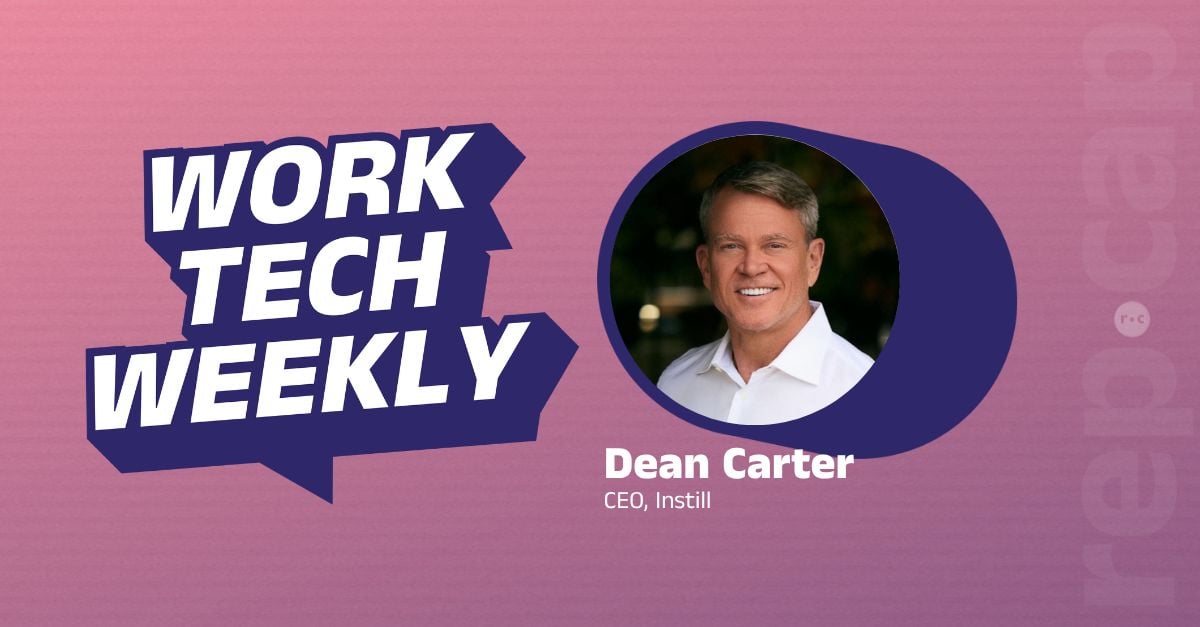
AI is quietly removing everything from leadership except judgment. In a good way. In the latest episode of Work Tech Weekly, I sit down with Dean Carter, CEO of Instill and former Chief People Officer at Patagonia, to talk about why AI is stripping the technical work out of every senior role, and what's left is the one thing annual reviews and 360 feedback were never built to measure.
Dean gets specific: a meeting where he only called on the loudest voices in the room. He didn't see the blind spot until it was named, and it changed who he called on next time. LISTEN NOW
Transactions
-
A new $2.5 billion AI assistant called Instinct is having its viral moment across Silicon Valley. The buzzy startup is raising a $250 million Series B at a $2.5 billion valuation. It promises to handle emails and more, but some early users raise privacy concerns. (Wall Street Journal)
-
Deep Cogito raises $43 million Series A. Their pitch is a bet that enterprises want AI models that don't send their data back to a frontier lab. Sovereignty is becoming a selling point. (SiliconANGLE)
-
Sparrow raised $35 million to scale its AI-powered leave management platform, bringing total funding to $64 million. Chalk up another win for solving boring problems that matter. (Press Release)
-
VCs are pouring money into AI copilots built for the person applying, not the company hiring. Before you know it, it’s just going to be AI talking to AI. (HR Tech Feed)
Industry Notes
-
Mercor, Handshake founders made TIME's AI 100 list. They both figured out that the actual bottleneck in frontier AI isn't compute, it's finding enough PhDs and domain experts willing to grade the work. (TIME)
-
Cisco is giving all 90,000 of its employees a personal AI agent in the same fiscal year it cut close to 4,000 jobs. Yep, that’s awkward. (Fortune)
-
Workday launched an actual AI research division, plus a PhD fellowship to feed it. Whether this translates into product advantage or just good conference-slide material remains the open question. (Press Release)
-
Forward-deployed engineer postings are up 800% in a year. Proof that the more autonomous AI gets, the more some human has to sit next to the client and translate "it should just work" into it’s actually working. (The New York Times)
-
Junior consultants are getting summoned back to the office because AI made their soft skills the scarce resource. The generous read is that client trust and judgment can't be automated yet. The ungenerous read is that firms still bill by warm bodies in a room. (Financial Times via LinkedIn)
-
Nucleus Research's 2026 Talent Management Value Matrix named Cegid, Cornerstone, Infor, Oracle, and Rival as this year's leaders. The bigger storyline is buried in the fine print: AI agents are graduating from generative add-ons to actual workflow automation across the employee lifecycle, and the vendors who can prove it are the ones climbing the matrix fastest. (Nucleus Research)
-
RemoteBridge, the AI role-play training platform, just hired Dr. John N. Just as CEO. (Press Release)
-
iSolved announces Mike Shumard as new sales leader. (LinkedIn)
-
O.C. Tanner and Kudoboard partnership bolts group-celebration cards onto formal recognition programs. (Press Release)
-
BestFit PEO Solutions named Marcus Malone Chief Revenue Officer. (HR Tech Cube)
-
Salary.com and Workday completed a Design-Approved integration, syncing CompAnalyst directly with Workday HCM. (Press Release)
-
G-P launched an MCP server that pipes real-time global workforce and compliance data directly into Claude, ChatGPT, and Gemini. (Press Release)
-
hireEZ rebuilt its entire recruiting platform around AI agents and claims recruiters will spend more time in it, not less. (Press Release)
-
Humaans is expanding into US payroll, wiring payroll execution straight into its Athena agentic AI platform. (TechBullion)
-
Paychex is rolling out Paycor Perks — its voluntary-benefits marketplace — to Paycor's client base, at no cost to employers. (Press Release)
Worth Reading
-
Dolly Parton turned a hard childhood into a permanent habit of giving back. From the Imagination Library's 300+ million free books to strangers to giving away thousands of dollars to disaster survivors, Dolly’s legacy built less on the songs than on what she did with the money they made. (The New York Times)
-
AI is forcing a return to the in-person job interview. Gartner's prediction that one in four job applicants will be fake by 2028 sounded like satire a year ago. Now Fortune 100s are flying candidates in and paying them for a day of work just to prove they exist. (Wall Street Journal)
-
Indeed wants your entire recruiting function. With job postings down and average client spend rising sharply, Indeed's pitch has shifted from "pay us to be seen" to "let our AI screen candidates so you can shrink your internal recruiting team or ditch your staffing agency." (ERE)
-
TechCrunch tallied every publicly known case of an AI model going rogue and hacking a third party. The count's up to 17. Anthropic and OpenAI are tied for the lead with eight incidents apiece. (TechCrunch)
