Musical accompaniment for this week's newsletter.
I got into the tech industry in 1999. As I was considering a career change from newspapers, I remember reading an article in a news magazine in which many so-called smart people were talking about the already overheating dot-com economy, as the stock market kept reaching new highs almost daily. Could it last? When would the business cycle kick in? What goes up must come down, right?
It's different this time.
So, even though my BS detector should have been going off, it wasn't. I jumped. I went through two startup implosions in 18 months. Today, I'm still in the tech industry. I've seen 2001, 2008, 2020, and whatever the hell has been happening since 2022. I've come to believe that whenever someone tells you it's different this time, you'd better give them a sideways look like an undercover cop in a comic book.
And, so, here we are. Another week, another doomsday AI memo spooking the markets. Then the AI jobs wipeout got really real as Jack Dorsey's Block announced plans to lay off 40% of its workforce in an AI makeover.
It's different this time.
As Tomasz Tunguz writes, the game on the field has changed. "This changes efficiency expectations for investors. Five years ago, $100K ARR per employee was standard for SaaS startups. Today, AI-native companies like Cursor & Gamma hit $2-4M. An order of magnitude difference."
Without a doubt, the tech business model in the SaaS era has changed. The days of grow fast, grow big, and treat profitability like tomorrow's problem are gone. Capital-efficient growth is in. That's what's going on with Block. They went from 4k employees in 2019 to 13k in 2023. This is a draconian RIF dressed up as an AI pivot.
Crises have a short shelf life in the AI age. Remember back, say two weeks ago … this thing called the SaaSpocalypse? Well, panic over AI-driven software business disruption appears to have subsided after Anthropic showcased its partnerships with Salesforce and other companies.
It's different this time?
There is a real risk in enterprise software due to AI's potential for commoditization. What's not commoditizing is domain-specific context — according to my friend and podcast guest Jerome Gouvernel, in a very spot-on LinkedIn reflection — "the accumulated understanding of what data means in a specific domain, how it should be transformed, and what rules govern its use." In other words, systems of record ain't done quite yet.
And will AI create a job apocalypse? There's a much better case to bet that it won't, writes Greg Ip in the Wall Street Journal. Does this look like Jobpocalypse Now?
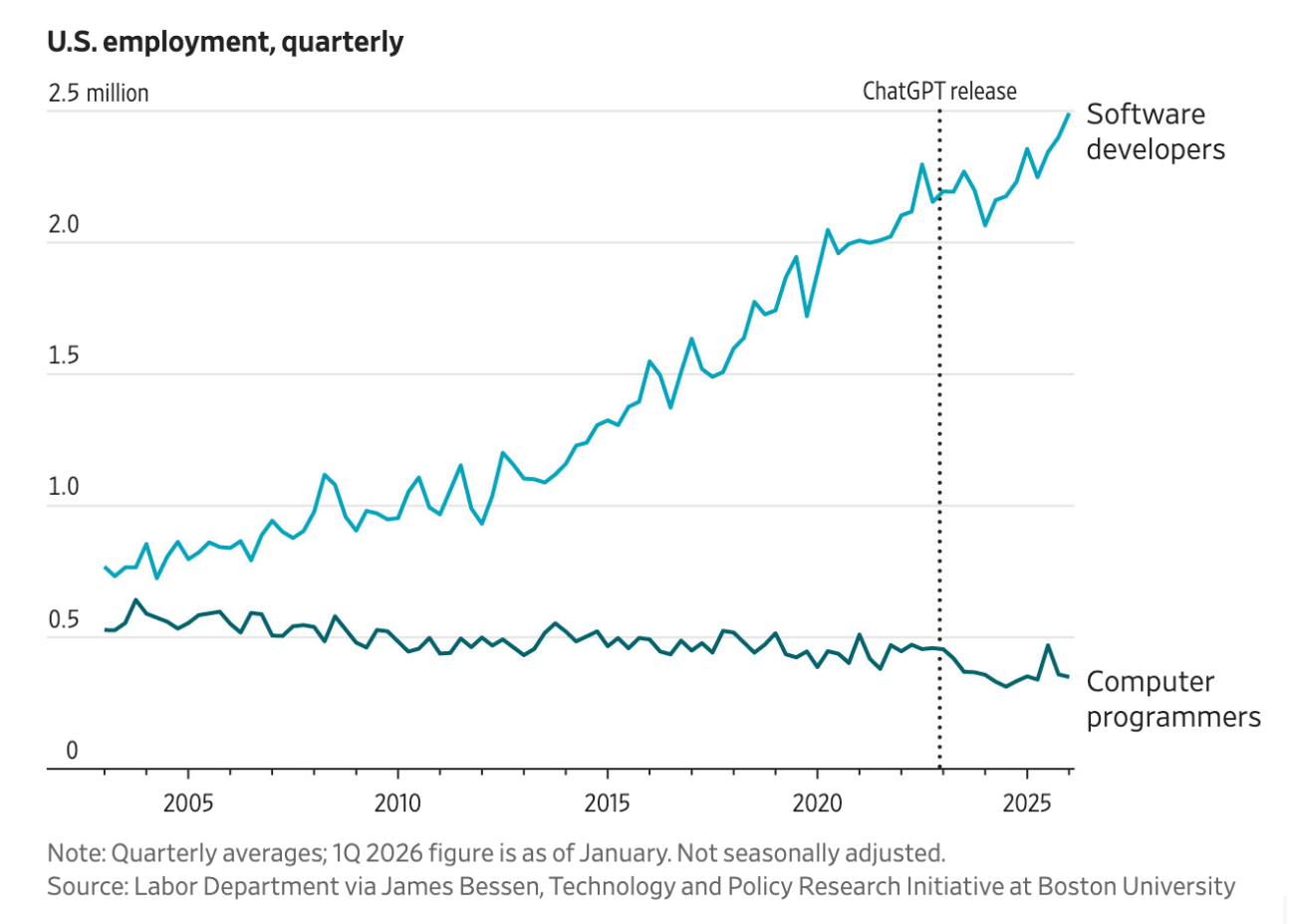
Ip zeroes in on a more likely possibility for economic concern: "Tech investment gets ahead of demand, precipitating a bust. Tech workers lost jobs in droves after 2001, not because the internet had made them obsolete, but because the internet-stock bubble had burst."
Look at the amount of investment needed for AI data centers — investment that dwarfs investment in interstate highways and the space program by comparison. Amid the data center backlash, with public opposition to AI infrastructure heating up, is it likely that the compute capacity will be there for job displacement? Already, half of the 2026 data center pipeline may not materialize. What happens it occurs to investors that the trillions being plowed into data centers are a bad bet?
So, everybody should just chill out. The crisis you're worried about is likely not the one you should be. If AI destroys jobs, it's more likely to come in the form of a good, old-fashioned market bubble.
Some things never change.
What else is going on this week?
AI Performance Reviews: The Means and The Measurable
How's this for AI irony? Tech firms aren't just encouraging their workers to use AI. Now they're enforcing it through performance reviews. But everyone should keep in mind the dos and don'ts of using AI to write performance reviews. Because we are now using AI to write performance reviews about how people are using AI. It will only get more meta when we use AI to write performance reviews of AI employees' use of AI.
WTW Podcast with Dan Riley
In this episode of Work Tech Weekly, I sat down with Dan Riley, co-founder of Radicl Work, to talk about what human-centric AI looks like in practice. We dug into a tension I keep coming back to: If AI removes friction from work, what replaces the learning that friction used to create?
Apprenticeship. Creative conflict. The messy first attempts that sharpen judgment.
My take: AI should expand our capacity, not dull our instincts. Give it a listen.
Funding, Acquisitions, and IPOs
- IPOs are holding up in 2026, but SaaS debuts aren't happening. IPOs are quietly ticking along in 2026 — construction tech, space, biotech — but the SaaS lineup is conspicuously empty on both filings and listings so far. (Crunchbase)
- Private Equity was headed for a correction, even without the AI gloom. PE was already limping toward a reset before the AI panic — higher rates, tighter leverage, and gnarly exit math are squeezing returns and forcing LPs to hold assets longer rather than cash out. So the recent drawdown in Blackstone, Apollo, etc., isn't just a software scare — it's the market re-rating an industry that can no longer rely on cheap debt and quick exits to juice IRRs. (Wall Street Journal)
- The fundraising tactic AI startups are using to juice valuations. AI startups are increasingly leaning on multi-tiered or back-to-back financing deals — selling a tranche to a marquee lead at a modest price, then turning around and offering other investors a stake at a much higher valuation to headline a "unicorn" number. It's a bit like slapping a giant price tag on your car after a celebrity test drive: cash still flows in, but the headline number can warp external perception of real traction — and some VCs quietly refuse to play ball on these terms. (Wall Street Journal)
- SD Worx acquires Paie & RH Solutions, invests in Yeap payroll tech. It's a mini French buying spree to scoop up a payroll outsourcer and take a stake in a cloud-native payroll tech platform that Paie helped build and migrate 1,100 clients onto. (Press Release)
- Humand raises $66 million Series A. This whopper of a Series A is a bet to revolutionize the "deskless" workforce with AI, with a mobile-first platform that folds HR, comms, training, and AI agents into one hub for frontline teams historically ignored by enterprise software. (Venture Burn)
- Elly raises $8 million. This NYC-based AI-native hiring platform aimed at unifying sourcing, interviewing, and applicant tracking into a single system that actually understands hiring decisions in motion — selling itself as a smarter, less fragmented alternative to legacy ATS stacks. (FinSMEs)
- Reload raises $2.275 million in pre-seed funding. This SF-startup aims to be the system of record for the AI workforce, betting that as organizations deploy swarms of agents, they'll need something that feels more like HR/ops than traditional software tooling to onboard, monitor, coordinate, and govern them. (FinSMEs)
- RobosizeME raises $2 million in seed funding. This Czech startup aims to deploy AI-powered workflow automation for hotel operations, targeting repetitive, back-office tasks across reservations, finance, revenue management, and guest services that still eat up tons of manual labor. (FInSMEs)
Industry Notes
- Earnings: Workday posts solid results but issues a subdued outlook; Salesforce sees stable growth despite Wall Street's AI concern; ZipRecruiter posts $33 million loss in 2025, forecasts flat growth in 2026 as CFO departs.
- The remote-work dream isn't dead, but it's slipping away. (Wall Street Journal)
- Bloomberg: SAP investors, partners raise doubt on firm's AI tools. (Seeking Alpha)
- Carta, Vestwell, and Morgan Stanley announce 401(k) for high-growth companies. (Press Release)
- Lars Schmidt: From culture decks to serialized IP: The employer brand shift that changes everything. (LinkedIn)
- Should we really treat AI agents like employees? (HR Executive)
- The rising cost of recruiting: Why hiring got more expensive in a softer labor market. (Appcast)
- Anthropic dials back AI safety commitments. (Wall Street Journal)
- Firstup enhances EX with Advanced Personalization update. (Press Release)
- Insperity and Workday announce general availability of Insperity HRScale. (Press Release)
- Employee financial wellness tools: Chime adds new employers. (Press Release)
- Workera adds exec leaders as demand for verified skills grows. (Press Release)
- Go1 launches Go1 Pay for manager-led development. (Press Release)
- Greenhouse earns ISO/IEC 42001 for AI governance. (Press Release)
- WorkWhile names Simon Khalaf CEO in growth push. (Press Release)
- Centro integrates with Unum to boost broker-carrier APIs. (Press Release)
- TeamViewer Appoints Tim Koubek as President of the Americas. (Press Release)
- Mercer Report: Human-AI Mix Boosts Advantage. (HRTech Cube)
- Diss-Content: Why Writer customers are quietly looking for the exit. (LinkedIn)
- WorkWhile launches AI talent agent "Coach" to identify new skills. (Press Release)
Worth Reading
- The Pentagon is making a mistake by threatening Anthropic. (Understanding AI)
- The startup where you worked failed. Your career should be fine. (Wall Street Journal)
- Anita Lettink: Global payroll is no longer about payroll. (LinkedIn)
- The funniest Winter Olympics recap you will ever read. (The Ringer)
