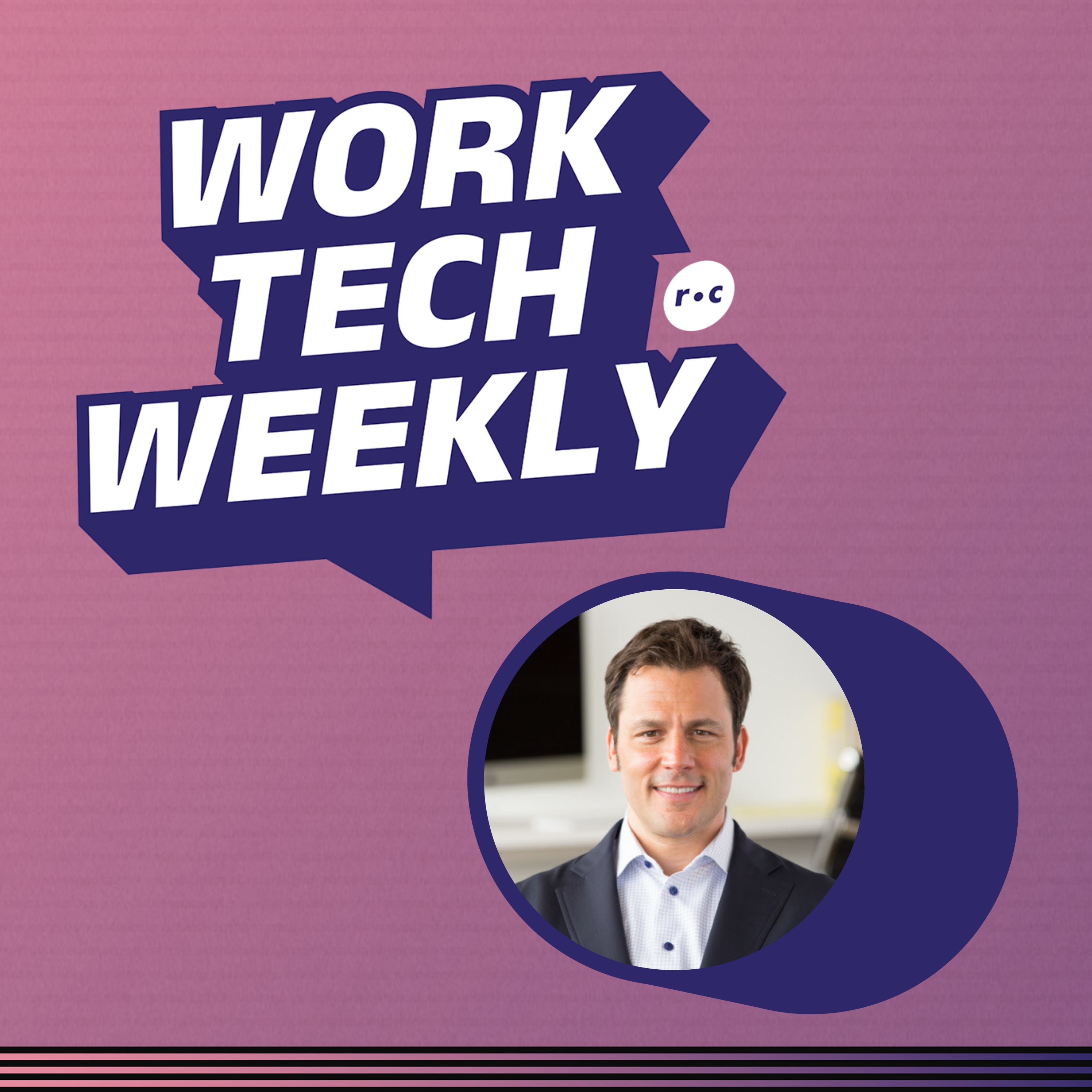
Ryan Estis:
AI experimentation's over. The boat's left the building. It's not about the software. It's about leveraging the software to become increasingly more human. Our customers expect more expertise, more personalization, more customization. There's a sense of urgency. They want it now. They want it their way. We're more equipped to do it, but we have to make the investment.
Steve Smith:
Hey, everyone. Welcome to the very first Work Tech Weekly podcast. I'm really excited to be here because I've been wanting to do this for the longest time. There are so many really interesting conversations that go on every day in this industry. There are so many really just interesting, thoughtful people out there. What I want to be able to do is bring these people to you, have these conversations in front of you, just get to something that's real, even if it gets a little messy sometimes.
To kick things off, I'm joined by Ryan Estis. Ryan is a former Fortune 500 Chief Revenue Officer. Today, he's a bestselling author, and he's delivered more than a thousand corporate keynotes on leadership and growth. So in this episode, we're talking about human-centered leadership and what sales leaders actually need to unlearn. We get to what makes a sales kickoff worth the investment. And we talk about how AI is changing sales, including which human skills matter even more now. So if you're ready to get a smarter take on what all this means for teams going into this brand-new year, you're in the right place. Let's get to it. Ryan Estis, welcome to the podcast. How are you doing today?
Ryan Estis:
I'm doing great. It's good to be with you.
Steve Smith:
Thank you very much for joining us. Well, we got a lot we want to talk about today. But I wanted to kick things off by getting into some of the key ideas that you talk about in your keynotes and in your coaching about human-centered leadership. You talk about it as both a mindset and a method. What's the sharpest distinction between human-centered leadership and maybe traditional leadership approaches?
Ryan Estis:
I'd say the biggest distinction is prioritizing people over short-term revenue goals. The thesis really, it's borrowed or evolved out of servant leadership and design thinking. I think as the world becomes more complex and continues to change, it's increasingly more difficult for an organization to scale and provide sustainable growth over rigidity and control. You see that playing out in the modern world of work. I think people are increasingly disengaged, dissatisfied, frustrated, mistrusting, and disappointed in their leadership. So I think growth in today's world demands a different approach.
Our thesis around that is as human-centered organizations creates the conditions internally to navigate the complexity externally. Human-centered organizations outperform traditional organizations by an average about 30%. They're more agile, they're more innovative, they get ideas to the market two times faster, and bottom line, they're better places to work. So that's a little background of the thesis and a little bit of definition on the approach and informed really the second half of my last book.
Steve Smith:
Well, and what's interesting is that, all of that, when you say it, to me, that sounds like just common sense. But I know that there's probably a lot of very skeptical sales leaders out there that might hear that and think, "Oh, this is soft. It's not really strategic." How would you respond to that?
Ryan Estis:
Yeah, it is the opposite of soft. I take a bit of an issue with what I consider to be a misnomer around this idea of soft skills. I actually think empathy, and particularly for the sales and the revenue function, is one of the most critical leadership and producer competencies, and it is a competency that we can cultivate. It's one of the hardest things to do. I think a core and fundamental human need is to feel seen, understood, and valued. In sales, that's a big part of what the job is. It's also a function of quality leadership, too. So I don't think it's soft at all. I think it's the catalyst for hyper-growth and performance today.
I was doing a CEO roundtable a few months ago, and we were talking about the future of work, the state of the workplace. When you think about a number, and it's a Gallup number, only 23% of today's workforce is engaged. I see the CEOs looking at that, and I know every CEO in the room thinks to themselves, "Well, not in my company. Two out of 10? Come on, it couldn't be me. Well, where's all the data coming from?" In a time where a commercial organization in particular needs more discretionary effort, more skilling up, more commitment, more innovation, more contribution to think that leaders are positioned to get increasingly less. So there's this tension, this friction.
I always say leadership isn't a job. It's a responsibility and isn't about us. It's about helping other people become the best they're capable of being. So I take a little bit of umbrage with the word soft. We've replaced soft with human, and I think that's really the idea. The soft skills are going to become the hard skills. EQ trumps IQ. We've got machines that can think a lot faster than we can now, and that's only going to increase. So what's left is human-centricity, and that's what we believe is true.
Steve Smith:
Do you feel like, in some ways, that there are a lot of leaders who make a nod at empathy, but they're still running the quotas and the dashboards like they're in Glengarry Glen Ross?
Ryan Estis:
Without question.
Steve Smith:
Is there something that you think that a lot of sales leaders need to unlearn, or those types of sales leaders need to unlearn?
Ryan Estis:
There you go, it's an unlearning. Yes, fundamentally, I think many executives need to unlearn how they led previously in traditional hierarchical command and control cultures and systems and relearn how to lead this way. So it's an unlearning and relearning. Why is there a nod or "Yeah, I get it"? It's because it's ingrained in us. I grew up in a culture like that. I grew up in a command and control. When my boss said to do something, I figured I was going to do it or get fired.
I remember being on a senior executive team. We would have these executive meetings. Our CEO would come in and say, "Okay, this is what we're going to do. Now we're going to go around and tell me what you think about it." Well, what the hell? It's like, "Okay." So we had a team. It was kind of the opposite of what I'd preach. Instead of an environment where we could disagree and then commit and come to a great decision where we were aligned, we would go to that room, agree and then go to 10 different cities and dissent. "Ah, that's a corporate thing. We're going to do it." You hear that all the time today. It's no different today. But the stakes are higher because the world's changing faster.
We're in the era of complexity, man, and disruption’s around every corner and every industry. There's more pressure. The cycles move faster. I believe that there's more repercussions if we continue to give this a nod and don't embrace it.
Steve Smith:
One of the things I want to talk about today, when we air this podcast, it's going to be in January, and it will be in the heart of sales kickoff season. I already have a lot of our clients that are talking about sales kickoffs. I know that you've done your share of keynotes at sales kickoff events, so there's a lot I am dying to talk to you about on this topic.
Ryan Estis:
Well, I've got 12 booked this January, so we can get into it.
Steve Smith:
Okay. Well, so tell me, in your experience, what's the difference between a sales kickoff that wows and ones that waste budget?
Ryan Estis:
I think there's a few keys to do them right. I'll say this as a broad comment, and then I'll get into some specific recommendations. As a broad comment, I think these meetings are more critical today, one, because of the accelerated pace of change; two, because of the distributed workforce; three, because the need to up and re-skill. So that creates a real necessity, I think, to bring people together to align around strategic priorities and goals. So I think there's some responsibility of the executive leadership and the enterprise to communicate a vision, to get people aligned and behind it so there's a little bit of that transparency and why and rationale and visioning. I was a territory rep for years. As somebody who's working out of their house, calling on clients, a field rep wants to feel like they're part of something larger and receive that confidence and feel connected to that. That's number one. So I would say alignment.
Number two, skill development. I'm attending a couple meetings in January where it's a week-long training, product development, rolling out a new suite of solutions, software, technology. So I think learning and development has become a big part of an effective sales conference.
Then, yes, connection and camaraderie, create some space to collaborate in cross-functional relationships. I think one of the trends that I've seen is the typical sales, or now it's a commercial or revenue kickoff, the attendee list is expanding. You're going to get technology and marketing and communications and most executive leadership, other functional leaders. I think that's the way it should be because selling is a team sport today. It's a collaborative effort. So, facilitating that relationship development. Even rep to rep: It's nice to have a peer in another territory who's going through the same challenges you are. You can pick up the phone. You build those relationships in person.
So those are three keys, I think, to make the meeting a great experience. Celebrate, get excited, vision, energize the team. Make them feel like they're part of something special and they're going to win, and that's important. But there's another key to this that I think is often missed, and it's a strong recommendation. I believe the most important minute of a kickoff meeting like this is 8:01 a.m. Monday morning, when you get back into the business. What are you going to go do and do differently based on the investment that was made? If there isn't throughput, then it was just a boondoggle and a celebration in Vegas. I think being really intentional about the forward plan to maximize the ROI of that investment is essential. We offer a bunch of resources to help our clients do that.
I used to run these meetings. I was a chief revenue officer. When I think back, I didn't do it perfectly. I would always say, "We'll get about 90 days, maybe six months if it's a really good year of motivation out of that." Oh, you have to do a mid-year meeting. Then the mid-year meeting comes, or you have to get them together again and pump them back up. I think today with tools and technology and enablement, you can extend that momentum through the year. I think that's a real strategic objective that people putting these events on and investing in them should have. Make it last.
Steve Smith:
In Work Tech, and especially around the tech community, it has been a lightning pace of change over the past three or four years with the explosion of AI and changes in the capital markets. Do you think that sales kickoffs are meeting the moment, or have you seen them change and maybe not change fast enough?
Ryan Estis:
I think probably that's an extension of our commercial teams meeting the moment. 82% of B2B buyers are frustrated with the lack of preparation from their vendor partners. So are we meeting the moment with our customers? I was just in this conversation yesterday. It's like, you have to have a foot in two worlds. You have to execute and perform given today's current competitive landscape and marketplace reality, but you also have to have a foot firmly entrenched in the learning and development, the constant iteration, the evolution, the training, because the landscape's shifting so fast. It's a little bit of that old entrepreneur adage. We got to build the plane while we're flying it. I think that's true all the way down to the individual contributor level. Because if you're not investing in yourself and your knowledge, if you don't stay a student, you're going to be left behind.
You're seeing it. You mentioned AI. The statistic, I think it's down to the individual rep, the sales reps that use AI in their daily sales motions are two times likely to make their performance target — two times. And we're just getting started. That's my other point of emphasis. So the longer you delay, the further you get behind, and it’s going to be harder to catch up. So we just have to get accustomed to working a little bit differently and create enough wait space to invest in the skilling up and the retraining and the evolution that's required to meet the moment.
Steve Smith:
You brought in the AI conversation, which is, I guess, unavoidable in talking about both the business environment and the sales environment. It seems like I see a lot of sales teams and revenue teams where you have either, on one end of the spectrum, some people who are eager and enthusiastic adopters of AI, and then I think you see a lot of fear and resistance. What do you think in sales kickoffs this year sales leaders need to do to try to close that chasm between those two ends of the polls and really accelerate that AI adoption?
Ryan Estis:
I think it's a couple things. Number one, speak the truth. If you're a C-level leader and enterprise leader, and look, it's dependent upon category, but you have to have some clarity and line of sight into how technology disruption is going to affect your business. So, speak truth. That's the first thing.
Second thing is clearly defined expectations. So what is the strategic plan? You look out 2030, where are you going and what's going to be required? Share that, be transparent about that, create alignment around that, and then drill that down to what this means for the people in the room. That's the communication piece. The second piece you've got to do is create the time, space, and investment to support it. So if there's an expectation that people are going to leverage this technology to improve their time and territory management, teach it, instill it. Provide the tools and resources and the time and training so people can skill up and perform better. That's to me the essence of good leadership. Not all of that is required in a three-day kickoff, but set the stage.
My thinking around this is we're going to have a business plan and every producer knows this. You have a territory plan. You have a quota. It's black and white. It's one of the things I love about it. I've been doing that my whole life. But everybody today, alongside their business plan, better have a development plan. I would inspect that real closely. I think the other area that needs attention is management, sales leadership. You could have a great kickoff, get 800 producers excited. How are they going to be coached? How are they going to be developed? How are they going to be held accountable? How are the leaders holding themselves accountable? I think part of the leadership mandate is you got to model the right behavior. If you're going to incorporate technology to drive process, improvement, and efficiency, the leaders might eat last, but maybe around this, they need to go first. Model the behavior that you expect across the enterprise. I think you'll get a lot more adoption that way.
Steve Smith:
Well, if in sales kickoff, you really want to do that modeling and you want to do that training and enablement, how do you make sure that you create this defining moment that really gets everybody amped and ready to go? How do you make sure that you sustain the momentum coming out of it?
Ryan Estis:
A big kickoff meeting should be part celebratory. I want my people at a meeting to feel like they're part of something special, what we're about to do is meaningful. You get to go on this ride, and you get to be a part of it. We want to instill that level of confidence and emotional commitment. We also want to make them feel supported and invested in. I mentioned value. We want our people to feel valued. We're going to pour into you and pour over you. My whole thing is, even if one of my people leave, they're going to take what I gave them with them. Career mobility is a real thing. People don't stay forever. But I always say, "If you're here, we're going to leave you better than we found you." I think that's part of our employment value proposition. So you want people to feel like they're confident, they believe, they're inspired, and then they're getting the support they need to go perform and deliver.
So I think there's a combination of things that have to happen to... You can't just sit people in a room for nine hours and drill them with PowerPoints. You got to create space and connection, make it experiential. Salespeople have ADHD anyway and now when you think about all the distractions with technology. So it's give people space, create some experiential component of the meeting so people can connect and feel like they're part of something. I think post-meeting, you got to get intentional long before. That's part of the planning process. How are we going to coach this? How are we going to train this?
Often when I get into these conversations with my clients, and I mentioned I'm doing 12 of these kickoff meetings, I asked several clients, I said, "Can you give me 30 minutes or 45 minutes in a special section with your managers? Can I talk to your leaders about the importance of coaching this, of the accountability feature around everything that is talked about this week?" Because if you don't have that follow-up and that line of sight and you don't have managers in the field driving these initiatives forward, they fall apart. Really, back to the leadership piece, the leader is the linchpin in any change or transformation initiative. If that piece falls apart, you're just not going to maximize your ROI in a meeting like this.
Steve Smith:
I think another question that's important to ask about sales leadership today is obviously sales leaders everywhere are under pressure to demonstrate AI adoption. But I think that there's this question about, is the bigger problem or bigger challenge sales leaders over-hyping AI or underestimating AI? What are you seeing?
Ryan Estis:
I'll specifically speak to the sales leadership function, I think we're underestimating it. I'll give you my thesis on that. I'm a big fan of Salesforce and their research. They had a statistic, it was a popular one, a blog and written about, that the average sales professional only spends about 36% of their week actually selling. They're inundated with administration and CRM and all the things that go into a complex selling rhythm in managing your time and territory. Well, guess what? You just got a tool that can automate so much of the intangible and return back to you space to humanize the intangible. Imagine if you could clear off 50% of that administrivia and capture that time and opportunity to spend it with clients or prospects doing the things that a skilled salesperson in the field should be doing.
To me, as a revenue leader, the efficiency, I believe deeply that quality enterprise B2B sellers, this is their defining moment. Our customers are overwhelmed. They're inundated with information. They need experts and sense makers and guides for the right decision-making. This is sort of that moment, that defining moment. But if you're not leveraging the tools and technology, to me, it's... AI experimentation's over. The boat's left the building. It's not about the software. It's about leveraging the software to become increasingly more human. Our customers expect more expertise, more personalization, more customization. There's a sense of urgency. They want it now. They want it their way. We're more equipped to do it, but we have to make the investment.
Empathy, emotional intelligence. I'm fond of the refrain that selling is asking, not telling. It's listening, not talking. I was on Gemini this morning. It's just not a great listener, and it doesn't pick up my nonverbal cues. It doesn't know that I had an argument with my girlfriend two hours ago, and it doesn't know that my boss just tendered his resignation and on and on. We started this conversation with the soft skills, the human skills. What customers want is different. They don't need problem identification. They don't even need solution identification. They're overwhelmed. They have all the information. They need sense making and insight. They need a human who understands their world and can help them see their own future differently in partnership. It's co-creation. I believe that's the future of selling. So it requires more skill and more competency and more expertise today. You got to be a student, not just of your world and your solutions and your product updates, but of your customer's world.
Steve Smith:
Do you think that there's one habit that high-performing sales leaders share that technology just can't replace?
Ryan Estis:
Yeah, they're coaches. A high-performing sales leader is a coach. They get to know people at a personal and intimate level. They invest in those relationships. I'm going to cite another Gallup statistic. The single biggest lever on improving or unleashing performance is a 15-minute coaching conversation once a week. AI, I think, in some instances can be a reliable coach. It's made me a better sales coach. We have Zoom sales meetings. I can quickly analyze, was it a quality meeting or not? Who listened more? Who talked more? Who asked better questions? What questions did we ask? What did we miss? There's ways to analyze this. So a sales leader can become a hyper-effective, precise coach.
But there's also something to be said for supporting someone's dreams and knowing where they want to go in their life in five years and being there when their mom got sick and caring about somebody's career and progression. We probably all could think, if you thought for a minute, Steve, who's the best boss you ever worked for, maybe as you were coming up in your career, somebody that saw you, believed in you, poured into you, supported you, stretched you, held you accountable, maybe actually believed in your potential before you did and expanded your view of what was possible in your career and life? We've all had someone like that. That's a human-centered leader.
I could tell you, the best boss I ever worked for, John, I haven't worked for him for 16 years, but if I sent him a text in five minutes, he'd be on the phone saying, "What can I do for you, Ryan?" because I'm one of his guys. The relationship transcended. So at the end of Q3, when he called and said, "Hey, we're going to fall short. What do you have? Can you do something for me?" I wanted that call. Yeah, delivering results was good for me, but I wanted to do it for him because of what he had done for me. It was a relationship. He was a mentor and served and supported me long after I left that company.
We read about that in the book, this idea of leadership. It isn't a job. It's a responsibility. This whole idea of developing a family tree of people that you support, nurture, develop, invest in, and they go out in the world and create an impact. For me, when I think back about my career, that's the most rewarding part of it. It isn't some big keynote I gave, that's great, or a big deal I did with a Fortune 500 company. It was the impact I had on those people, their career, and their life. I think at the end of the day, leaders who embrace that responsibility make the world of work and the world a better place.
Steve Smith:
Wow. Do you think that there are any risks of maybe leaning too hard on AI in sales or any things that sales leaders should keep in mind even as they're pushing their teams to adopt more AI?
Ryan Estis:
Absolutely. I think there's all kinds of risks inherent to do that. There's articles being published about enterprise digitization, the lack of ROI. Harvard Business Review just did a big article about workslop. Yeah, don't rob your people of the opportunity to think and to creatively problem-solve and to write and to develop their skills and competency.
The other issue is differentiation. I don't know about you, but just as a writer and somebody who publishes books and blogs frequently, I can tell there's so much more content around there, just like there's a whole host of new solutions in the market. You've got to be differentiated and compelling. I think we're missing some opportunity to help our people develop these critical competencies. That's the first thing.
The second thing is be careful about automating everything. I can tell you how I feel when I'm on the phone with my bank for 17 minutes and I'm transferred through a menu of eight buttons, and then I'm on hold again, and then I'm transferred to the other department. It's a shitty experience. At the end of the day, customer experience, it starts in the sales process. I see this with young salespeople, not just young, but a lot of salespeople, this condition that we can automate everything, I call it hiding behind the screen. It's like, "No, actually pick up the phone, talk to somebody. Let them know that you have something that you really think can help them. It isn't about you. It's about helping that person. It's an act of service."
Selling when it's done right, Steve, I believe, is one of the most noble and altruistic things we can do for someone else. It's not something we do to someone. It's something we do for someone. It's an act of service. I think part of the prioritization, even back to the big kickoff meetings, is, what kind of results are our customers getting? What success do they have? One great component of the sales kickoff should be the voice of the customer. Let them come in, let them sit on a panel, put them up on the video screen. What are we doing right? What are we doing wrong? They'll tell you what they want to buy. They'll tell you where they want you to go in the future to serve them.
If you think about it that way, you can't automate some of those things. I know the most meaningful relationships in my business and my life aren't automated. They're people I trust, I depend on, I care about. I have an advisory board. I can call them. I can get advice. I think if we look at sales the function that way and we evolve it in lockstep with our customers, we're in a much better position for sustainable growth over the long term, wherever the technology goes.
Steve Smith:
I'm really interested to hear you prognosticate the future a little bit. So finish this sentence: The future of sales belongs to people who-
Ryan Estis:
The future of sales belongs to people who put their customers' needs at the center of everything they do and build the skills, expertise, capability, and co-creation around delivering value to support them.
Steve Smith:
Thank you very much, Ryan Estis. It's been great talking to you.
Ryan Estis:
Yeah, it was a pleasure. Thanks for having me.
Steve Smith:
All right, so that's a wrap for Episode 1 of the Work Tech Weekly podcast. If you only take one thing away from this conversation, let it be this: Human-centered leadership is not soft. It's a performance advantage. It's how teams stay engaged, adapt faster, and win in a world that keeps changing.
Ryan also made a point every sales leader should remember in kickoff season. A sales kickoff is not measured by how good it feels in the room at the event. As Ryan says, it's measured by what happens at 8:01 on Monday morning when everyone's back in the business. If it doesn't change behavior, create follow-through and extend momentum, it's just an expensive event. On the topic of AI, Ryan made an excellent point. A lot of leaders are still underestimating what's coming. The winners are not the teams that talk about AI the most. They're the teams who use it to clear the noise, free up time, and become more human with customers. They do that through better empathy, better coaching, and better sense-making.
If you enjoyed this episode, make sure to subscribe to Work Tech Weekly on Apple Podcasts, Spotify, or YouTube Music. Stay tuned for more conversations that give you perspective on Work Tech that you can actually use.
Thanks for listening, and I'll see you next time.
.png?width=1090&height=1080&name=WTW%20-%20Ryan%20Description%20%26%20Headshot%20(1).png)