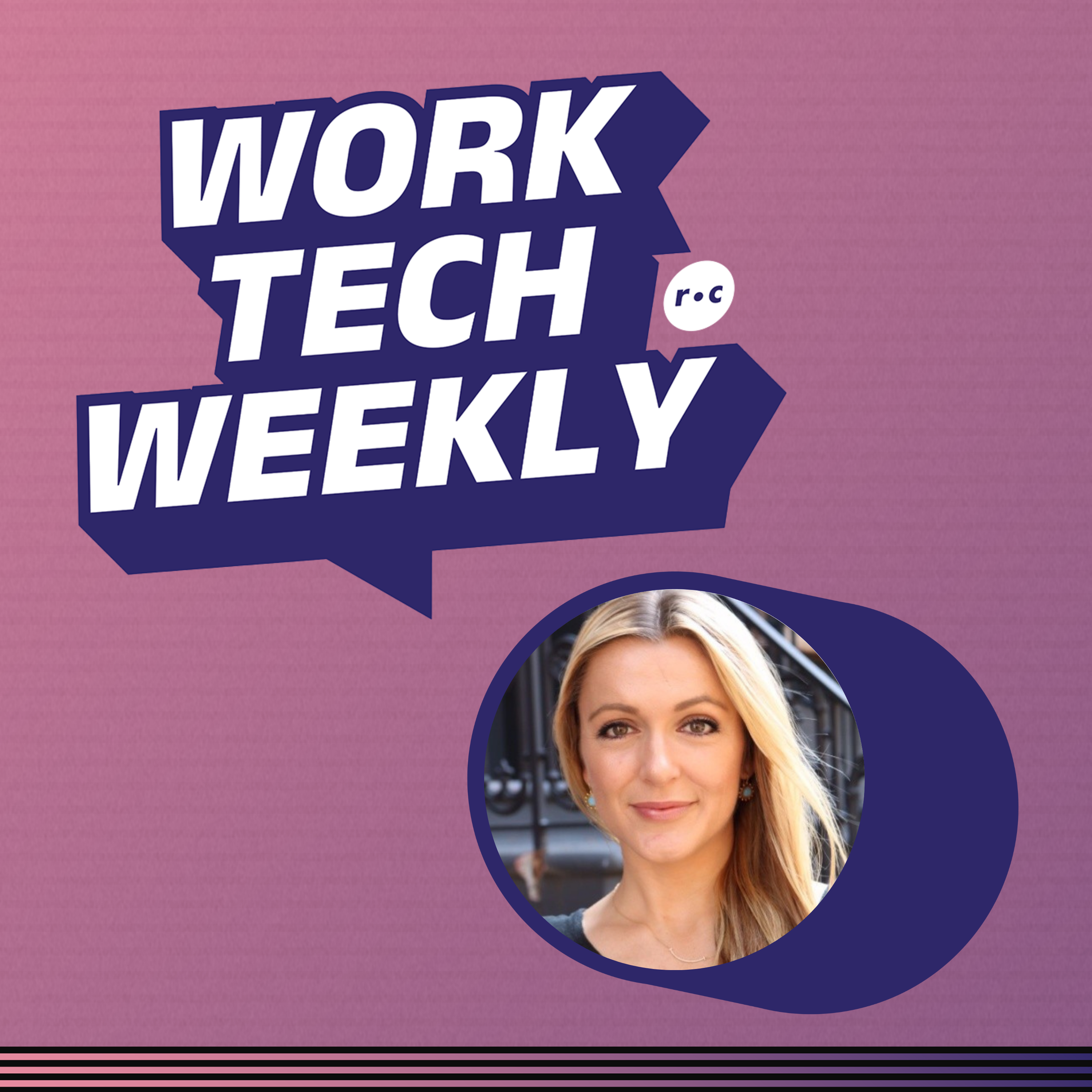
Claire McTaggart:
When we were building some of our fraud tools where we posted a real role at SquarePeg, but it was a remote engineering role, and we got so many fraudulent applicants. And on purpose we had our product manager interview all of them. And I interviewed a ton of them, so I got to see it up close. It is just so funny when you're talking to somebody and you just ask them about where they live and you say, "Oh, cool, you live in Miami, what part?" And you can see them zeroing in on the map and say, "I live on the left-hand side." You say, "Okay."
Steve Smith:
Hey, everyone. Welcome back to another episode of Work Tech Weekly. In today's episode, we're digging into the most frustrating problems in hiring right now. Everyone knows that hiring's broken, but most conversations are stopping at the surface-level complaints. However, the problems are all around us, resume overload, AI noise, fraud, bias, and a lot of finger-pointing. My guest today is Claire McTaggart, founder and CEO of SquarePeg. Claire works directly with recruiting teams who are drowning in applicants and trying to figure out how to find a real signal in a system that keeps rewarding shortcuts.
In this conversation, we talk about why hiring became a volume problem in the first place, why fraud is less about bad actors and more about broken systems, and how AI could actually restore trust instead of making things worse. If you want to understand why resumes all look the same today, why the hiring system rewards the wrong behaviors, and what better hiring might actually look like as we go from here, this episode is for you. Let's get into it. Claire, welcome to the show. Really happy to have you here.
Claire McTaggart:
Happy to be here.
Steve Smith:
Well, we were talking earlier and I've had a lot of great conversations with you when I've seen you at shows and been to Salt Lake City, I know that you're right in the middle of a lot of really interesting trends going on in the industry right now. So I'm happy to have you here just to talk about what's going on and what you're seeing. I think a great place to start is just, not everyone probably knows about SquarePeg. Why don't you tell us a little bit about your company and how you got to this point?
Claire McTaggart:
Yeah, absolutely. And appreciate you having me on. We've met, I don't know, many times over the past year or two, and it's amazing the speed that things are going at because every time we meet, it feels like everything has started anew. Yeah, I'm the founder and CEO of SquarePeg. SquarePeg is really narrowly focused on one problem, which is the noise of job applicants and how can talent acquisition and recruiting teams do a better job of finding signal, of finding the best people in their talent pools and moving them through the funnel. So SquarePeg essentially works inside or embedded in your ATS and we will ingest all of your applicants.
We will do deep research on those applicants, add data to all of those applicants on interesting things about the companies that they've worked for. We will score and rank all of those applicants. We do fraud detection to make sure that those applicants are who they say they are, and then we help recruiters move the right people through their funnel. So rather than being an all-in-one, we work really closely with your existing ATS to give it the functionality of helping you get through the top of funnel.
Steve Smith:
There's a lot of solutions out there that sort of do what you do. Why don't you talk a little bit about your secret sauce and really how you're different?
Claire McTaggart:
One of the first things I think that's a helpful context is when SquarePeg started, we started as an all-in-one. We did a lot of different things. We had sourcing, screening, analytics, messaging, and light ATS. And it's very difficult to do 25 things extremely well. And what we saw is where the market is headed is one where AI is making things a little bit noisier currently. And we felt it was worth going all in on being the absolute best-in-breed for a few things, and that is, given a large pool of applicants, how can you identify who is qualified, who's real, and a story behind why they're qualified. So what makes us a little bit different, we'll start with enrichment. The first thing is we are not just taking a natural text query and matching it to a resume.
SquarePeg is taking every applicant and we are looking at, for every company that that applicant has worked for, what was that company doing during the time that that candidate worked there? Was it a high-growth company? Did their department double in size? Did they go through an IPO? What products were released? All different types of things, whether that's news items, products release, growth data, about where they worked. So in a world where GPT resumes all look the same, SquarePeg is starting to differentiate by doing some deep research that a human would never have time to do. A human cannot look at five companies per resume when they have 1,000 applicants per role and they're looking at 15 recs. So SquarePeg starts with that piece of deep research.
That, I think, initially differentiates us from almost everything that's out there. Then we do applicant scoring and stack ranking, and we'll do a lot of deep analysis on why this candidate is a fit. And then in addition to that, we do the fraud detection that I think is just becoming table stakes for anybody that's in top-of-funnel screening to have a really robust set of fraud flags to identify who's real. One of the areas on fraud that makes us a little bit different is we are not just looking for bad actors. We are also looking for a lot of this extreme embellishment is probably fitnism or gray area fraud where you're looking to see is the data that candidates are giving you, is that real, and have they made up a fair amount of that?
A lot of the things that we'll do is an authenticity score, is, I guess, the latest version of that. So on the fraud piece, I think it's a spectrum and you have bad actors and then you have a lot of gray area and SquarePeg is doing a lot of work focusing on that gray area, which I think is going to be sort of the next frontier of fraud.
Steve Smith:
So when you're looking at your customers right now and you're seeing things go well and you're seeing the things that give you a glimmer of hope, what are some examples of like, "Yes, this is exactly how it should be done"?
Claire McTaggart:
An employer using SquarePeg can now go in and say, "I really need somebody who's figured out how to work on a global distributed team that has doubled in size. And if they did that in a really heavily regulated industry, that's great. And if they did it while being an IC that then still managed people, that's even better." Now, we can take that, which is the context of the employer, and we can assess all of their applicants on that, even if the applicants don't have any of that in their resume. So that is some of the exciting stuff is, again, you're taking that contextual data and getting really deep in matching.
And the things that you can do, and again, like all of the AI products now, it's all natural language based. So a hiring manager, an employer can just chat and say, "Here are the things that I really want." And moreover, SquarePeg can actually help prompt them to do that. We're coming out with something that sort of prefills these requirements and said, "Hey, we noticed that this department at your company is new. Would you like somebody that helped start up a new department?" Or, "There are lots of things that we can bring from your company context and from the job description, help you understand the possibilities of what you can think about and then match based on that."
I think that's the stuff that people have been wanting for a long time. It's been promised for recruiters for a decade and we're finally starting to get some of that deeper context in matching. I would say that matters and just the speed of it that you can get 1,000 applicants, and within seconds, you can get them scored, ranked, data on them, you can pull out the fraud. So all of that mess that has historically been plaguing them, there's just a speed to getting a little bit more clarity.
Steve Smith:
Well, that all sounds really cool and also very encouraging because that sort of context is actually valuable and meaningful in the hiring process. And it's nice to get a little bit of good news just because when you look at the current AI arms race, it just seems like it's a lot of bad all over, whether you're talking about candidates or hiring managers.
You've got, on the one hand, candidates using AI to do pretty much everything from burnish your resume, embellish your resume, or even have a deepfake show up and do the interview for you. But then on the hiring side, there's AI being used to screen, score, and filter and you're seeing incidences of making a stack deck already stacked more against the candidate where there's instances of bias and these kinds of conversations happening. So in this kind of situation, is anybody winning right now or is everybody losing or does one side or the other have an upper hand in your opinion?
Claire McTaggart:
I will say this, on the employer side, when you talk about bias and you talk about stacking the deck against candidates, I don't ever see a world where we're going to go back to bulk rejecting candidates because they don't have a keyword in their resume and trying to use a simple heuristic to make mass judgements. I think while the tech may not be adopted, the tech is there that you don't have to do that anymore. So now we're in the phase of how do you make it better, faster, wider adoption, all of these things about fitting it into your workflow. How do you not have to context switch and have a crazy tech stack? On the employer side, it's available to do something that is deeper and more thoughtful and more considerate of your entire candidate pool and takes that into consideration. And that's available now.
I don't think we're going backwards ever. And while it seems really messy, I think it seems really messy because people are trying to figure out, "What tool do I use and how does it work with my ATS and how do I not context switch between 17 apps?" I think the problems are more workflow problems right now versus the tech being there yet. I think it is there on the employer side. Now, on the candidate side, what does that mean? Well, what we've seen historically is candidates respond incredibly well to incentives. So once the employer stops penalizing you for not having a keyword and this rudimentary way that we've been doing this for a long time with the available tech, once we see that AI screening actually is considering every person and actually is considering all the context and doing the research, candidates will respond and they will start putting more authentic context because that's what's going to get rewarded. If you say, "Here are some things that really show how I'm different versus how I look the same."
Every employer that we talk to that has not used a tool before, they say every resume looks the same, the GPT resume, "I built a widget, my company grew 25% because of the widget that I built." Job titles are the same, keywords are the same, tech stack, everybody knows everything in terms of the required skills. And the way that they write their resumes looks the same because that's being rewarded. We're going to get to a world where that doesn't get rewarded anymore, that gets penalized. And incentives will be powerful enough where I think candidates will say, "Okay, what makes me different from every other person who's applying and what have I done that's really unique in the market? And how can I put that information forward so that AI can use that in helping me look authentic and credible?" Now, there will still be issues because people will still make stuff up. That is always going to be the case.
People will get very good at embellishing and making up things, they always have. I don't think that's ever going to go away. People will always fib to make themselves look better, but I still prefer this world where, "As a job applicant, I think about how I'm different, I think about how I'm unique, and I think about all of the context that I can provide that shows that," versus, "How do I change myself to look like a bot that looks like everybody else?" which is kind of where we are today.
Steve Smith:
Well, jumping right into, and you've been talking a lot about the candidate fraud issues and certainly, it seems you can't go a day without hearing some crazy story about deepfake interview or proxy test takers or AI-generated work samples. Do you think that candidate fraud is a talent problem or is it a systems design problem?
Claire McTaggart:
I think if people can find a way through and there's enough of a prize at the end, the ingenuity of how they figure out how to get through that will be there and people will figure it out. I think it is more a systems design problem at the moment. The state of play for fraud detection right now is whack-a-mole, that's how most people describe it. You see these signals that all of the fraudulent candidates have, and it takes vendors like us a moment to evaluate those to build solutions, and then that signal, you can immediately spot it and you can weed those people out. While you've done that, they've come up with something else.
So there's a lot, and I think fraud, this is the world we live in, I don't think it's just in recruiting and HR, I think it's going to be all over the place, understanding deepfakes and understanding fraud. But I will say this, when it comes to truly bad actors, there's less nuance and context that's required. You really can get these signals of, "Okay, great, this person doesn't have a phone number that's registered in the country they say they're living in. They have an email that they just created for this. They just created their LinkedIn profile a month ago. They don't have any connections at any of the companies they say that they worked at."
There are so many signals that are out there that companies like ours are looking at. I think you will be able to detect at the top of funnel quite easily who's fraud. I'm also a little bit interested in this idea of maybe you are a real person, but you've just embellished to such an extent that it's fraud. We see this a lot with requirements now that everybody has worked in AI. So we see people who had jobs historically and titles and work experience that had nothing to do with AI, and now they've completely fabricated that to be something else. I think that's an area of interest where, again, you have to require research on what was the company that they're working for doing during that time. The products that they released, were those AI products? Was that person in that department?
So there's a little bit of fraud detection when it comes out there. But ultimately, the North Korean bad actors or wherever else they're coming from, they're always going to try this and it's up to the vendors and the systems to make those flags readily apparent. The thing that's been so hard is that this has all been put on HR. If you are a recruiter or in talent acquisition, spotting fraudulent candidates is not your expertise that you've honed over the years. That has not made you a good recruiter. So you're putting this skillset on people that this has historically not been something that they've focused on or done. And I think that's been really hard because they've typically looked for like, "Do you meet the requirements, and do you have the skills that are needed?"
And now these recruiters are supposed to be detectives to identify that. So I definitely don't think that this should be put on HR and recruiting teams. They should be aware of it, they should be trained on it, but they should not be experts in this. You really should rely on vendors, background checks, screening tools to be able to get there. And again, the problem is big enough and the risks are so high that most companies, I think, are going to just adopt the tech that weeds this out.
Steve Smith:
Well, that makes a lot of sense. And I think you're dialing in on a really important nuance of distinguishing between bad actors and just smart people who are responding rationally to broken incentives. And it's interesting, on the bad actor side, I knew an agency owner that was doing web dev who actually hired one of those North Korean people. And the story he told me was absolutely crazy. And it ended up with blackmail and the FBI involved and it became a big crazy deal.
Claire McTaggart:
Yeah. We hosted a panel on fraud recently and all of the talent acquisition professionals on the panel had some type of FBI investigation going on in their company. It is rampant. It is not to be understated.
Steve Smith:
What's your craziest story about candidate fraud?
Claire McTaggart:
I don't have one that is particularly crazy. I'll say there are themes that are just so egregious that come up all the time, which is different people show up for different stages of the interview and you'll go from people who are entirely different ethnicities, ages, genders, everything. So you'll see just different people showing up. Even if they get the offer, they'll provide 10 different addresses of where to ship the laptop. If you haven't been on one of these interviews where you're talking to a fraudulent candidate or somebody that's using some type of voice swap or face swap technology, it's wild to see it. I wouldn't say I have anything as crazy.
When we were building some of our fraud tools, we went through an exercise where we posted a real role at SquarePeg, but it was a remote engineering role, and we got so many fraudulent applicants. And on purpose, we had our product manager interview all of them. So we purposely interviewed. And I interviewed a ton of them, so I got to see it sort of up close. It is just so funny when you're talking to somebody and you just ask them about where they live and you say, "Oh, cool. You live in Miami, what part?" And you can see them zeroing in on the map and say, "I live on the left-hand side." You say, "Okay."
Steve Smith:
Yeah, Left Miami's a very popular neighborhood.
Claire McTaggart:
The restaurants in Left Miami are some of the best.
Steve Smith:
Oh yeah, that's my experience too.
Claire McTaggart:
Yeah. We would do these things where we'd ask these questions and we found just saying something really simple about, "Oh, cool, what are some good restaurants where you live?" What you'd normally consider an icebreaker are the hardest ones. You ask them to do a coding assessment, they're going to knock it out of the park, but ask them for something interesting local that happened in the area where they lived and right away you can see it.
So yeah, we had an interesting time purposefully interviewing. Our product manager probably talked to 400 fraudulent candidates. It's not that there was one thing that was so egregious, just how repetitive it was that no one could answer basic questions about where they lived and the voices were different, the faces were different. It was kind of obvious the technology. I expect the fraudulent candidates to get better at all that stuff, but right now they've been pretty sloppy about it.
Steve Smith:
And it's interesting because a lot of this is, I don't know, it's sort of an AI theme around trust and trust breaking down. And it's easy to see on the employer side why trust would be breaking down there because of the fraudulent candidates, candidate AI embellishment. But when you look at it from the candidate side, I think that there's a growing sense, and maybe this is just me, that AI is not necessarily your friend in the workplace or in the hiring process where it's just like, "Is AI really there to help me?" But the things you're describing about how the hiring process could change because of AI, actually, those seem like steps that could end up being steps in restoring some of that trust to the process.
Claire McTaggart:
Absolutely. AI, if anything, should make things more fair, less biased. You should give every candidate more of a shot than they would have if a human gave them a seven-second resume review. It should take in more research, more context. And ultimately, you want a process that's just much, much more informed and much more judicious and that's better for both the employer and the candidate. We're stuck. We're still growing out of these legacy systems that we have. And this tech is really new and there's a lot of it and it's really hard to figure out what to use.
There's going to be a period of seeing what's out there in the market, trying different things, figuring out how to get what works well for you and your tech stack, but ultimately these AI tools have to make the process better. And interestingly enough, we get audited on a monthly basis to look at bias in AI. That's a new industry that's come up to say, "Okay, great, you are..." There's a lot of responsibility for a company that is judging applicants and doing all of this research and matching and all of that. We use a company that sees, "Is any of this leading to bias?" And I think starting with that and making sure that you audit that regularly is also pretty important.
Steve Smith:
Considering we're talking about AI, there's a surprising amount of optimism in the conversation here, which surprises me and also makes me happy because I think that one of the things you're talking about, there's a lot of negativity in recruiting and talent acquisition right now.
Claire McTaggart:
We're at a all-time low right now, so it only can get better from here, right?
Steve Smith:
I know. When you see recruiters who've been out of work and you pick up the industry narratives, it's pretty bleak out there. But the thing that you're pointing to is what I think is really the gold about what a good recruiter or a good hiring manager or an empowered hiring manager can bring to the process because when I think back on my career about the candidates that I was involved in hiring that were the success stories, the ones I think back on and the ones I tell stories about, they were not an exact match to the job rec.
Claire McTaggart:
Exactly.
Steve Smith:
It was someone in the process, whether it was the head of HR or the recruiter or whatever, saw something that wasn't in the box score and said, "We need to filter this person in." And then given that chance, they were able to shine and impress and get the job, and then you see where they flourish from there. What you're talking about is, "Let's get more of that into the process." And I think that sounds great.
Claire McTaggart:
Yeah. I think we've killed out-of-the box thinking and we've killed that idea of finding somebody who is not your perfect match from a keyword perspective. When you talk about why things are so tough right now, that's a big part of it is that if you aren't perfect, then you're ignored. And everybody wants to get back to that place because historically you look at the people who were lawyers and then became tech founders. We have a tremendous ability to move from one type of career and one thing to the next. I did a lot in my career. I've not been in tech forever. I was in a lot of different industries. And people have that ability, but when you're facing so much volume and you have really crude instruments to handle that volume, then you go back to, "I just need somebody who has four years of Java or whatever it is."
But ultimately, the optimism is that as we get past that, we can start to say, "Okay, this era is over where you're looking for keyword stuffing," we're beyond that, then we can get, I think, more creative about the signals that we look for. Small anecdote, I used to work in management consulting for Deloitte and management consulting has these famous case study interviews where you come in and you have to go through these long interviews sometimes in front of multiple people. I was on the team that was involved, like the hiring manager team, and we would bring people in. And one of the things that we always tried to do is bring people in with really different backgrounds because in management consulting, what you care about is somebody incredibly curious and can they figure out how to solve problems that maybe they haven't solved anymore.
And so we would say, "Okay, what about this person that studied autoengineering in Germany versus this person that has a creative writing background?" They're going to be working together and solving problems in a really different way, and that diversity of thought is really helpful. We all know that. All the data shows that. So we would try to bring people in from all of these backgrounds. That has died a little bit. We've gone really into hyper-specialist mode. If you haven't done this exact job that I'm hiring for at another company, then we're not going to look at you. And that's tragic. And I hope we do get back to this world where, like you said, everybody's best hire is somebody that was unexpected that you didn't think would do it. They came from an interesting background. It's not a pure fit. But again, I keep going back to, well, what are the signals that made you look at that person?
Maybe you care about people who are really hungry or have a lot of grit when faced with adversity and you want people that have been faced with adversity. So maybe you look for somebody that worked for a brand that was the number 20 in the category that they were in and they had all the adversity against them as a salesperson and they still were able to hit quota it even though their brand was not even in the top 10, or maybe look for just more nuanced signals than something like 10 years of Salesforce or whatever it is.
Steve Smith:
One last question, and this is a two-part question for you. So looking ahead to the future, like five years. So if we look back and we say, "AI made hiring worse," what do you think will have gone wrong? And then the opposite, if AI made hiring better, what do you think we have had the courage to change?
Claire McTaggart:
If AI made hiring worse, which it has, in the short term, it all comes back to noise or slop, which is, again, one of the popular words of 2025 is that we just generated so much noise and so much slop and it made everybody's lives harder, whether you're a candidate, whether you're a recruiter, whether you're head of talent acquisition. So it became really easy to take a lot of actions with AI and produce a ton of documentation and a lot of it was really sloppy and noisy. So that's where it's gone wrong. Honestly, it is the state of play today of where things stand.
And where it got better goes back to signal. How did AI do a better job of the things that it's getting very good at, which is research and reasoning? And how did AI bring research and reasoning on a large group of people to help employers go beyond keywords and really figure out who might be relevant to their roles? So that's where I think it'll go well. I have high hopes for just what it's like to work in your job every day. If you had a job where 50% of it was manual work, AI is going to be great for you. A lot of people are eliminating the recruiting coordinator, but think about that job.
We have a customer, and their chief people officer talks about what her job used to be in HR. And she said, "I used to manage physical files. I had a filing cabinet and I managed employee files, and that was my job. I don't long for those days. I'm very glad that is over." I think we're going to be doing the same things and say, "Do you remember that time where people used to actually try to spend hours on scheduling? That's done." Or, "Remember when a person used to look through 1,000 resumes in a day, that's done." So I think people will find more enjoyment in their jobs when it's a little bit less manual. It requires a lot more thought and effort and your job might get harder, but it will be far less boring, I would say.
Steve Smith:
Well, Claire, thank you so much for joining us. This has been a lot more encouraging conversation than I was anticipating. And thank you so much for your thoughtful answers. I'm glad that you were able to share what you're seeing with the world because I think that this is front and center with what's some of the most important trends going on in the industry. So I really appreciate it.
Claire McTaggart:
Yeah. Well, it's always good to talk to you. And again, maybe we catch up in a year, all of this is materialized, maybe none of it has, but it's definitely fun to think about this stuff and definitely fun to be operating while this just explosion of new technology and capabilities are here. It's a fun time to be working in HR tech.
Steve Smith:
Absolutely.
Claire McTaggart:
All right. Take care.
Steve Smith:
Thanks. All right, that's a wrap on today's episode of Work Tech Weekly. Thanks again to Claire for a really thoughtful conversation. As we talked about, hiring didn't get broken overnight, it became noisy because incentives changed. Applying stopped signaling intent, volume replaced fit, and both candidates and recruiters started responding rationationally to a system that wasn't built to handle that scale. What I found most interesting is how Claire reframes fraud and bias as systems problems, not people problems.
When the process rewards shortcuts, people take them. And when recruiters are drowning in applications, even good tools get used in blunt ways. Claire also made the case that better hiring comes from better context, not more automation. Research and reasoning matter. Human judgment still matters. And the goal isn't to eliminate recruiters from the process, but to give them the space to focus on the decisions that actually move outcomes. If you enjoyed this episode, make sure to subscribe to Work Tech Weekly on Apple Podcasts, Spotify, or YouTube Music. And I'll see you next time.

![[WTW] Hubspot thumb - BLOG SQUARE](https://repcap.com/hs-fs/hubfs/%5BWTW%5D%20Hubspot%20thumb%20-%20BLOG%20SQUARE.png?width=3000&height=3000&name=%5BWTW%5D%20Hubspot%20thumb%20-%20BLOG%20SQUARE.png)