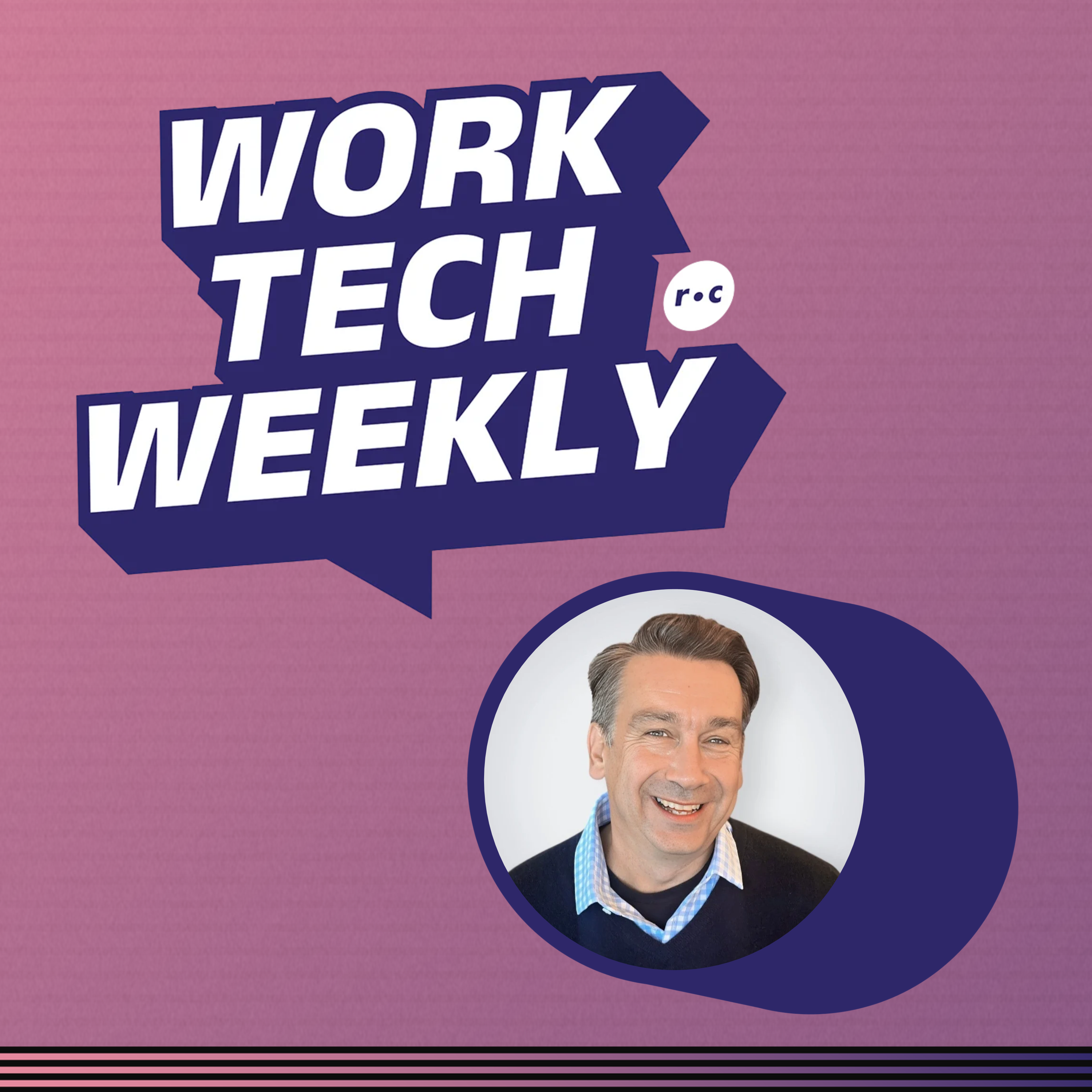
Josh Millet:
Now, with AI, there's just so much candidate behavior to optimize their resumes. They all look identical now. They all look good. And so I think it's really sort of accelerating the demise of the resume that predicted would come for a long time, 'cause HR people are just throwing up their hands and saying, look, all these resumes look great, and I've got more of them than ever before. So what do I do?
Steve Smith:
Hey everyone, welcome back to another episode of Work Tech Weekly. I'm Steve Smith, Managing Director of Growth at Rep Cap.
Somewhere right now, an HR manager is staring at seven hundred resumes that all look qualified. AI wrote most of them. For the people doing the hiring, that's the whole problem.
My guest is Josh Millet, founder and CEO of Criteria. Criteria builds science-based talent assessments that give employers a real signal about a candidate, instead of relying on a resume.
Josh has spent nearly twenty years arguing that the resume was never a reliable way to predict who would succeed on the job. Now that AI has made resumes even less trustworthy, he thinks the rest of the hiring world is finally catching up to that idea.
We talk about why AI is accelerating the death of the resume and what durable skills like judgment and critical thinking mean in a world where agents can handle more of the technical work. We also get into why so few hiring professionals actually trust the AI tools built to help them… and the strange new problem of candidates who have no idea they even applied for a job, because an AI agent applied for them.
If you've ever wondered whether the resume as we know it is finally on its way out, this episode makes a strong case that it is.
Let's get into it.
Josh, welcome to the podcast.
Josh Millet:
Thanks, Steve. Nice to be here.
Steve Smith:
Great to have you here. You know, it's in the world of talent acquisition, things are a little interesting right now. It's a bit spicy.
Josh Millet:
It's a very interesting period to be in the field. Yeah, for...
Steve Smith:
Well, and you've been in and around kind of assessment and hiring for, you know, nearly 20 years. What are you seeing right now that you haven't seen before?
Josh Millet:
Yeah, I mean, you kind of alluded to it, but just the velocity of change is incredible. You know, when I think about even our own company, not just our own internal efforts to hire great talent, but what we see with our customers, the job seeker behaviors are changing so quickly. And of course our customers, talent acquisition professionals, HR people, and their responses to those changes in behavior, you know, are having to be just as quick.
And so I feel like in a lot of ways, what we're seeing today with some of the trends is not new, but it's just vastly accelerating trends that we already saw were in place in some ways. So we can unpack that. But yeah, a fascinating time to be in the field, and it feels like what used to take 12 months is now sort of compressed into three in terms of the pace of tech change and just change in...
Steve Smith:
And when you think about, I mean, obviously AI is changing everything in the workplace, but it seems like the hiring process is getting the disruption and some of that change being hit even harder. You know, what are you hearing from customers about kind of the AI in hiring conversation?
Are they excited about it? Are they anxious about it, or is a little both?
Josh Millet:
It's definitely a little of both. You know, like, if you go to certain conferences, and I know, you know, you probably do go to a lot of them, like you'd think that everything's AI and everyone's embracing AI everywhere. And the reality in talent acquisition especially is quite different. I would say in general, not universally, but in general, there's a lot of excitement about AI and its potential.
But as you well know, Steve, this is a highly regulated space. There's been some pretty high profile litigation. There's certainly, I would say, like a regulatory wave that's happening in terms of state laws in New York and Colorado and California, where I'm based.
And so what I see is there is extreme excitement, but there's also a lot of caution, and what that means for us, we have a lot of AI based products, we get a lot of interest, and then the sales cycles move very slowly because companies want to vet everything appropriately, right? And what I'm observing is that even among large customers, you know, this is so, so new to everyone.
There's no like playbook for enterprise AI adoption, you know? And so it's like navigating one organization to another, like what folks are comfortable with, what they're not. And you know, as I say, hiring is a highly scrutinized space. It should be, 'cause it's a really important thing for society. And so, you know, people are sometimes moving slower there than they would be adopting AI in less sort of high stakes areas where it's just like workflow automation and stuff.
So yeah, there's definitely that bifurcation between like excitement around the tech and caution around actually rolling it out.
Steve Smith:
I'm interested to talk to you because you have a bit of a different origin story than most of the people I talked to. So you spent your twenties getting a PhD in Medieval French history from Harvard. And I spent a little bit of my college years exposed to Abelard and Heloise and George Duby, and it didn't grab me. I was like, no, I'm outta here.
So, what happened? What happened on your end? What's your story?
Josh Millet:
For a second, I thought we were gonna be able to have a great conversation about Avalara.
But...
Steve Smith:
Nope. I'm sorry. I'm not your guy on that one.
Josh Millet:
Whoa. Gotcha. Well, if you have any Joan of Arc questions, she was always my favorite. So, yeah, I mean, I guess, you know, people make different life choices in their twenties. I was very convinced. I, you know, was gonna be a history professor. Still loved the material and the period, but ended up doing that. But actually when I was in grad school, I ended up, because of a roommate, long story, but I ended up getting to know a lot of psychologists. And so when I went to found my first little startup right out of grad school, which was very much, this is gonna allow you to age me very precisely, but it was in that first.com, you know, boom was cresting, and we started a little educational assessment company aimed at helping people prepare for standardized tests. And I did that with a psychologist who later became my co-founder, one of my co-founders, at Criteria.
So it was a non-linear path into entrepreneurship for sure. But yeah, that's my story.
Steve Smith:
And so, you know, you went from an EdTech startup to building a pre-employment testing company, which is a pretty specific jump.
What did you see about hiring that convinced you that's the problem you wanted to tackle?
Josh Millet:
Yeah, I mean, really when I got into the field, I had, I would say, less than 12 months experience in it. When I had sold my first startup, I became involved in working for the new company. It was still, actually, my first startup was very tiny, five people, you know, when we sold. So it was, we'd only been at it like a year and a half. Sold to a bigger company, but was still a small company. I think it had about 60. And because we were that small, there was no real HR to speak of still at that company. And somehow they tapped me on the shoulder to be involved in the hiring process. And so the actual origin story of Criteria is, I used to review resumes that were submitted and schedule interviews.
We were based in Culver City, California at the time, and I was in one particular interview, and it was just clearly, you know, one of those ones where you realized quite early on it's not a fit. And I think the poor gentleman I was interviewing also probably realized it wasn't a fit, but it was scheduled to be an hour interview, and I caught myself looking up at the clock and we were only seven minutes into the hour.
So.
Steve Smith:
Yeah, I've had a few of those interviews. Those are not fun.
Josh Millet:
They're not, you know. So I was like, what do we do with the next 53 minutes? You know? But that was the moment that got me thinking about, there's gotta be a way to incorporate data and evidence. And, you know, as I thought about what it was about this person's resume, I was thinking, you know, was it that I recognized certain companies they worked for?
Was it the font used on the resume? You know? And so it just got me thinking about, of course there was a connection to my first startup with assessments, but it got me thinking about using like a science-based approach to help other folks avoid that bad feeling of being seven minutes into an interview and realizing it was not remotely a fit. So that was kind of the genesis of Criteria, that bad interview.
Steve Smith:
Well, it seems like, you know, 20 years on, you know, you kind of made a bet that, you know, hey, we need to bring some science into this process and some data into this process. It seems like everything that's happened since then has sort of validated that assumption. Is there anything else that you've kinda learned along the way that you feel like, boy, that was really either a good or a bad idea I had back in the day.
Josh Millet:
Yeah. I mean, I would say it's funny you asked that, because we started this podcast by saying, you know, how quickly things are changing. Certainly true. In certain ways though, I think like the core insight that we had back then was, like, basically, you know, directionally correct.
Like, of course we've shifted our strategy here and there, but we've never made a pivot from the sort of core insight we had. Which was just that traditional hiring, and by that I mean hiring really focused on the resume as the central sort of artifact of decision making, really gets a lot of things wrong.
It's fundamentally backward looking rather than forward looking. It weights heavily to things that research shows don't work very well, like educational pedigree and years of experience in a given field. They have some predictive power, but they're not really strong signals. And the research shows there's a whole collection of things that do not work really well.
So things like work ethic and problem solving ability and critical thinking. So, just the idea that we should index to those factors and not to the stuff that's less predictive. I think that core insight has basically been proven out, has sort of been core to our product offering since then. The joke around Criteria is that, you know, Josh has been saying that the resume is dead for 20 years, and he might finally be right.
The things that we're seeing now with AI, there's just so much candidate behavior to optimize their resumes. They all look identical now. They all look good. And so I think it's really sort of accelerating the demise of the resume that we've predicted would come, you know, for a long time, 'cause HR people are just throwing up their hands and saying, look, all these resumes look great, and I've got more of them than ever before. So what do I do? You know?
Steve Smith:
When it seems like, you know, obviously the death of the resume has been, you know, at hand for most of this century, it seems like. And I think part of that is that the resume never really correlated, as you mentioned, with what made a person successful in a job. And so maybe if AI has made resumes irrelevant because it's easy for everyone to have an immaculate resume.
And if you have all these resumes that maybe don't even have anything to do with reality, what good is it? Do you think that, you know, maybe this isn't such a bad thing, that maybe we can finally, as you know, as part of the hiring process, get down to the conversation we really need to be having with people?
Josh Millet:
I think there's a lot to that, but the irony, of course, is that the problem that everyone in HR tech is trying to solve now is how to use AI to do great talent matching at scale, right? And what you run into, over and over in the market, is: a lot of this new AI is still focusing on the same input, like it's using the resume very heavily.
Some of the best AI HR tech out there, where the tech is really good, but the primary input is the resume. And it's like, for me, that's kind of like a garbage in, garbage out. Like, we need better inputs, you know, we need better, we call 'em talent signals at Criteria. You know, we need better data to feed, 'cause no matter how good the AI is, if you're feeding it sort of weak data, or data that only sort of predicts mildly, then, you know, the AI can't get past that, you know? So I still think there's a big opportunity to leverage AI to do better talent matching, but we can't base it on the same stuff that we've been using for decades.
'Cause it won't, you know, it'll just scale what we had before. It won't — it will fundamentally change things. So that's kind of my perspective on that.
Steve Smith:
Well, you know, one of the things that seems to be emerging in kind of this AI moment that we're in is, if you go back, you know, last 10 or 15 years, the skills conversation, everything's been about hard skills and STEM and all of that. And it seems like now, where you can just dial up Claude Code and it can write better code than, you know, 95% of humans out there.
It seems like emotional intelligence is now kind of having a moment. I mean, I might not have done well in French medieval history, but I did end up with a liberal arts degree. And so I'm a big fan of the humanities, and I feel like a lot of the skills that I basically took out of that, which is how do you take disparate pieces of information and synthesize that into cogent thought?
And it seems like that's a more useful skill to have in this moment than, you know, specific hard skills. Do you think that, you know, it does seem like emotional intelligence and that kind of like more abstract skill is more important at this moment. Do you, I mean, are you seeing that? Do you agree with that, or is that just the answer I wanna tell myself?
Josh Millet:
I think that's your observation spot on. And it's not just 'cause you and I both want to feel better about our liberal arts background. I think it's exactly what we're hearing from customers, is that of course there are still fields where hard skills are very important and may continue to be, especially the more specialized those skills become. Right. But in general, what we've seen the last five years is, and it kind of fits with what we've been saying all along, but it's really having a moment for the reasons that you mentioned: the presence of Claude in the world, right? Is that what a lot of people would call soft skills.
I hate that term, 'cause I think it's very dismissive. I think of it as like durable skills or core human skills, you know, emotional intelligence being one, but also judgment, critical thinking. You know, all these things that we're gonna need. As we start to work alongside agents and AI, like those things become more and more important. And you're right, some of those hard skills are gonna be done by agents, and done pretty well, right? And then it's the thinking about how to arrange the work that AI does, you know. Those are the skills that I think will be very durable and in demand and at a premium for a long time to come.
And so if I think about, like, just a basic example, right, of how work could change, you know, let's say there's 10 things, five years ago, there's 10 things that, you know, correlate with success in sales, right? 10 job activities, or 10 areas, competencies, whatever you want to call them. And maybe six of those are gonna be unchanged, you know, through this transition. And four of them are gonna become less important, 'cause they might be done by AI, and there might be one or two new ones that come to the fore in terms of interacting with AI and managing AI systems.
So it's not that, you know, I'm not one to say that job descriptions are gonna disappear altogether as we know them. But I think like the taxonomy will change pretty quickly, of like, what works in a given role and what is important in a given role. I think some of the things that are important are gonna change in each role pretty quickly, you know, on a two, two or three year timeline. And so that's really interesting to think about.
And obviously you have to adapt your talent acquisition strategies to meet those new job roles and get a view of what they are, more importantly.
Steve Smith:
You reference sort of the AI arms race that we're seeing in hiring, you know, where it's just like, you know, candidates are using AI to improve their position, and then, you know, employers are trying to respond, and it does seem to be an escalation on both sides. What I'm kind of curious about, you know, it's just like, you know, and it's a legitimate concern, that, you know, the AI tools are getting better at screening, candidates will get better at gaming that.
At what point does that extend to using AI to take assessments and game assessments? Do you think we're there, or do you think we're almost there?
Josh Millet:
Yeah, I mean, we're definitely there in terms of some of the job seeker activity we see, and we've got all sorts of products to protect against that. We've got a proctoring product. We've got layers of protection built into the core assessment experience. There's old fashioned ways to cheat.
There's new fashioned ways, right? We have to be aware of them all. The old fashioned way is still to have your smarter sister take the assessment with you, right? So you can't catch that through just identifying agentic approaches on a computer. There's all sorts of ways to cheat. So part of that has been like a focus for us for 20 years.
But then, of course, all the AI new approaches are relatively new challenge. What I would say more broadly about like the impact of AI on job seeker behaviors. Obviously people are using it to enhance their resumes. They're sometimes using it also to try to cheat on assessments. Those are new ways of doing old activities, right? It used to be that you could pay someone a hundred bucks to fix up your resume. So that was a service that, like, people who are more affluent could use. Now there's a much more cost effective way to do that. Same with cheating, right? We've sort of broadened the vectors of risk in terms of cheating because it's easier to do now.
So we've gotta have approaches in place for both of those. But the other thing that it's doing to sort of job seeker activity is that we're really seeing, like, just in the last six months, really take off. Whereas we saw like a resume optimization that was happening two years ago, what's happened more in the last six months, is, as we sit here in 2026, people are using agentic approaches to mass apply to jobs, right? And so you get this phenomenon of an HR person finds an applicant that looks really good, contacts them in some way or another, and they literally have no idea that they applied for that role.
And so, you know, that creates another problem of, like, candidate intent, and, you know, it also creates this exploding volume problem. Like, I was just on a call with a customer yesterday that said, in the last 12 months, even though they're doing less hiring than they were, you know, a year or two ago, the last 12 months, they've had a hundred thousand applicants to their roles. And the year before was 57,000. And that's with less job posts. Right.
So almost a doubling in the year with fewer jobs. So as that applicant to hire ratio gets higher and higher, it's almost like you can understand how HR people have no choice but to use some form of automation at the top of the funnel. You simply can't have a human read all those resumes when you have 700 applicants for a role, or 1,200 applicants for a role. So then the question becomes, how do we use... what kinds of automation are gonna create the best signal, are gonna be most fair to applicants? And oh, by the way, we also want applicants to have a very positive candidate experience.
So solving that calculus is really complex.
Steve Smith:
You've been pretty vocal about essentially responsible AI use and, you know, requiring vendors to provide bias audits and job related validity before adopting AI hiring tools. In your mind, what does a responsible AI vendor look like versus one that's just AI washing stuff with some slick marketing?
Josh Millet:
Yeah, it's a great question, and I think it's one that, you know, is not easy to answer in the marketplace, 'cause the answer I'm about to give you will sound great on this podcast, I hope. But, you know, when you talk to vendors, there's a whole set of follow-ups you get. And what we realize quite recently that we have to do with our new AI based products is, given what we mentioned earlier about, you know, litigation and the regulatory environment changing very quickly to meet these new approaches, we have to help them navigate that, because when we talk to big enterprise customers, especially bigger customers, it is not such an issue if you're talking to like a 200 person company.
But in the enterprise space, legal and compliance have a huge role to play in procurement, and, you know, appropriately so, they're risk averse organizations in a lot of cases, as they should be when they're that big. And there's no like playbook for enterprise AI adoption, and they've heard about all these lawsuits, they've heard about the regulation. And in a lot of ways, what we show them about our product is very similar to what we would show them if they were looking at an assessment that didn't involve AI, right?
It's gotta be science-based. It's gotta be proven to predict results. It's gotta be relatively bias free. It's gotta not have adverse impact on certain groups. You know, there's all these things you have to do, and I think those are all equally important in AI, in vetting AI. I also think a great rule of thumb in terms of looking at AI tech is that if you don't understand how it works, you shouldn't buy it.
You know? So, like, that transparency is really important. And anytime that a vendor tells you, well, that's proprietary, or, you know, that is a warning sign for me. Because it may be that they don't want to spill secrets, but it also may be, like, that the explanation is complicated, and you may not like some of it. You know? And that's where I think you run into legal risk, is if... even if it's working in terms of predictive ability, right? If you don't understand why it's working, that's a problem, right? Like, some earlier generations of AI tech in HR were using things like how far does the applicant live from the office?
Well, that may be a way to predict turnover, right? A long commute, people get fed up, you know, they might be more likely to quit. That might be accurate in predictive terms, but in ethical terms, should we use that? Probably not, right? Like, if someone can't afford to live close to your fancy downtown office, that's probably not a good reason to exclude them from, you know, or to downgrade them in terms of their application process, right?
So that's why I think anything black box should be very concerning to folks. And of course there's a distinction, like the exact ways the algorithm works, like, it's fine to protect those, but like the basics of how the AI works should be altogether explainable to someone without a tech background. And you know, certainly if you're in HR and talent selection, again, highly regulated space, like you should have an understanding that you're comfortable with, what the AI is doing, how it's measuring, how it's informing decisions.
Steve Smith:
Totally agree. And I guess, you know, that kind of gets into, I guess, to put it mildly, AI has a trust problem.
Josh Millet:
That's right. That's right. Yeah.
Steve Smith:
And I think it's, you know, you have some benchmark data that shows it's particularly pronounced with hiring professionals. Only 9% of hiring professionals trust AI more than traditional methods.
Given that most traditional methods are also pretty bad and flawed, what should that tell us?
Josh Millet:
That's right. That's right. Yeah. You're scoring on a curve, and the...
Steve Smith:
Yeah, that's right.
Josh Millet:
The curve doesn't have a lot of trust as well. Yeah, it's a great point. Yeah, I think, so what we've seen in, like, that candidate experience survey, or, sorry, I think you're referring to the benchmark report we do with HR professionals.
We do another one on the candidate side, but what I think you're seeing there, is over the last three years, to just look at the trend, is an increase, a slight increase in the willingness to use AI, the appetite for AI, and even the trust for it. But it's still not at a critical... as you point out, it's still not at a level that would suggest a tipping point or, like, universal, you know, trust.
And I think that's partly, so it's going up partly because the AI is getting better. Right. Like, if you think about even what Claude can do today versus, like, when I first tried ChatGPT in the early days, it was like, this is cool, but every third query runs into major problems, hallucinations, or just wrong information or whatever. So the tech is improving very quickly. People see that.
And on the candidate side, interestingly, there's a growing appetite to be judged in part by AI, right. There's a growing comfort there. I wouldn't say it's still at a threshold that's like a majority or anything. It is growing quickly there. And so I think, again, you're right, it's absolutely trust that's the sort of threshold we need to cross. I think that's gonna be a long battle.
You know, honestly, self-interestedly, I would hope it isn't, but I think you're right that it's a critical thing to get past. For us, it's like, again, exposing that, we call it, you know, responsible AI is obviously the market term, we call it explainable AI. Like, if we can explain it to people, that is the first step to trust, right? Even to candidates, like, this is how the AI will work, you know, on a certain level.
Now, obviously not to the level that then they can sort of adjust their behaviors, but, you know, like, if you're using AI in an assessment, for example, we have an assessment that uses AI to measure writing ability. Okay. That used to be something you needed a human to get a good grade of someone's writing sample.
And now AI is very good at doing that if you give it the proper instructions for how to grade it. And so, you know, people are totally okay with that use case of AI. Right? It's fairly uncontroversial, I think people are okay with it. But as you get more and more into high stakes decisioning, you know, in areas that aren't as clear cut as, like, okay, we're using it to grade a writing sample, the more high stakes it is, the more you have to explain, right? Like, if you're using AI to do interview scheduling, there's no issue, right? Like, yeah, it's better at finding an interview spot on your calendar than, you know... so that's straightforward.
But as it impacts high stakes decisions, you need to overexplain how the AI works. I feel.
Steve Smith:
Oh, yeah, I totally agree with that. And I think that's a laudable goal. I mean, one of the other things that, you know, I know that you feel strongly about is this skills-based hiring narrative. And it's just like this idea that we need to reform the hiring process, ditch degree requirements, and focus on demonstrated ability. I mean, you've been arguing about this for, you know, 20 years. Do you feel like the market's finally catching up with your POV?
Josh Millet:
Yeah, it's interesting, like, when skills-based hiring first came along, it, you know, my reaction was, oh, this is kind of what we've been saying all along. I wish I'd thought of that term. Right. And...
Steve Smith:
And trademarked it?
Josh Millet:
Yeah, I wish I'd trademarked it, exactly. But, you know, it wasn't like a perfect description of our approach, because skills-based sort of implies to me a little bit more hard skills, which, to your earlier question, I think is not like the exact approach. We'd advocate for all sorts of skills, like a broad conception of skills, like what can you do, demonstrated abilities, right. From that standpoint, I think it's a great movement. It got a lot of traction. I feel like at the CEO level, at the CPO level, like chief people officer level, almost universal approval for the theory behind it. And then where it ran into friction, or where it stopped getting adoption, was actually at the adoption level.
Like, okay, I agree with all this. We shouldn't index so heavily to degrees. You know, we should focus on what people can do, not where they've been, not the opportunities they've had in the past. Okay, great. I've got a stack of resumes. How do I do that? You know? And so we've sort of seen a little bit of a stall in the movement in ways, because, like, I agree with the theory, but how do I do it in practice?
And in practice, what I sometimes come back to is, like, I see a good degree on a resume, I still like that a lot, you know, even if I've dropped the degree requirement from the process. Obviously our platform is partly about providing, like, a toolkit for doing that, for measuring skills and abilities and demonstrated capabilities. But I feel like also what we're seeing because of AI is maybe a little bit of a revival of that movement that, you know, got stuck in how do I actually do this once the theory was accepted, because, as the resume's relevance begins to fade more quickly because of all the, you know, resume doctoring and perfect resumes go out there.
I feel like the modality that we're entering is, it used to be, tell me what you can do, and now it's, show me what you can do. And that transition is, like, really, that's kind of skills-based hiring at its heart. Like, that's what that movement is all about, is, like, show me what you're capable of from a skills perspective, and we'll forget the fact that you didn't go to college or, you know...
And I think that is a good thing. And maybe, even though you hear that phrase a little bit less now with all the AI talk, I think that movement is still very much like a good thing for the world. And so if AI can help push that along and help us do it in practice, that's a really good thing from my perspective.
Steve Smith:
Well, you know, just to kind of bring it back around to where we started, it's just like, you know, you made a pivot from being an academic to a founder. And you know, what seems to me pretty clear is that, you know, working at, you know, a PhD level, there's a lot of research that goes into it. So I can sort of see how you're bringing that into the way that you're still working.
Is there anything else that you've kept from, you know, that historian's mindset that shapes the way that you're doing your work?
Josh Millet:
That's funny, 'cause I was asked by a team member about that. We had a revenue kickoff meeting last month, and I was asked that question 'cause I had joked about my medieval historian upbringing. And I think, you know, it's interesting, in history, it's obviously a very backward-looking discipline, right? And you learn to evaluate, like, you learn that not all sources are created equal. That's like a basic thing you learn in history, that some are highly reliable, some aren't, and one of the most unreliable types of historical sources is a first person narrative where the writer essentially makes himself the hero of their own story, right?
Like, those you have to take with a giant hunk of salt. And as I was saying that, I realized, like, that's precisely what a resume is, right? It's like a first person narrative where the writer becomes the hero of their story. So that's that kind of grounding in, like, being evidence-based, considering all the sources and considering the biases in all the sources. You know, I think led me maybe to, like, that insight seven minutes into that interview, that, like, hey, maybe this isn't the best way of doing things. And I certainly wasn't the only one to have that observation at all. You know, assessments, as you point out, being around for a long time, but sort of moving us along in that direction, I think, based on the idea that, you know, there's gotta be a better way to do this, is kind of the journey we've been on as a company ever since, almost 20 years ago. So.
Steve Smith:
Well, Josh, it's been a great conversation. Thanks for making some time to join us.
Josh Millet:
This has been so fun, Steve. Thanks for having me.
Steve Smith:
A resume is basically a first-person account of someone's own career, written by the person trying to get the job. That alone should make us more skeptical of it, not less.
Josh's background as a historian gave him a useful lens here. Historians learn early that a first-person narrative, especially one where the narrator makes himself the hero of the story, is one of the least reliable sources available. A resume works exactly the same way. And now that AI can help anyone write a flawless version of that story, the format is breaking down even faster than it already was.
Resumes are getting harder to trust, but the deeper issue runs further than that. The entire hiring process built around them, from the interviews to the AI layered on top, has to account for the fact that the input itself is unreliable. Better assessments and better talent signals only work if companies are willing to stop leaning on the resume as the anchor point.
The harder question for any hiring team is what to replace it with, and whether they're willing to change the process enough to actually do it.
If you enjoyed this episode, make sure to subscribe to Work Tech Weekly on Apple Podcasts, Spotify, or YouTube. And I'll see you next time.